
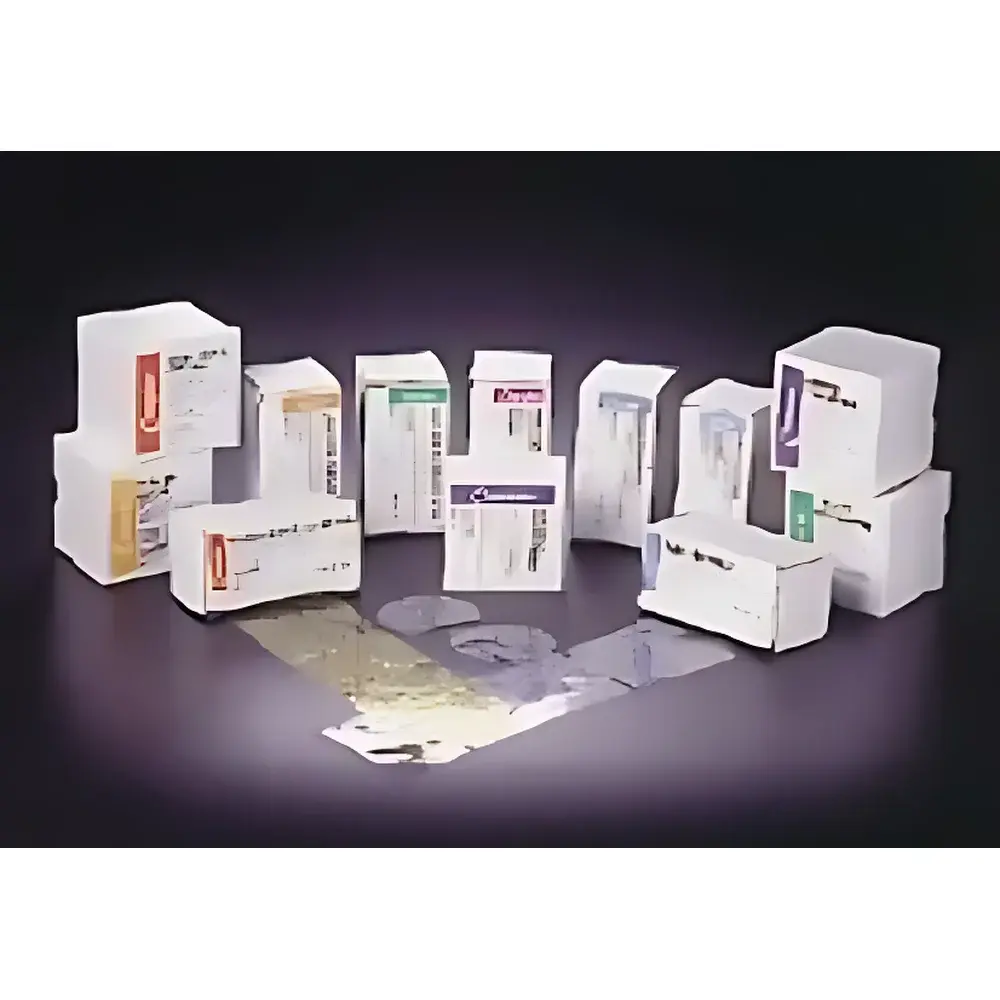
Chemplex XRF Sample Films for Elemental Analysis
| Brand | Chemplex |
|---|---|
| Origin | USA |
| Product Type | XRF Sample Support Films |
| Model | 100 |
| Thickness | 2.5 µm |
| Format | Roll (3.0" × 300') |
| Material | Mylar® Polyester Film |
| Compliance | ASTM E1361, ISO 8596, USP <233> |
Overview
Chemplex XRF Sample Films are precision-engineered polymer support membranes designed exclusively for quantitative and qualitative elemental analysis by wavelength-dispersive (WDXRF) and energy-dispersive (EDXRF) X-ray fluorescence spectrometry. These films serve as inert, low-background substrates that minimize spectral interference while maintaining mechanical integrity under vacuum or helium purge environments—critical for trace-level detection of light elements (Na–F) and accurate quantification across the full periodic table (Z = 11–92). Unlike generic plastic films, Chemplex formulations undergo rigorous lot-to-lot certification for elemental purity (e.g., 120 MPa for Mylar®), and dimensional stability (<0.1% thermal expansion coefficient over 20–40°C), ensuring reproducible sample presentation and long-term instrument calibration stability.
Key Features
- Ultra-low elemental background: Certified for minimal intrinsic Kα emissions from Na, Mg, Al, Si, P, S, Cl, K, Ca—validated per ASTM E1361 Annex A2 protocols.
- Controlled thickness tolerance: ±5% deviation across full roll length (e.g., 2.5 µm ± 0.13 µm for Model 100), enabling consistent X-ray transmission correction in fundamental parameter (FP) quantification models.
- High tensile modulus and puncture resistance: Mylar®-based films withstand static loads up to 250 g/cm² without sagging or rupture—essential for viscous slurries, fused beads, and powdered samples in standard 32-mm sample cups.
- Pre-perforated (PP) variants available: Precisely aligned micro-perforations (Ø1.2 mm, 3 mm pitch) facilitate rapid solvent evaporation and uniform drying of aqueous suspensions, reducing particle segregation artifacts.
- ISO 8596-compliant surface flatness: RMS roughness <15 nm over 1 mm² area ensures homogeneous X-ray beam interaction and eliminates scattering-induced intensity drift during multi-point mapping.
Sample Compatibility & Compliance
Chemplex XRF films are validated for use with all major benchtop and floor-standing XRF platforms—including Shimadzu, Bruker, Rigaku, Thermo Fisher, PANalytical, HORIBA, JEOL, and SPECTRO systems—without modification to collimator geometry or detector alignment. Each film type is supplied with a Certificate of Conformance (CoC) documenting batch-specific ICP-MS trace metal screening, FTIR identity verification, and thickness metrology via laser interferometry. The Mylar® 100 series meets USP requirements for elemental impurities testing in pharmaceutical excipients and active ingredients, supporting GLP/GMP audit readiness. All SpectroMembrane® framed supports comply with ASTM D7359-22 Annex A3 for certified reference material (CRM) mounting, including thermal cycling validation (−20°C to +60°C, 5 cycles) with zero delamination or frame warping.
Software & Data Management
While Chemplex films are hardware consumables, their metrological traceability integrates seamlessly into regulated analytical workflows. Batch-specific CoCs are encoded in QR-linked PDFs compatible with LIMS and ELN systems (e.g., LabWare, Benchling, Veeva Vault). For laboratories operating under FDA 21 CFR Part 11, Chemplex provides electronic signatures on CoCs and maintains raw test data archives for ≥15 years. When used with Bruker’s SPECTRA software or Rigaku’s SuperQ suite, film thickness values can be directly imported into matrix correction modules, eliminating manual entry errors and supporting automated uncertainty propagation per ISO/IEC 17025:2017 Clause 7.6.2.
Applications
- Environmental testing: Soil, sediment, and airborne particulate matter (PM2.5/PM10) analysis per EPA Method 6200 and ISO 12847.
- Geological exploration: Rock powder and drill core homogenates for multi-element geochemical profiling (Li–U).
- Materials science: Thin-film coating composition verification (e.g., TiN, ITO, perovskite layers) using micro-XRF mapping.
- Pharmaceutical QA/QC: Catalyst residue screening in APIs (e.g., Pd, Pt, Rh) and packaging leachables (Al, Cr, Ni) per ICH Q3D.
- Recycled metal sorting: Rapid alloy grade identification in scrap processing lines using handheld XRF (e.g., Niton, Olympus Vanta).
FAQ
Are Chemplex XRF films suitable for vacuum-compatible XRF chambers?
Yes. Mylar® and Prolene® films exhibit vapor pressure <1×10⁻⁹ Torr at 25°C and outgassing rates below 1.0×10⁻¹⁰ g/cm²·s (per ASTM E595), making them compliant with high-vacuum XRF systems.
How does film thickness affect detection limits for light elements?
Thinner films (e.g., 1.5 µm Ultra-Polyester®) reduce absorption of low-energy X-rays (F Kα = 0.677 keV, O Kα = 0.523 keV), improving signal-to-background ratios by up to 35% versus 6.0 µm alternatives—quantified in NIST SRM 2782 interlaboratory studies.
Can SpectroMembrane® frames be reused?
No. SpectroMembrane® is a single-use, pre-assembled system; frame adhesion integrity degrades after first vacuum cycle, risking film slippage and positional error >±50 µm during automated stage movement.
Do you offer custom diameters or coatings?
Yes. Chemplex provides OEM services for non-standard sizes (e.g., 4.0″, 5.0″) and proprietary anti-static coatings (surface resistivity 10⁶–10⁸ Ω/sq) under NDA—lead time 6–8 weeks.
Is there a shelf life specification?
Unopened rolls retain certified performance for 36 months when stored at 15–25°C and <60% RH; exposure to UV or ozone accelerates hydrolytic degradation and must be avoided.



