
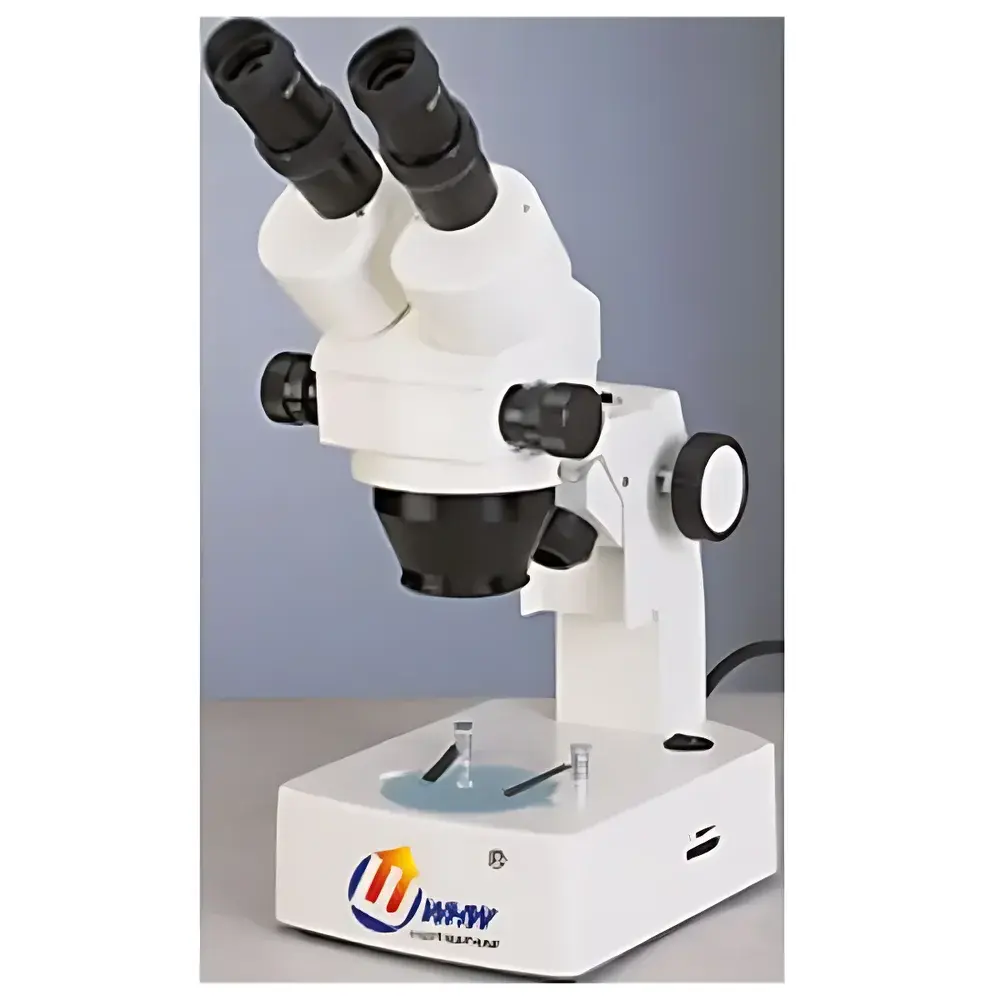
YANRUN SM-5L Continuous Zoom Stereo Microscope
| Brand | YANRUN |
|---|---|
| Origin | Shanghai, China |
| Manufacturer Type | Direct Manufacturer |
| Product Type | Upright |
| Total Magnification | 7X–45X |
| Eyepiece | Widefield 10X (Φ20 mm) |
| Objective Zoom Range | 0.7X–4.5X |
| Field of View | Φ28.5 mm–Φ4.5 mm |
| Working Distance | 88 mm |
| Vertical Travel | 25 mm ≤ H < 265 mm |
| Base Dimensions | 215 × 160 × 60 mm |
| Illumination | Adjustable 12 V / 10 W Halogen Lamp with Reflector Cup (Top-Lighting) |
| Overall Dimensions | 394 × 230 × 160 mm |
| Optional Accessories | Widefield Eyepieces (10X/15X/20X/25X, various FOV diameters), Graticule Eyepieces (10X, 0.1 mm/div), Auxiliary Objectives (0.5X–2X), LED Ring Light (8 W, 90–265 V, WD 35–200 mm), Fluorescent Ring Light (5 W, 110/220 V) |
Overview
The YANRUN SM-5L Continuous Zoom Stereo Microscope is an upright, high-stability optical instrument engineered for precision visual inspection, quality control, and routine laboratory examination of macro-to-mesoscale specimens. Designed around a Galilean optical system with continuous zoom capability, it delivers seamless magnification adjustment from 7X to 45X without discrete steps—enabling rapid adaptation across varying sample topographies and operational requirements. Its fixed 88 mm working distance ensures consistent ergonomic access and accommodates standard tooling, fixtures, and non-contact measurement accessories. The microscope employs a dual-path optical train with independent eyepiece tubes, providing natural stereoscopic depth perception essential for manual manipulation, soldering, dissection, or surface defect assessment. All optical components—including the zoom objective assembly and widefield 10X eyepieces (Φ20 mm)—are fully corrected for chromatic and spherical aberration, minimizing distortion across the entire magnification range.
Key Features
- Continuous zoom optics (0.7X–4.5X objective + 10X eyepiece = 7X–45X total magnification) with smooth, backlash-free focusing mechanism
- Fixed working distance of 88 mm—optimized for integration with micromanipulators, stage-mounted lighting, and non-destructive testing workflows
- Robust cast-aluminum base (215 × 160 × 60 mm) and vertical column with 240 mm travel range (25 mm minimum height), supporting stable positioning over extended use cycles
- Dedicated top-illumination system: 12 V / 10 W halogen lamp with reflector cup and analog brightness control—providing uniform, glare-reduced illumination ideal for reflective or metallic surfaces
- Interchangeable widefield eyepieces (including graticule variants calibrated to 0.1 mm per division) and auxiliary objectives (0.5X–2X) for field-of-view expansion or high-resolution detail capture
- Modular design compliant with ISO 10934-1 (stereomicroscopy terminology) and aligned with general metrological practice for visual inspection systems
Sample Compatibility & Compliance
The SM-5L accommodates a broad spectrum of non-transmissive samples including metallographic sections, PCB assemblies, machined components, geological specimens, botanical samples, and polymer parts. Its upright configuration and generous working clearance support both bare specimens and those mounted in standard Petri dishes, sample holders, or custom jigs. While not configured for transmitted-light microscopy, optional ring-type LED or fluorescent illumination units (8 W and 5 W variants, respectively) extend adaptability to semi-transparent or low-contrast materials. The instrument meets general-purpose industrial inspection requirements under ISO 9001-aligned QA protocols and supports traceable visual documentation when paired with third-party digital imaging modules. No built-in image analysis software is included; however, the optical path is compatible with C-mount adapters for integration into validated imaging platforms used in GLP environments.
Software & Data Management
The SM-5L operates as a purely optical, hardware-based inspection tool with no embedded firmware or proprietary software. This architecture eliminates calibration drift associated with electronic processing and ensures long-term stability in regulated settings where software validation is cost-prohibitive. Users may integrate external USB or HDMI cameras via standard C-mount interfaces, enabling compatibility with widely deployed image acquisition suites—including NIH ImageJ, Olympus cellSens, and Media Cybernetics Image-Pro Premier—subject to local validation procedures. Audit trails, metadata tagging, and user-access controls must be implemented at the host system level, in accordance with FDA 21 CFR Part 11 or EU Annex 11 expectations where applicable. Firmware updates, remote diagnostics, and cloud connectivity are intentionally omitted to preserve mechanical integrity and reduce cybersecurity exposure vectors.
Applications
- Metallurgical evaluation: grain structure observation, inclusion analysis, and coating thickness estimation on polished cross-sections
- Electronics manufacturing: solder joint inspection, component placement verification, and micro-defect identification on SMT assemblies
- Quality assurance labs: dimensional verification using calibrated graticule eyepieces, surface finish assessment, and contamination detection
- Educational laboratories: comparative morphology studies in biology and materials science curricula
- Maintenance and repair operations: precision alignment of optical components, fiber optic connector end-face inspection, and mechanical assembly verification
FAQ
Does the SM-5L support transmitted light illumination?
No—the instrument is configured exclusively for incident (top) illumination. Transmitted-light capability requires external modification and is not supported by the standard optical path.
Can the SM-5L be integrated into a GMP-compliant inspection workflow?
Yes, provided that operator training, calibration frequency, and documentation practices align with ISO/IEC 17025 or relevant internal SOPs. Its mechanical-only design simplifies qualification (IQ/OQ) and avoids software validation burdens.
What is the maximum usable field diameter at lowest magnification?
At 7X total magnification, the field of view measures Φ28.5 mm—sufficient for observing full 25 mm diameter metallographic mounts or small PCB boards without repositioning.
Is the halogen lamp replaceable with an LED module?
Yes—third-party LED retrofit kits with compatible voltage input (12 V DC) and mechanical footprint can be installed, though color temperature and CRI characteristics will differ from the original halogen source.
Are calibration certificates available for the graticule eyepieces?
Calibration is performed per ISO 10110-5 and traceable to NIST standards upon request; however, certification incurs additional lead time and cost and is not included in standard delivery.



