
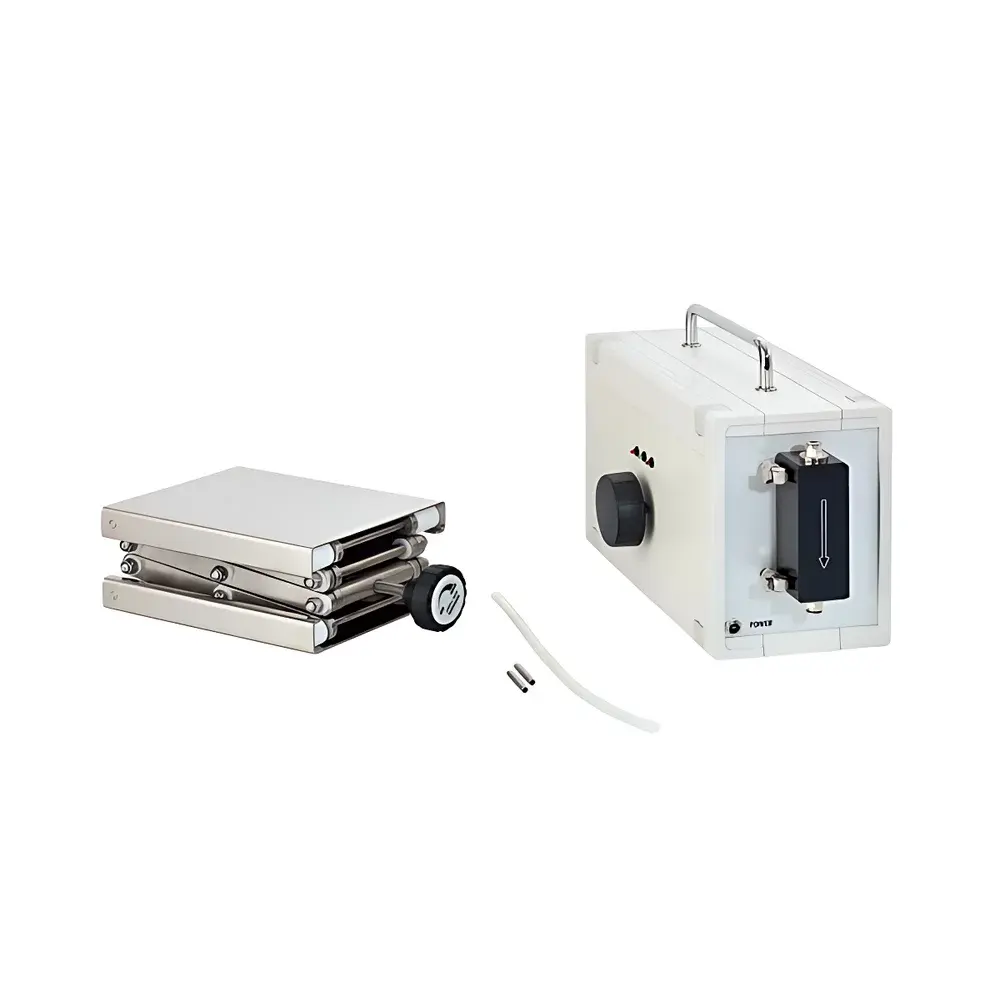
GRIMM 1159-10/100 Constant-Ratio Aerosol Diluter
| Brand | GRIMM |
|---|---|
| Origin | Germany |
| Model | 1159-10 / 1159-100 |
| Dilution Ratios | 1:10 and 1:100 |
| Sample Flow Rate | 1.2 L/min |
| Capillary Flow Rates | 0.12 L/min (1159-10), 0.012 L/min (1159-100) |
| Operating Temperature | 0–40 °C |
| Pressure Range | ±50 mbar |
| Power Input | 110–220 VAC, 50–60 Hz |
| DC Output | 9–12 VDC |
| Dilution Principle | Capillary-based flow splitting with integrated HEPA filtration |
| Filtration Efficiency | >99.97% @ 0.3 µm (HEPA) |
Overview
The GRIMM 1159-10/100 Constant-Ratio Aerosol Diluter is a precision-engineered passive dilution system designed for quantitative aerosol sampling in ambient air monitoring, occupational hygiene, and laboratory-based particle characterization workflows. It operates on the principle of laminar flow splitting via calibrated capillary restrictors—eliminating dependence on external compressed air or active pumping. The device divides a total sample stream of 1.2 L/min into two parallel paths: a primary sample flow (1.08 L/min for 1:10; 1.188 L/min for 1:100) and a precisely metered capillary bypass flow (0.12 L/min or 0.012 L/min). All particles in the bypass stream are removed by an integrated, certified HEPA filter capsule (efficiency ≥99.97% at 0.3 µm), ensuring only clean, particle-free air recombines with the undiluted sample downstream. Real-time dilution fidelity is continuously verified via differential pressure sensing across the capillary—enabling traceable, stable dilution ratios without recalibration under standard operating conditions.
Key Features
- Two fixed dilution configurations: 1:10 (model 1159-10) and 1:100 (model 1159-100), each defined by a factory-calibrated capillary geometry
- No external gas supply required—fully passive operation relying solely on the suction force of the connected aerosol spectrometer
- Integrated HEPA filter capsule compliant with EN 1822-1:2022 for high-efficiency particulate removal in bypass flow
- Differential pressure sensor monitors capillary ΔP to validate actual dilution ratio in real time, supporting audit-ready data integrity
- Stable performance across ambient temperatures from 0 °C to 40 °C and pressure deviations up to ±50 mbar
- Universal mechanical and pneumatic interface compatible with all portable GRIMM aerosol spectrometers (e.g., EDM 180, SMPS+ series)
- Low-power DC output (9–12 VDC) enables direct integration into mobile measurement platforms or battery-powered setups
Sample Compatibility & Compliance
The 1159-10/100 is optimized for use with aerosols containing solid or liquid particles ranging from sub-10 nm to >20 µm in aerodynamic diameter. Its inert stainless-steel and PTFE-wetted path minimizes adsorption or volatilization artifacts for hygroscopic or semi-volatile species. The system meets essential requirements for standardized environmental monitoring protocols, including ISO 29463-1 (HEPA filter classification), ISO 14644-1 (cleanroom compatibility), and ASTM D6245 (indoor air quality sampling). When deployed within validated measurement chains—including GRIMM’s traceable optical particle counters—it supports GLP-compliant reporting and contributes to data integrity frameworks aligned with FDA 21 CFR Part 11 when paired with compliant data acquisition software.
Software & Data Management
While the 1159-10/100 itself contains no embedded firmware or digital interface, its analog pressure signal (0–5 V or 4–20 mA optional) can be routed to GRIMM’s GRIMM LabControl or third-party DAQ systems (e.g., LabVIEW, MATLAB) for continuous dilution ratio logging. This enables time-synchronized correction of raw particle number concentration data—critical for regulatory submissions requiring uncertainty propagation (e.g., EU Directive 2008/50/EC Annex III). Audit trails, calibration history, and pressure-derived dilution validation metrics are retained in the host software, satisfying traceability demands of ISO/IEC 17025-accredited laboratories.
Applications
- Ambient air quality monitoring networks requiring reproducible, low-maintenance dilution prior to optical particle counting
- Workplace exposure assessment where high-concentration aerosols (e.g., welding fumes, pharmaceutical powder handling) exceed instrument upper detection limits
- Calibration and verification of aerosol generation systems (e.g., condensation particle counters, nebulizers) using reference-grade dilution
- Field-deployable studies of wildfire smoke, urban ultrafine particles, or indoor bioaerosols where portability and power autonomy are essential
- Method development for ISO 21501-4 compliant particle sizing, where consistent dilution reduces coincidence error and improves counting statistics
FAQ
Does the 1159-10/100 require periodic recalibration?
No—capillary geometry and HEPA filter integrity are factory-verified and stable over time. Users should confirm ΔP readings against nominal values annually as part of routine QA.
Can it be used with non-GRIMM instruments?
Yes, provided the downstream analyzer draws 1.2 L/min at ≤−250 mbar vacuum and accepts 6.35 mm OD inlet tubing.
Is the HEPA filter replaceable in the field?
Yes—the filter capsule is user-serviceable with standard Torx tools; replacement parts carry GRIMM’s serial-number-traceable certification.
What happens if the sample flow deviates from 1.2 L/min?
Dilution ratio accuracy degrades nonlinearly; GRIMM recommends verifying flow with a calibrated mass flowmeter before deployment.
Does it introduce significant particle loss due to diffusion or impaction?
Losses are 20 nm under nominal flow conditions, validated per ISO 27891:2019 for dilutor transmission efficiency.
Related Products







