
AMS Mercury Sampling System for Flue Gas
| Brand | AMS |
|---|---|
| Origin | Italy |
| Model | AMS Mercury Sampling System |
| Instrument Type | Flue Gas Sampling System |
| Target Analyte | Mercury (Hg) and Other Heavy Metals |
| Flow Accuracy | ±2% |
| Compliance | UNI-EN 13211 |
| Sample Path Material | Borosilicate Glass & Inert Heated Components |
| Probe Operating Temperature | ≥120 °C (≥20 °C above acid dew point) |
| Max. Sample Residence Time | <5 s (from probe inlet to impinger train) |
Overview
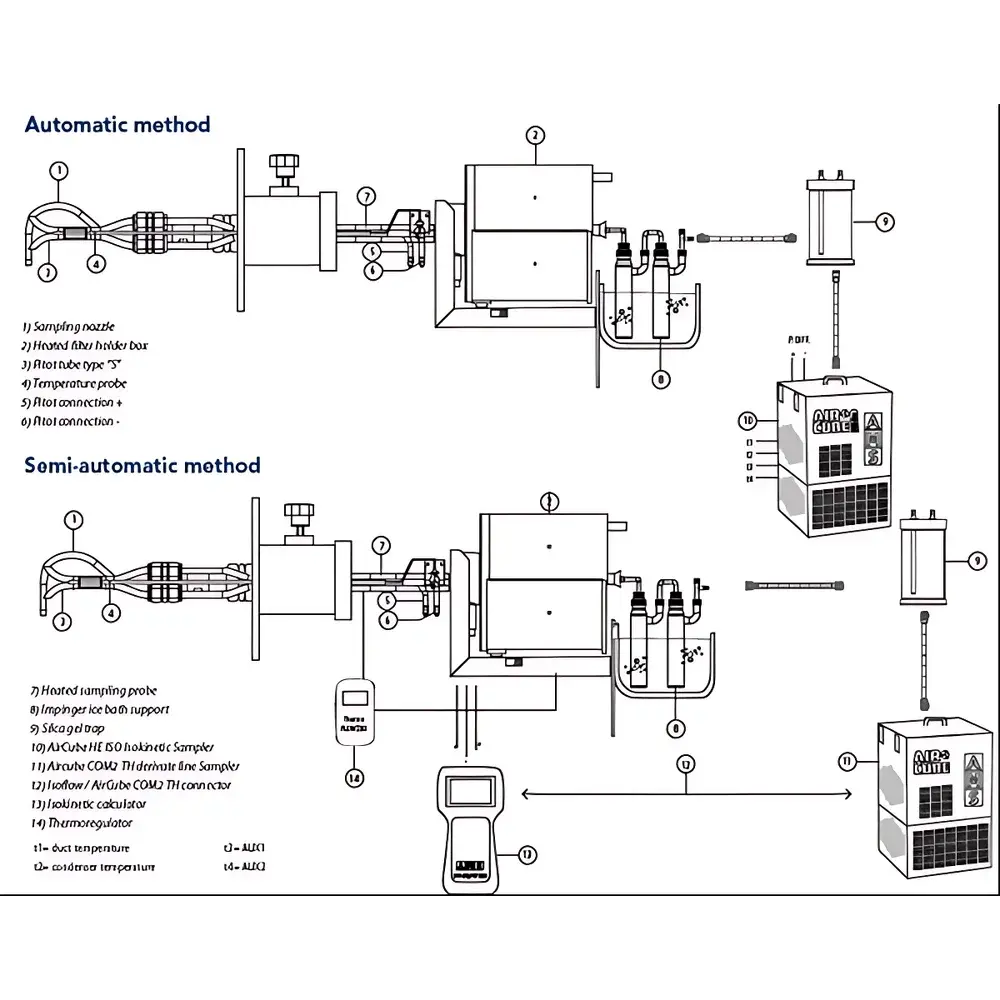
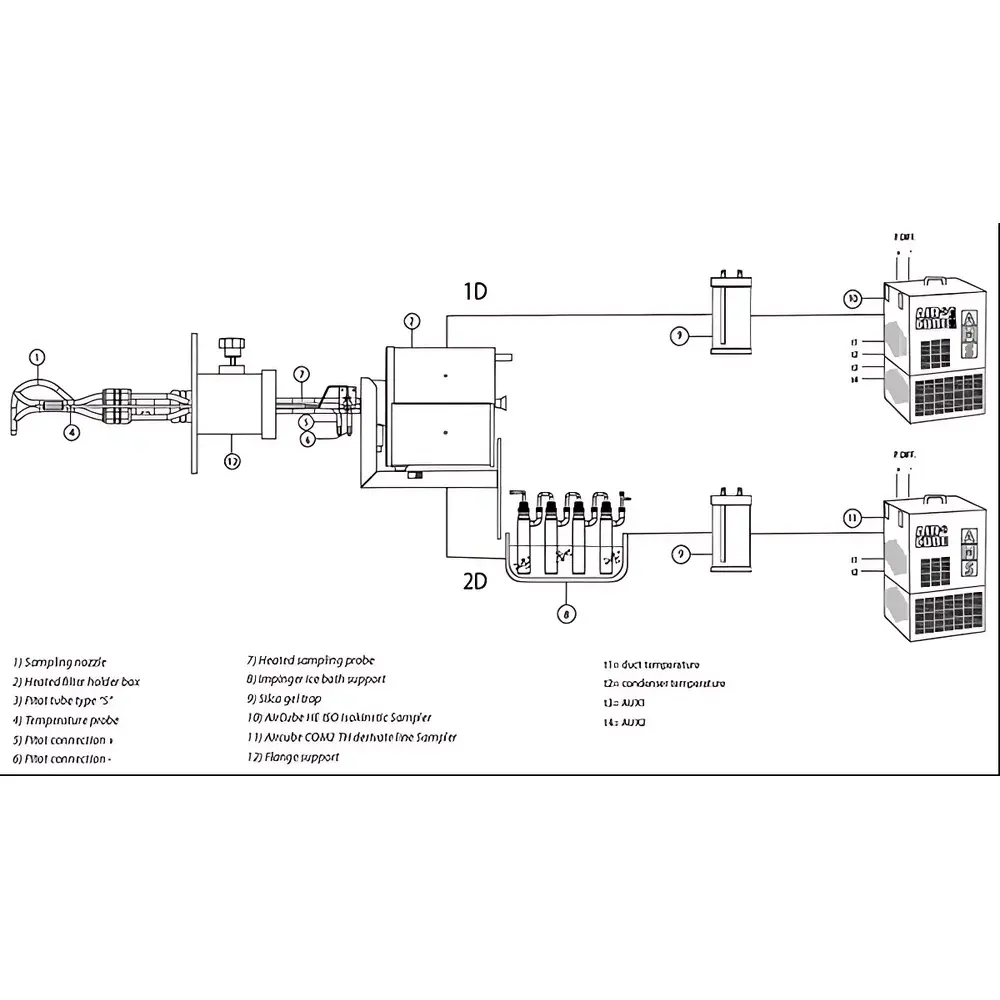
The AMS Mercury Sampling System for Flue Gas is a rigorously engineered, field-deployable solution designed for the quantitative collection and preservation of elemental and oxidized mercury species (Hg⁰, Hg²⁺) from industrial flue gas streams. Based on the principle of isokinetic sampling coupled with inert, temperature-controlled adsorption and absorption, the system ensures representative capture without artifact formation or analyte loss. It adheres strictly to the European standard UNI-EN 13211 (equivalent to ISO 17892-4 for solid waste leaching, but adapted here for flue gas Hg speciation protocols), which defines performance criteria for sampling accuracy, thermal management, and material compatibility in high-temperature, corrosive environments. The system’s core architecture eliminates all metallic contact surfaces—sample gas flows exclusively through heated borosilicate glass probes, quartz-lined filters, and inert impinger trains—thereby preventing catalytic reduction, adsorption, or re-emission of mercury compounds during transit.
Key Features
- Inert sample path constructed entirely from high-purity borosilicate glass and quartz components—no stainless steel, nickel alloys, or other reactive metals in direct contact with the gas stream.
- Heated sampling probe with real-time temperature monitoring; maintained at ≥120 °C to exceed acid dew point by ≥20 °C, suppressing condensation of sulfuric and hydrochloric acid vapors that could cause mercury volatility or deposition losses.
- Minimized residence time (<5 seconds) between probe inlet and first absorption bottle, achieved via compact thermal design and optimized flow geometry—critical for preserving redox-sensitive mercury species.
- Modular heated filtration unit with ceramic or quartz fiber filter media, integrated upstream of the impinger train to separate particulate-bound mercury (Hgp) prior to gaseous phase capture.
- Configurable impinger train (typically 2–4 stages) using standardized solutions such as KMnO4/H2SO4, KCl, or NaOH for selective retention of Hg²⁺, Hg⁰, and halogenated mercury compounds.
- Support for three validated operational modes: fully automated sequential sampling, semi-automated manual-triggered acquisition, and derivative sampling (derivative dilution method) for high-concentration or transient emission scenarios.
Sample Compatibility & Compliance
The AMS Mercury Sampling System is validated for use across coal-fired power plants, waste incinerators, cement kilns, and non-ferrous metal smelters—environments characterized by high particulate load, acidic gases (SO2, HCl, NOx), and variable moisture content. Its inert construction and thermal control meet the material integrity requirements of EN 13211 Annex B for mercury speciation sampling. While not a certified reference method per EPA Method 29 or ASTM D6784-22, it serves as a compliant field sampling platform compatible with subsequent laboratory analysis by Cold Vapor Atomic Fluorescence Spectrometry (CVAFS) or ICP-MS. All glassware conforms to DIN/ISO 3585 specifications for borosilicate 3.3 glass, ensuring dimensional stability and chemical resistance under prolonged thermal cycling.
Software & Data Management
The system operates in conjunction with optional AMS-compatible data loggers (e.g., AMS DL-2000 series) that record real-time parameters including probe temperature, sampling flow rate, total volume, pressure drop across the filter, and elapsed sampling duration. Data output complies with ISO/IEC 17025 documentation requirements and supports audit-ready CSV or XML export. When deployed in regulated environments subject to EU Industrial Emissions Directive (IED) reporting or national mercury inventories, the logger provides timestamped, tamper-evident records traceable to NIST-traceable flow calibrators. Full GLP-compliant audit trails—including user login, parameter changes, and calibration events—are retained for ≥12 months.
Applications
- Compliance monitoring of mercury emissions under the EU IED and U.S. MATS (Mercury and Air Toxics Standards).
- Source testing for mercury speciation (Hg⁰ vs. Hg²⁺) to inform sorbent injection optimization in flue gas desulfurization (FGD) and selective catalytic reduction (SCR) systems.
- Validation of continuous mercury monitors (CMMs) via parallel manual sampling campaigns.
- Research-grade sampling for kinetic studies on mercury re-emission from wet FGD slurry or activated carbon injection breakthrough behavior.
- Baseline characterization of mercury partitioning in emerging combustion technologies (e.g., oxy-fuel, biomass co-firing).
FAQ
Does this system comply with EPA Method 29?
No—the AMS Mercury Sampling System is designed to meet UNI-EN 13211 and supports equivalent analytical workflows, but it is not pre-certified as an EPA Method 29 apparatus. Users must validate its equivalence per 40 CFR Part 63, Appendix A if submitting data to U.S. regulatory authorities.
Can the system collect both particulate and gaseous mercury simultaneously?
Yes—via integrated heated filtration followed by multi-stage impinger absorption, enabling concurrent quantification of Hgp, Hg²⁺, and Hg⁰ fractions.
Is calibration traceable to international standards?
Flow calibration is performed using NIST-traceable primary standards (e.g., dry gas meters or critical orifices); temperature sensors are calibrated against PT100 reference probes accredited to ISO/IEC 17025.
What maintenance intervals are recommended for field deployment?
Glass components require post-run cleaning with 10% HNO3 and ultrapure water; quartz filters should be replaced after every 3–5 sampling events in high-dust environments; heater insulation integrity should be verified quarterly.
Related Products







