
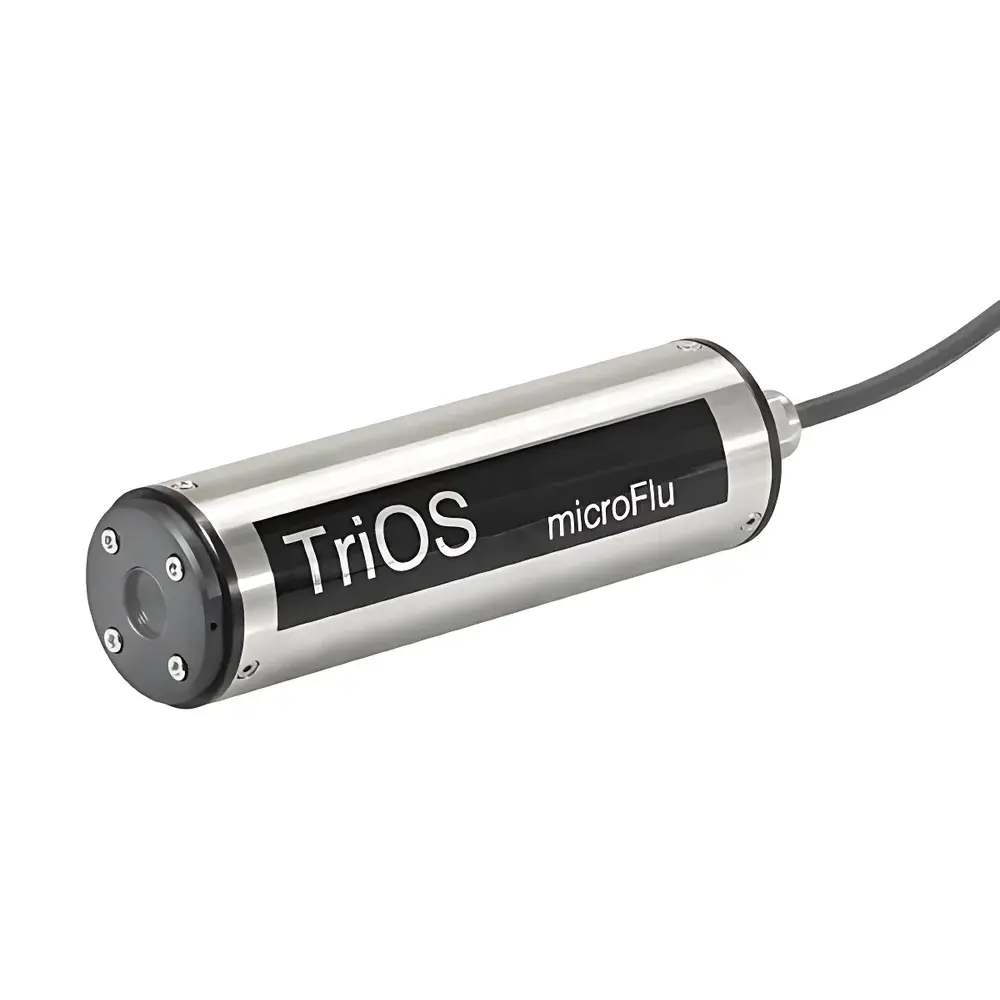
TriOS microFlu CDOM Fluorometer
| Brand | TriOS |
|---|---|
| Origin | Germany |
| Model | microFlu CDOM |
| Light Source | High-efficiency blue LEDs (370 nm) with internal reference photodiode |
| Detector | Photodiode (460 nm, 20 nm FWHM) |
| Measurement Range | 0–20 μg/L and 0–200 μg/L (dual-range auto-adaptive) |
| Detection Limit | 0.02 μg/L |
| Resolution | 0.02 μg/L |
| Accuracy | ±3% of reading |
| Housing | Marine-grade stainless steel (corrosion-resistant to seawater) |
| Dimensions | Ø48 × 200 mm |
| Weight | 0.5 kg |
| Pressure Rating | 500 m water depth |
| Electrical Interface | RS-232 and 0–5 V analog output |
| Connector | SUB-CONN Micro 5-pin male |
Overview
The TriOS microFlu CDOM Fluorometer is a submersible, field-deployable optical sensor engineered for high-precision, in situ quantification of Colored Dissolved Organic Matter (CDOM) in natural and engineered aquatic systems. It operates on the principle of ultraviolet-induced fluorescence: a narrowband 370 nm LED excites aromatic carbon structures within CDOM molecules, and the resulting emission at ~460 nm is detected by a temperature-stabilized photodiode with 20 nm full-width-at-half-maximum (FWHM) spectral bandwidth. This wavelength pair is empirically optimized for maximum sensitivity to humic- and fulvic-acid-like fluorophores while minimizing interference from chlorophyll-a and other common aquatic fluorophores. The instrument’s dual-range auto-adaptive detection architecture dynamically switches between low- and high-concentration measurement modes—eliminating saturation at elevated CDOM levels (>50 μg/L) and preserving resolution at trace concentrations (<1 μg/L). Its compact cylindrical form factor (Ø48 × 200 mm), 500 m pressure rating, and marine-grade stainless-steel housing enable long-term deployment in estuarine, coastal, deep-ocean, groundwater, and wastewater infrastructure environments without mechanical or optical degradation.
Key Features
- UV-optimized optical path with nano-coated lens assembly—resists biofouling, salt-crystallization, and UV-induced polymer aging during extended submersion
- Dual-range auto-adaptive signal processing—ensures linear response across 0–20 μg/L (high-sensitivity mode) and 0–200 μg/L (broad-range mode) without manual gain adjustment
- Stable excitation source: high-luminance 370 nm LEDs with integrated reference photodiode for real-time intensity monitoring and drift compensation
- Low-power operation (<1.2 W typical): supports battery-powered deployments up to 12 months when paired with TriOS TriBox 3 or compatible data loggers
- Multi-interface output: simultaneous RS-232 digital protocol (ASCII/Modbus RTU) and isolated 0–5 V analog output for integration into SCADA, PLC, or industrial telemetry systems
- IP68-rated hermetic seal and titanium-reinforced SUB-CONN Micro 5-pin interface—certified for continuous operation at 500 m depth in seawater per ISO 9001 and IEC 60529 standards
Sample Compatibility & Compliance
The microFlu CDOM is validated for direct immersion in freshwater, brackish water, seawater, treated effluent, and groundwater matrices. Its optical design minimizes quenching effects from dissolved oxygen and ionic strength variation across salinities 0–40 PSU. Sensor calibration is traceable to NIST-traceable CDOM reference standards (Suwannee River NOM, SRHA) and conforms to EPA Method 415.3 for dissolved organic carbon estimation via fluorescence correlation. While not a standalone regulatory compliance device, its output meets data quality objectives (DQOs) for long-term trend analysis under ISO 5667-3 (water sampling) and supports GLP-aligned monitoring programs when deployed with audit-trail-capable data loggers (e.g., TriBox 3 with 21 CFR Part 11-compliant firmware).
Software & Data Management
TriOS provides the free TriOS SensorControl software for PC-based configuration, real-time visualization, and offline calibration file management. All firmware updates, spectral diagnostics, and dark-current compensation routines are performed via RS-232. For autonomous deployments, the sensor integrates natively with TriOS TriBox 3—a ruggedized, IP67-rated industrial data acquisition unit supporting SD-card logging, GPS timestamping, configurable averaging intervals (1 s to 1 h), and encrypted Bluetooth 5.0 wireless retrieval using the YW-T-WPDA handheld terminal. Raw fluorescence intensity values (mV or digital counts) and derived CDOM concentration (μg/L) are stored with metadata including temperature, pressure, and sensor health flags—enabling post-processing alignment with concurrent parameters (e.g., turbidity, DOC, salinity) in MATLAB, Python (Pandas), or commercial LIMS platforms.
Applications
- Riverine and estuarine carbon flux studies—tracking terrestrial DOM export and photobleaching gradients
- Ocean color validation campaigns—supporting satellite-derived CDOM algorithms (e.g., SeaWiFS, Sentinel-3 OLCI)
- Drinking water source protection—early detection of allochthonous organic loading in reservoirs and aquifers
- Wastewater treatment plant optimization—monitoring biodegradable vs. recalcitrant DOM fractions in secondary and tertiary effluents
- Marine corrosion research—correlating CDOM absorption with electrochemical activity on submerged infrastructure
- Long-term observatory networks (e.g., OceanSITES, EuroGOOS)—as a core biogeochemical node in moored profiler and glider payloads
FAQ
Is the microFlu CDOM suitable for use in highly turbid waters?
Yes—its 370/460 nm excitation-emission pair exhibits minimal scattering interference compared to visible-light fluorometers; however, particulate correction (e.g., synchronous scanning or parallel factor analysis) is recommended for suspended solids >25 NTU.
Can the sensor be calibrated in-house?
Yes—calibration is performed using two-point standard solutions traceable to Suwannee River Humic Acid (SRHA); TriOS provides detailed SOPs and certified reference material sourcing guidance.
Does it require anti-fouling maintenance during multi-month deployments?
The nano-coated optics significantly delay biofilm formation; for deployments >60 days in eutrophic environments, optional copper-alloy mounting brackets or periodic wiper mechanisms (e.g., TriOS CleanBrush) are recommended.
How is temperature compensation handled?
An integrated Pt1000 thermistor provides real-time thermal correction of LED output and detector responsivity; factory calibration includes temperature coefficients across –2 °C to +35 °C.
Is the 0–5 V analog output isolated?
Yes—the analog channel features galvanic isolation rated to 1500 VDC, preventing ground-loop errors in industrial SCADA installations.
Related Products







