
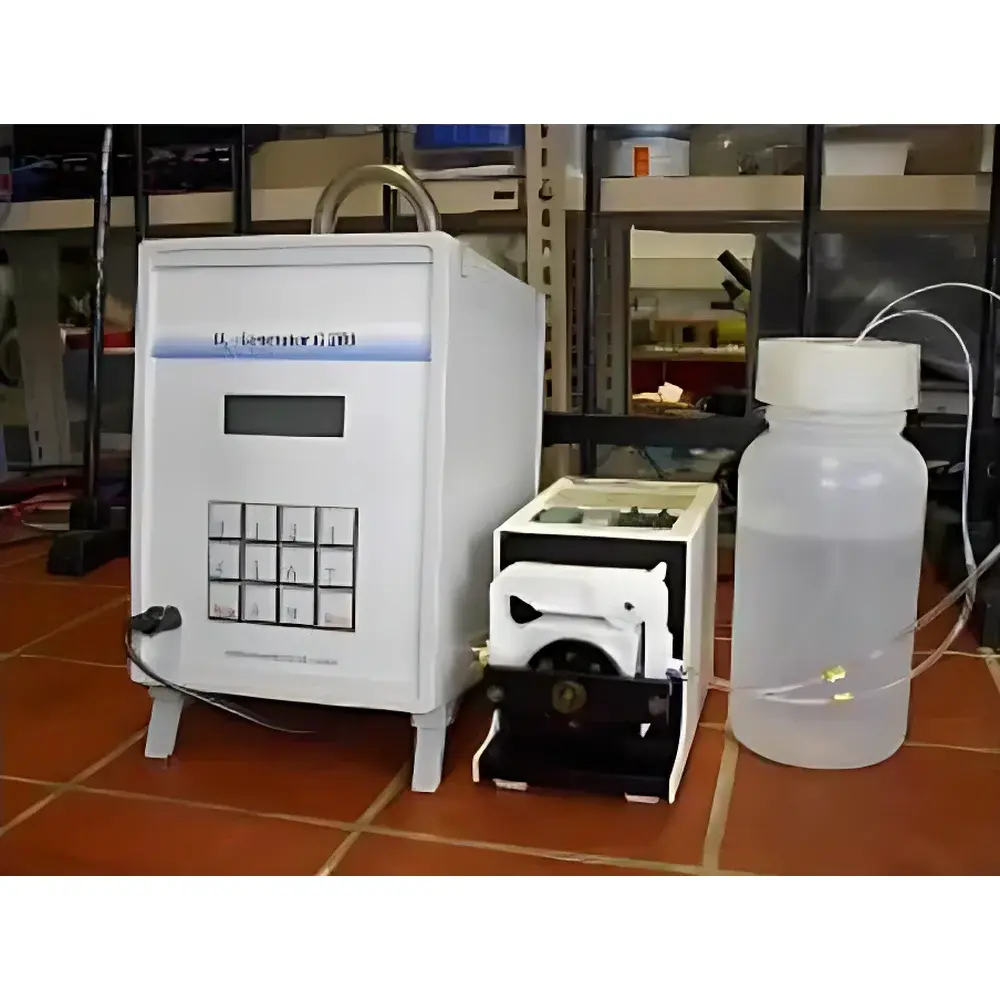
AMT G200 Coulometric H₂S Sulfide Generator
| Brand | AMT |
|---|---|
| Origin | Germany |
| Manufacturer Status | Authorized Distributor |
| Product Origin | Imported |
| Model | AMT G200 Coulometric H₂S Sulfide Generator |
| Price | Upon Request |
| Concentration Range | 0.002–60.0 mg/L H₂S (0.062–1871 µmol/L H₂S) |
| Electrode Capacity | ≈350 mAh |
| Dimensions | 220 mm (L) × 160 mm (W) × 250 mm (H) |
| Accuracy | ±0.25% (amperometric probe) |
| Purge Time | ~45 min |
| First Concentration Transition | ~15–30 min |
| Concentration Step Response Time | 1 h per 10 steps (dependent on step magnitude and gas flow rate) |
| Repeatability | 99.78% (amperometric), 97.51% (methylene blue) |
| Dry-Run Tolerance | ~4 working days |
Overview
The AMT G200 Coulometric H₂S Sulfide Generator is a precision electrochemical calibration source engineered for trace-level hydrogen sulfide (H₂S) gas generation in environmental and water quality laboratories. Unlike conventional permeation tubes or gas cylinders—whose output stability degrades significantly at sub-ppm concentrations—the G200 employs coulometric electrolysis of a certified aqueous sulfide standard solution to generate H₂S on demand with inherent stoichiometric control. This principle ensures metrological traceability to primary standards and eliminates the drift, evaporation, and temperature sensitivity common in diffusion-based generators. The device delivers stable, programmable H₂S concentrations across three orders of magnitude (0.002–60.0 mg/L, equivalent to 0.062–1871 µmol/L), making it suitable for calibrating amperometric sensors, colorimetric analyzers (e.g., methylene blue spectrophotometers), and online process monitors used in wastewater treatment plants, drinking water facilities, and regulatory compliance labs.
Key Features
- Coulometric generation principle: Quantitative H₂S release via controlled Faraday-electrolysis of sulfide ions (S²⁻) in a sealed, temperature-stabilized electrochemical cell—ensuring mass-balanced, zero-drift output.
- High metrological fidelity: Certified accuracy of ±0.25% (relative to amperometric reference) and repeatability of 99.78% (amperometric detection) and 97.51% (methylene blue spectrophotometric validation), supporting ISO/IEC 17025-compliant calibration workflows.
- Extended operational autonomy: Integrated electrode with ≈350 mAh capacity enables up to four consecutive working days of continuous operation without recharging or solution replacement under typical flow conditions (e.g., 100–500 mL/min).
- Predictable dynamic response: Designed for controlled concentration stepping; initial purge completes in ~45 minutes; first concentration transition occurs within 15–30 minutes; subsequent 10-step transitions complete within one hour—enabling reproducible multi-point calibration sequences.
- Compact benchtop architecture: Dimensions of 220 × 160 × 250 mm facilitate integration into ISO 17025-accredited lab environments, fume hoods, or mobile calibration carts without requiring external gas supplies or high-pressure infrastructure.
Sample Compatibility & Compliance
The G200 is compatible with all standard H₂S detection methodologies used in water quality analysis, including amperometric membrane sensors (e.g., Hach, Dr. Lange, Palintest), UV-Vis spectrophotometers equipped with methylene blue reagents (per ASTM D974, ISO 10530, EPA Method 376.1), and ion-selective electrodes. Its output is chemically pure H₂S in humidified air or nitrogen carrier gas—free from organic interferents, metal contaminants, or residual solvents. The generator complies with requirements for reference material traceability under ISO Guide 34 and supports GLP/GMP audit trails when paired with validated data acquisition systems. It is routinely employed in laboratories undergoing accreditation to ISO/IEC 17025:2017 (Clause 5.5.2, calibration of measurement equipment) and meets functional equivalence criteria for US EPA and EU WFD (Water Framework Directive) monitoring programs.
Software & Data Management
While the G200 operates as a standalone hardware generator, its output stability and repeatable timing profiles are fully compatible with third-party LIMS and calibration management platforms (e.g., LabWare, Thermo Fisher SampleManager). Users may log purge times, step durations, concentration setpoints, and verification measurements using CSV-exportable timestamped logs generated by connected amperometric analyzers or spectrophotometers. For full 21 CFR Part 11 compliance, the system supports integration with electronic signature-enabled software that enforces audit trails, user access controls, and change history—particularly when used in regulated wastewater discharge reporting or pharmaceutical process water monitoring.
Applications
- Primary calibration of online H₂S sensors in municipal wastewater influent/effluent streams and biogas desulfurization units.
- Verification and recalibration of portable field meters (e.g., H₂S handheld detectors, multiparameter sondes) prior to EPA Method 1681 or ISO 10530 field deployments.
- Generation of certified reference gas mixtures for method validation studies, including recovery testing, limit-of-detection (LOD) determination, and interlaboratory comparison exercises.
- Supporting ISO 17025 internal quality control protocols—specifically for laboratories performing routine sulfide analysis in surface water, groundwater, and industrial effluents per EN ISO 10530 or DIN 38405-27.
- Research applications requiring precise, time-resolved H₂S dosing in microbial sulfate-reduction inhibition assays or corrosion studies under controlled aqueous headspace conditions.
FAQ
How does coulometric generation differ from permeation tube-based H₂S sources?
Coulometric generation relies on Faraday’s law of electrolysis to produce H₂S stoichiometrically from dissolved sulfide—eliminating reliance on passive diffusion, temperature-dependent vapor pressure, or aging-related flux decay.
Can the G200 be used for calibrating methods other than amperometric detection?
Yes—it is validated for use with methylene blue spectrophotometry (ISO 10530), iodometric titration (APHA 4500-S²⁻ B), and ion chromatography with suppressed conductivity detection.
What maintenance is required to sustain metrological performance?
The electrochemical cell requires periodic replacement of the sulfide electrolyte solution (typically every 6–12 months depending on usage frequency) and annual verification of electrode capacity against certified reference standards.
Is the G200 compatible with inert carrier gases such as nitrogen or argon?
Yes—operation with N₂ or Ar is supported and recommended for applications requiring oxygen-free environments, such as anaerobic digestion process monitoring.
Does the device include built-in flow control or require an external mass flow controller?
The G200 does not integrate active flow regulation; it is designed for use with externally calibrated mass flow controllers (MFCs) to ensure accurate dilution and concentration delivery—consistent with ISO 6145-5 guidance for dynamic gas mixing.







