
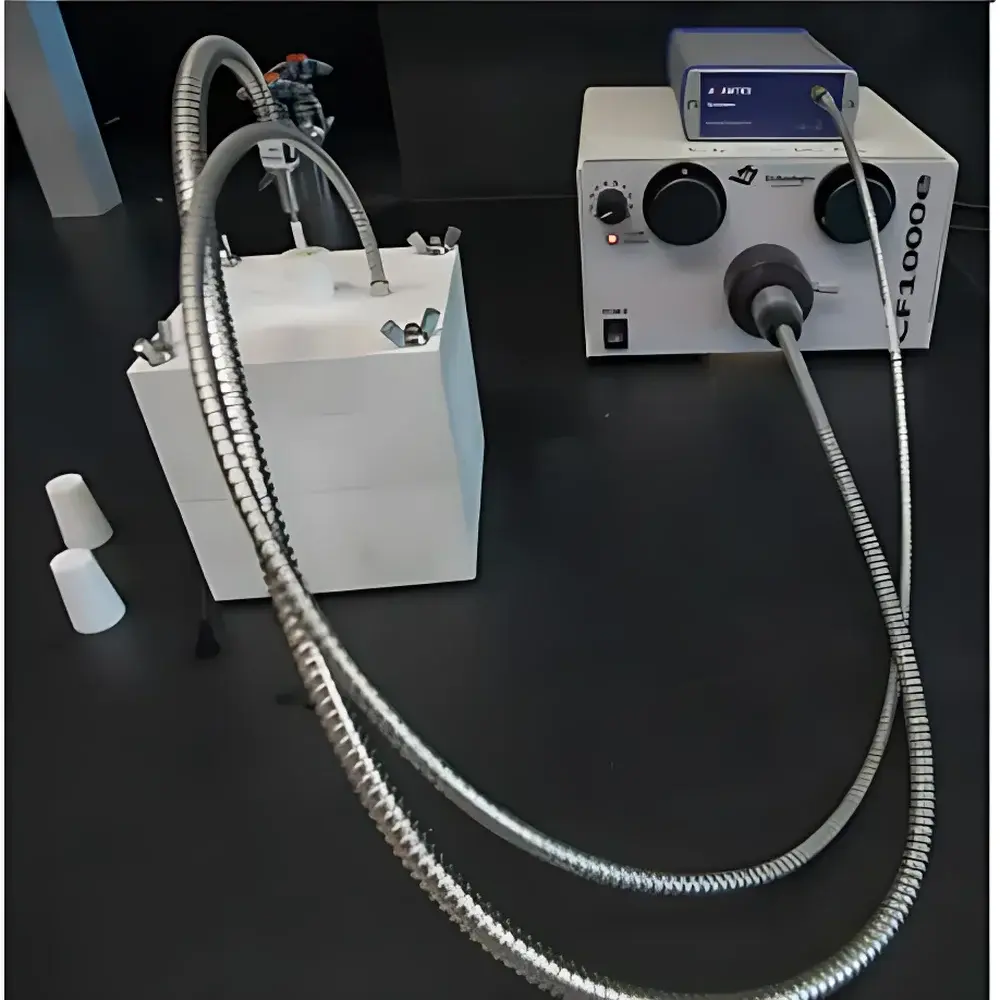
Sunstone PSICAM Point-Source Integrating Cavity Absorption Meter
| Brand | Sunstone |
|---|---|
| Origin | USA |
| Manufacturer Type | Authorized Distributor |
| Origin Category | Imported |
| Model | PSICAM |
| Price | Upon Request |
| Integrating Cavity Diameter | 9 cm |
| Cavity Material | OP.DI.MA diffuse reflector (Gigahertz-Optik, Germany) |
| Reflector Thickness | 10 mm |
| Reflectance | 97–98% |
| Central Diffuser Diameter | 10 mm |
| Diffuser Material | Ground Quartz Glass |
| Light Source | 150 W Halogen Lamp (IT 3500, Illumination Technology) |
| Light Delivery | Custom Quartz Fiber Optic Bundle |
| Detector | RAMSES ACC UV/VIS Irradiance Sensor (TRIOS, Germany) |
| Spectral Range (Detector) | 300–750 nm |
| Sampling Interval | 2 nm |
| Optical Resolution | 3.3 nm |
| Measurement Spectral Range | 350–800 nm |
| Absorption Coefficient Range | 0.001–5 m⁻¹ |
| Uncertainty | ±0.0008 m⁻¹ @ 450 nm |
| Fluorescence Correction | Integrated Short-Wave Filter for Chlorophyll-a Estimation |
| Temperature & Salinity Compensation | Supported |
Overview
The Sunstone PSICAM Point-Source Integrating Cavity Absorption Meter is a precision optical instrument engineered for high-sensitivity, in situ–compatible measurement of spectral absorption coefficients in natural waters. Unlike conventional spectrophotometric methods that rely on collimated beam transmission through fixed-path cuvettes, the PSICAM implements the point-source integrating cavity principle first conceptualized by J.T.O. Kirk (1983) and rigorously advanced by Dr. Rüdiger Röttgers for aquatic optics applications. Its core architecture centers on a highly reflective integrating cavity (9 cm internal diameter) fabricated from OP.DI.MA — a certified diffuse reflector material with >97% hemispherical reflectance at 10 mm thickness. A centrally mounted, isotropically diffusing quartz source (10 mm Ø) emits light into the cavity, establishing uniform radiance distribution. Absorption is inferred by measuring the attenuated irradiance exiting through a side-port window using a calibrated RAMSES ACC UV/VIS irradiance sensor (TRIOS), eliminating detector angular sensitivity artifacts inherent in direct-cavity detection schemes. This design yields an effective pathlength significantly longer than physical dimensions—enabling reliable quantification of low-absorption marine and oligotrophic freshwater samples down to 0.001 m⁻¹.
Key Features
- High-reflectance integrating cavity (OP.DI.MA, Gigahertz-Optik) ensures stable, Lambertian light diffusion and minimal spectral distortion across 350–800 nm.
- Centralized 150 W halogen lamp (IT 3500) coupled via custom quartz fiber bundle delivers stable, broadband illumination with negligible thermal drift.
- RAMSES ACC irradiance sensor provides traceable spectral responsivity from 300–750 nm at 2 nm sampling resolution (optical bandwidth: 3.3 nm FWHM).
- Integrated short-wave optical filter enables simultaneous correction for chlorophyll-a fluorescence interference during CDOM and phytoplankton absorption measurements.
- Onboard temperature and salinity compensation algorithms support field-deployable accuracy under variable oceanographic conditions.
- Uncertainty budget rigorously characterized per Röttgers et al. (2005, 2007): ±0.0008 m⁻¹ at 450 nm; ±0.002 m⁻¹ at 700 nm — validated against NIST-traceable reference standards and intercomparison with photometric techniques.
Sample Compatibility & Compliance
The PSICAM is optimized for liquid-phase absorption measurements in unfiltered or size-fractionated water samples, including seawater, estuarine, lacustrine, and riverine matrices. It accommodates both laboratory benchtop operation and shipboard deployment when integrated with standard CTD rosette frames or autonomous platforms. The system complies with ISO 10264 (water quality — determination of spectral absorption coefficients), aligns with ASTM D7322–17 guidelines for optical property characterization of natural waters, and supports data integrity requirements for GLP-compliant environmental monitoring programs. All calibration procedures follow documented SOPs traceable to NIST SRM 2036 (certified absorbance standards) and are compatible with FDA 21 CFR Part 11–enabled audit trails when operated with validated acquisition software.
Software & Data Management
Data acquisition and post-processing are performed using TRIOS’ proprietary OceanData software (v6.2+), which supports real-time spectral visualization, automated baseline correction, temperature/salinity/fluorescence compensation, and export of absorption coefficient spectra (m⁻¹) in NetCDF and ASCII formats. The software includes built-in validation modules for detector linearity, dark current stability, and cavity reflectance consistency checks. Exported datasets embed full metadata (instrument ID, calibration date, environmental parameters, operator ID), ensuring FAIR (Findable, Accessible, Interoperable, Reusable) data practices. Raw spectral files are structured to comply with IOCCG Protocols and SeaDataNet conventions for interoperability with regional observing systems (e.g., EuroGOOS, GOOS).
Applications
- Quantification of chromophoric dissolved organic matter (CDOM) absorption spectra for carbon cycling studies and remote sensing algorithm development.
- Particulate absorption profiling of phytoplankton assemblages, including taxon-specific pigment absorption signatures after controlled bleaching protocols.
- Validation of hyperspectral ocean color sensors (e.g., Sentinel-3 OLCI, PACE HARP2) through match-up in situ reference measurements.
- Long-term time-series monitoring of absorption budgets in coastal zones affected by eutrophication, riverine input, or climate-driven stratification shifts.
- Calibration and intercomparison of other absorption meters (e.g., AC-S, WET Labs) within international round-robin exercises coordinated by IOCCG or NASA’s Ocean Biology Processing Group.
FAQ
How does PSICAM differ from traditional transmissometers or AC-S instruments?
The PSICAM measures absorption via integrating cavity radiance rather than direct beam attenuation, eliminating pathlength uncertainty and enabling accurate low-absorption measurements without dilution or long-path cells.
Is PSICAM suitable for turbid or highly scattering waters?
Yes — its cavity geometry inherently minimizes scattering-induced errors; however, particulate scattering contributions must be removed via paired measurements with a transmissometer or modeled using Mie theory for rigorous particulate absorption retrieval.
Can PSICAM be deployed autonomously on moorings or gliders?
While primarily designed for shipboard and lab use, compact variants with pressure housings (up to 6000 m depth rating) and low-power LED sources are available upon request for long-term autonomous deployments.
What calibration standards are required for routine operation?
Annual cavity reflectance verification using certified reflectance standards (e.g., Spectralon® SRM 2036), quarterly lamp intensity and detector responsivity checks, and daily dark/reference measurements per IOCCG Best Practices.
Does the system support compliance with regulatory reporting frameworks such as EU WFD or US Clean Water Act?
Yes — absorption data generated with documented calibration history, uncertainty propagation, and metadata conforms to QA/QC requirements specified in EPA Method 418.1 and EU Commission Decision 2010/477/EU for ecological status assessment.
Related Products







