
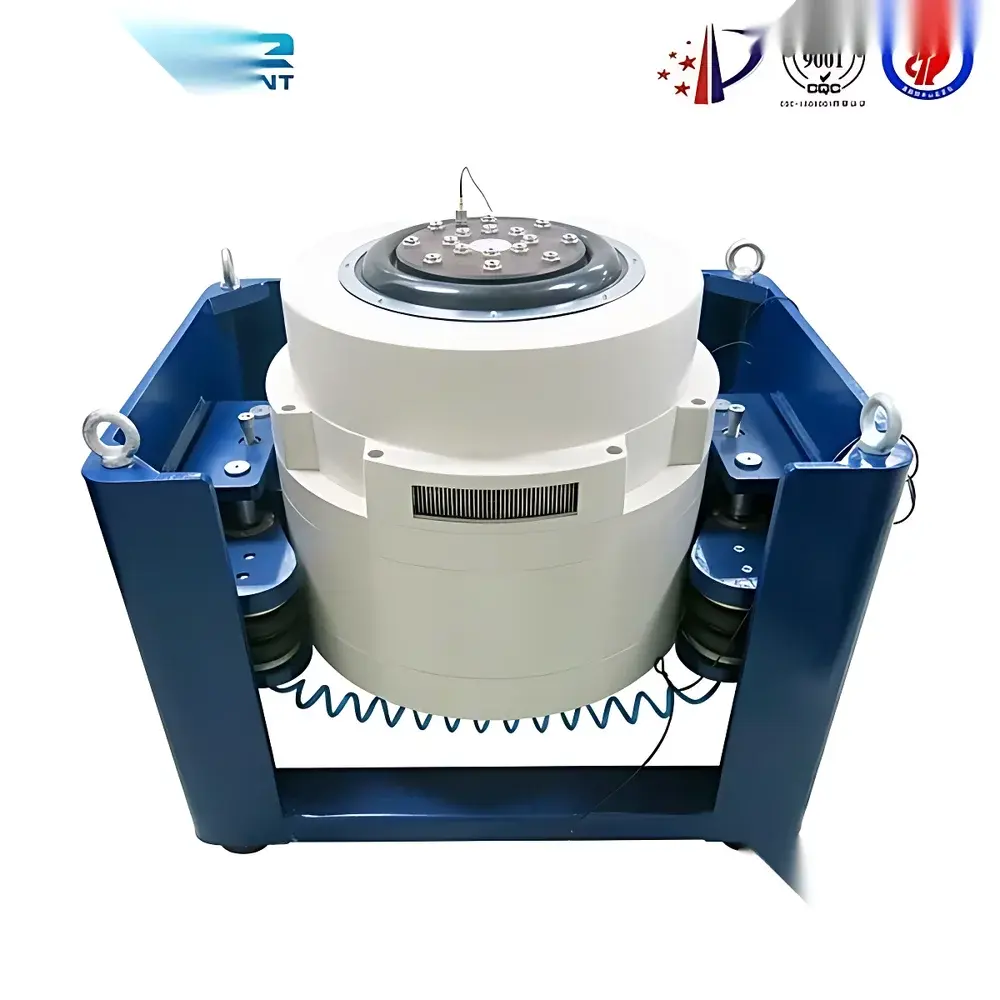
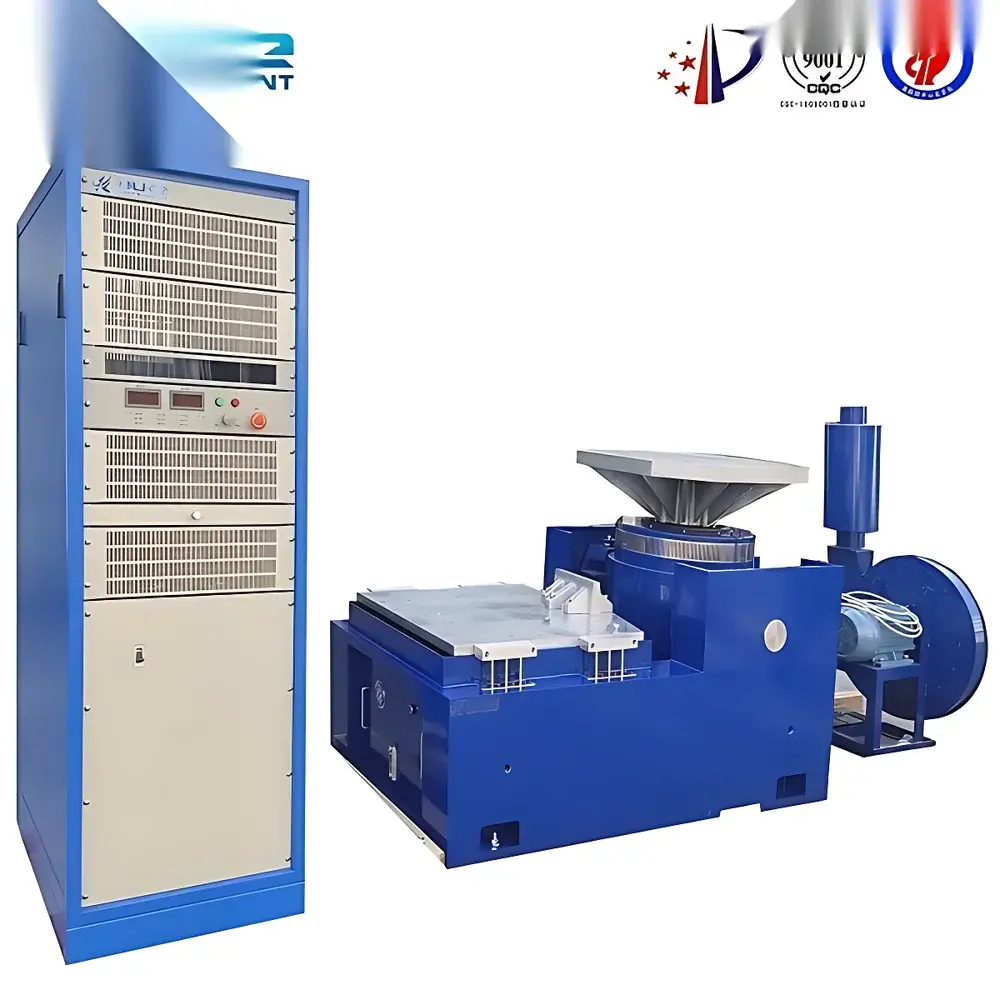
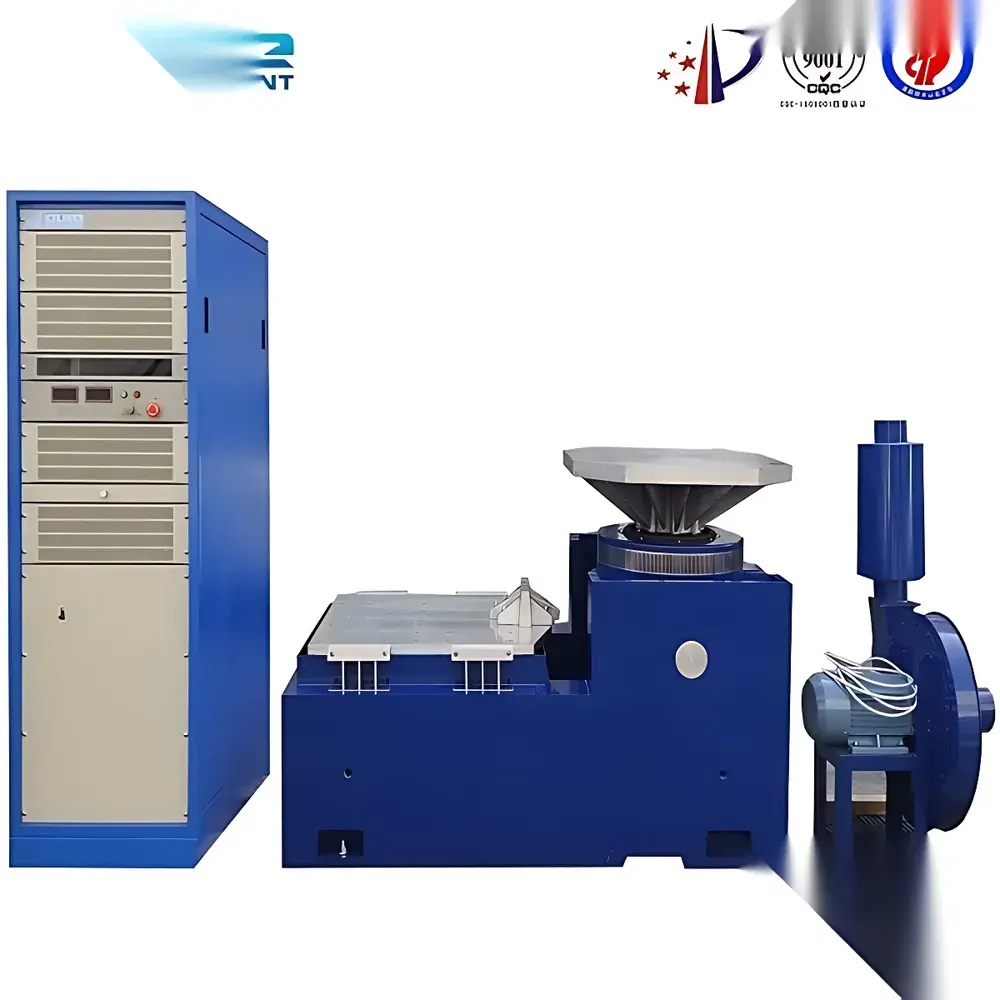
Heavy-Duty Electromagnetic Vibration Shaker System
| Brand | OEM / Custom-Built |
|---|---|
| Origin | Imported |
| Manufacturer Type | Authorized Distributor |
| Tabletop Dimensions | 500 × 500 mm |
| Shaker Body Dimensions | 500 × 450 × 500 mm |
| Mounting Pattern | 25 × M10 threaded holes on tabletop |
| Vibration Axes | Vertical (Y-axis) and Horizontal (X-axis) |
| Frequency Range | 1–5000 Hz, resolution 0.01 Hz |
| Peak-to-Peak Displacement | 0–4 mm adjustable |
| Maximum Load Capacity | 75 kg |
| Rated Sinusoidal Force | 1125 kgf (11.03 kN) |
| Maximum Acceleration | ≤15 g |
| Waveform | Sine (full- or half-cycle) |
| Test Duration Setting | Programmable in seconds (0–999,999 s) |
| Power Consumption | 3.8 kW |
| Input Current | ≤15 A |
| Supply Voltage | 380 V ±20%, 3-phase, 50/60 Hz |
| Operating Temperature | −10 °C to +60 °C |
| Relative Humidity | ≤95% RH (non-condensing) |
| Recommended Ambient | ≤28 °C with adequate ventilation |
Overview
The Heavy-Duty Electromagnetic Vibration Shaker System is an industrial-grade electrodynamic shaker engineered for rigorous mechanical stress screening of large-scale components and assemblies. It operates on the principle of Lorentz-force actuation—where controlled current through a voice-coil assembly interacts with a permanent magnetic field to generate precise, repeatable inertial excitation. Designed for compliance with vibration test standards including ISO 10816, IEC 60068-2-6, MIL-STD-810H Method 514.8, and GB/T 2423.10, this system delivers high-fidelity sinusoidal motion across a broad frequency spectrum (1–5000 Hz), enabling evaluation of structural integrity, resonant behavior, fastener retention, solder joint reliability, and interconnect stability under dynamic loading conditions. Its robust electromagnetic architecture supports both single-axis (X or Y) and synchronized dual-axis operation—critical for simulating real-world transport and operational vibration profiles encountered in aerospace, automotive, energy infrastructure, and heavy machinery sectors.
Key Features
- High-force electromagnetic actuator delivering up to 11.03 kN (1125 kgf) peak sinusoidal thrust, optimized for payloads up to 75 kg without performance derating.
- Dual-axis excitation capability with independent control of vertical (Y) and horizontal (X) motion—enabling sequential, alternating, or simultaneous multi-directional testing per IEC 60068-2-64 Annex B requirements.
- Wide-frequency bandwidth (1–5000 Hz) with 0.01 Hz frequency resolution and closed-loop digital servo control ensuring traceable amplitude and phase fidelity.
- Programmable waveform generation supporting fixed-frequency dwell, linear/logarithmic sweep (15-segment), step-sine, and octave-based frequency progression—fully compliant with ASTM D999 and ISTA 3A protocols.
- Integrated tabletop with 25 × M10 threaded mounting holes and four 70-mm L-slot hook rails for secure fixture integration and auxiliary load suspension.
- Thermally managed power amplifier with active cooling, rated at 3.8 kW continuous output and compatible with 380 V ±20% three-phase supply—designed for extended duty cycle operation under ambient temperatures up to 28 °C.
Sample Compatibility & Compliance
This shaker accommodates rigid and semi-rigid test articles—including enclosures, control cabinets, battery modules, engine subassemblies, and railway onboard electronics—within its 500 × 500 mm active surface and 75 kg mass limit. Fixture design must maintain center-of-gravity alignment within ±15 mm of the shaker’s geometric centerline to ensure force vector integrity and minimize rocking moments. The system meets CE marking requirements for EMC (2014/30/EU) and Low Voltage Directive (2014/35/EU). All control firmware and test sequencing logic are structured to support GLP/GMP audit trails when integrated with validated data acquisition systems. While not pre-certified to FDA 21 CFR Part 11, the platform provides timestamped, non-editable binary log export (CSV/ASCII) suitable for validation against electronic record retention policies.
Software & Data Management
The system interfaces via Ethernet or USB with vendor-supplied PC-based control software supporting real-time spectrum monitoring, closed-loop acceleration/displacement feedback, and automated pass/fail threshold evaluation. Test sequences—including sweep rates, dwell times, amplitude profiles, and abort conditions—are stored as encrypted .vts project files. Raw time-history data (acceleration, velocity, displacement) is acquired at ≥51.2 kHz sampling rate with 24-bit ADC resolution and archived in IEEE 754-compliant binary format. Export options include MATLAB (.mat), Universal File Format (UFF 58), and CSV with metadata headers compliant with ISO 18431-2. Audit logs record operator ID, test start/stop timestamps, parameter changes, and hardware fault events—retained for minimum 90 days unless externally archived.
Applications
- Qualification testing of avionics chassis per DO-160 Section 8 (Vibration).
- Transport simulation for wind turbine pitch controllers and grid-tie inverters (ISTA 3E, ASTM D4169).
- Resonance search and fatigue life assessment of welded structural frames in material handling equipment.
- Loose-part detection and contact reliability verification in high-voltage switchgear and EV battery management systems.
- Modal survey support for finite element model correlation using impact hammer cross-validation.
- Environmental stress screening (ESS) of defense electronics prior to HALT/HASS campaigns.
FAQ
What is the maximum allowable center-of-gravity height for a 75 kg test article?
For optimal force transmission and minimal overturning moment, the center of gravity should not exceed 300 mm above the tabletop surface. Exceeding this requires custom base stiffening and dynamic balancing verification.
Can the system perform random vibration testing?
No—this model is configured exclusively for deterministic waveforms (sine, sweep, programmable steps). Random vibration capability requires optional PSD controller hardware and dedicated software license.
Is third-party calibration certification included?
Factory calibration is performed per ISO 17025-accredited procedures and documented in a traceable certificate. On-site calibration by accredited labs (e.g., A2LA or UKAS) is available upon request.
How is thermal protection implemented during prolonged 15 g tests?
The shaker incorporates dual-stage thermal monitoring: coil temperature sensed via embedded PT100 sensors, and amplifier heatsink monitored via thermocouples. Automatic power roll-back initiates at 120 °C coil temp; full shutdown occurs at 135 °C.
Does the controller support external trigger synchronization?
Yes—TTL-compatible trigger input/output ports enable synchronization with high-speed cameras, strain gauge DAQ systems, or environmental chambers for multi-stress testing.
Related Products



