
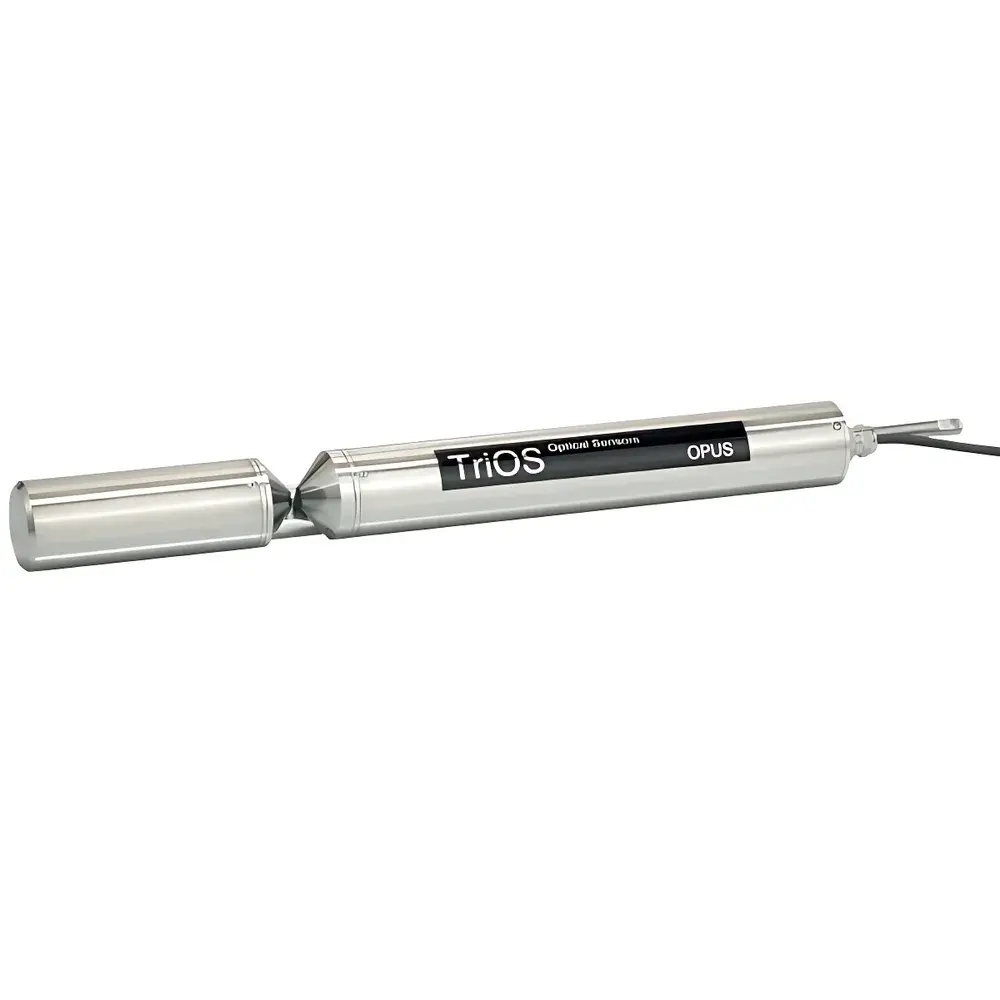
TriOS OPUS UV Spectrophotometer
| Brand | TriOS |
|---|---|
| Origin | Germany |
| Model | OPUS UV |
| Light Source | Xenon lamp |
| Detector | 256-channel miniature spectrometer (200–360 nm, 0.8 nm/pixel) |
| Measurement Principle | Absorption spectroscopy (attenuation-based) |
| Optical Path Lengths | 0.3 mm, 1 mm, 2 mm, 5 mm, 10 mm, 50 mm |
| Turbidity Compensation | Yes |
| Data Memory | 2 GB internal |
| Measurement Interval | ≥1 minute |
| Output Interfaces | RS232 or RS485 |
| Power Consumption | ≤8 W |
| Housing Material | Stainless steel or titanium alloy (seawater-resistant) |
| Dimensions | Ø48 × 470 mm |
| Weight | 3 kg (stainless steel, 10 mm path) |
| Pressure Rating | 30 bar (with SubConn connector), 3 bar (fixed cable), 1 bar (flow cell, 2–4 L/min) |
| Ingress Protection | IP68 |
| Sample Temperature Range | 2–40 °C |
| Ambient Temperature Range | 2–40 °C |
| Storage Temperature Range | −20–80 °C |
Overview
The TriOS OPUS UV Spectrophotometer is a high-precision, submersible in-situ optical sensor engineered for continuous, reagent-free quantification of nitrogen- and carbon-related water quality parameters in real time. Operating on the fundamental principle of ultraviolet absorption spectroscopy—specifically, multi-wavelength attenuation analysis across the 200–360 nm spectral band—the OPUS UV enables direct, non-invasive measurement of key analytes without sample extraction, digestion, or chemical reagents. Its core optical architecture integrates a pulsed xenon light source and a thermally stabilized 256-channel miniature spectrometer with 0.8 nm spectral resolution, ensuring high photometric accuracy and long-term signal stability under variable field conditions. Designed for deployment in dynamic aquatic environments—including wastewater influent/effluent streams, drinking water distribution networks, surface water bodies, and industrial process loops—the OPUS UV delivers trace-level sensitivity to nitrate-nitrogen (NO3-N), nitrite-nitrogen (NO2-N), and organic equivalents such as CODeq, BODeq, DOCeq, and TOCeq. The instrument’s nanocoated sapphire optical window resists biofouling and chemical abrasion, while its turbidity compensation algorithm corrects for scattering effects, preserving analytical integrity in optically complex matrices.
Key Features
- Reagent-free, maintenance-light operation—eliminates consumables, calibration drift from reagent degradation, and associated operational downtime
- Multi-pathlength configuration (0.3–50 mm) optimized for wide dynamic range: from ultra-low NO3-N concentrations (200 mg/L)
- Integrated turbidity compensation using dual-band spectral referencing—validates absorbance linearity independent of suspended solids load
- G2 interface module with embedded web server: enables zero-client browser-based configuration, firmware updates, and live spectral visualization via Ethernet/Wi-Fi
- IP68-rated stainless steel or titanium housing rated to 30 bar (≈300 m depth)—certified for permanent submersion in seawater, brackish, and aggressive industrial effluents
- Onboard 2 GB non-volatile memory with timestamped raw spectra and processed parameter logs—supports gap-free data continuity during communication outages
- Low-power design (≤8 W) compatible with solar/battery-powered telemetry systems; optional external battery pack enables portable survey deployments
Sample Compatibility & Compliance
The OPUS UV is validated for use in natural waters, municipal and industrial wastewater, potable water, and process streams with total suspended solids (TSS) up to 100 mg/L and salinity up to 35 g/kg. Its spectral modeling engine is trained on reference datasets traceable to NIST-certified standards and aligned with ISO 7027 (turbidity), ISO 15681-1 (phosphate), and ASTM D3868 (nitrate by UV spectrophotometry). While not a standalone compliance instrument per EPA Method 353.2 or ISO 10304-1, it serves as a primary monitoring tool within GLP- and GMP-aligned QA/QC frameworks when paired with periodic laboratory verification. All firmware and data handling routines comply with IEC 62443-3-3 cybersecurity requirements for industrial control systems.
Software & Data Management
The G2 interface provides native support for Modbus RTU/ASCII/TCP, SDI-12, and MQTT protocols—enabling seamless integration into SCADA, DCS, and cloud-based IoT platforms (e.g., Azure IoT Hub, AWS IoT Core). Raw spectral data (256 × wavelength intensity vectors) and derived parameters are exportable in CSV, JSON, or NetCDF formats. Audit-trail functionality records all configuration changes, firmware updates, and manual recalibrations with user ID and UTC timestamps—meeting FDA 21 CFR Part 11 electronic record requirements when deployed in regulated pharmaceutical or food-processing water loops. Remote diagnostics include spectral SNR monitoring, lamp intensity decay tracking, and window fouling index estimation.
Applications
- Real-time nitrification/denitrification monitoring in activated sludge and MBR bioreactors
- Early-warning detection of organic shock loads in WWTP influent channels
- Compliance tracking of NO3-N in groundwater abstraction wells and distribution reservoirs
- Process optimization of UV disinfection systems via real-time DOC monitoring
- Environmental surveillance of agricultural runoff and eutrophic lake tributaries
- Industrial cooling water and boiler feedwater quality assurance
FAQ
Does the OPUS UV require daily calibration?
No—factory-applied multivariate calibration models are stable for ≥6 months under typical operating conditions. Field verification using certified standard solutions is recommended every 30–90 days depending on matrix fouling risk.
Can it distinguish between NO3− and NO2− in mixed solutions?
Yes—the 256-channel spectral resolution and chemometric deconvolution algorithm resolve overlapping UV absorption bands at 201 nm (NO2−) and 220 nm (NO3−), enabling independent quantification with <±5% relative error vs. ion chromatography.
Is the titanium housing suitable for offshore oil & gas platform discharge monitoring?
Yes—titanium Grade 2 construction meets NORSOK M-501 Category C3 corrosion resistance requirements and has been deployed in North Sea produced water applications exceeding 25 bar and 35 °C.
How is spectral drift compensated over temperature fluctuations?
An integrated Peltier-stabilized detector and dual-reference dark/light correction routine maintain photometric baseline stability across the full 2–40 °C operational range.
Can raw spectra be exported for third-party chemometric modeling?
Yes—via G2 web interface or RS485, users can retrieve unprocessed intensity arrays (wavelength × counts) at user-defined intervals for custom PLS, PCR, or machine learning model development.
Related Products







