
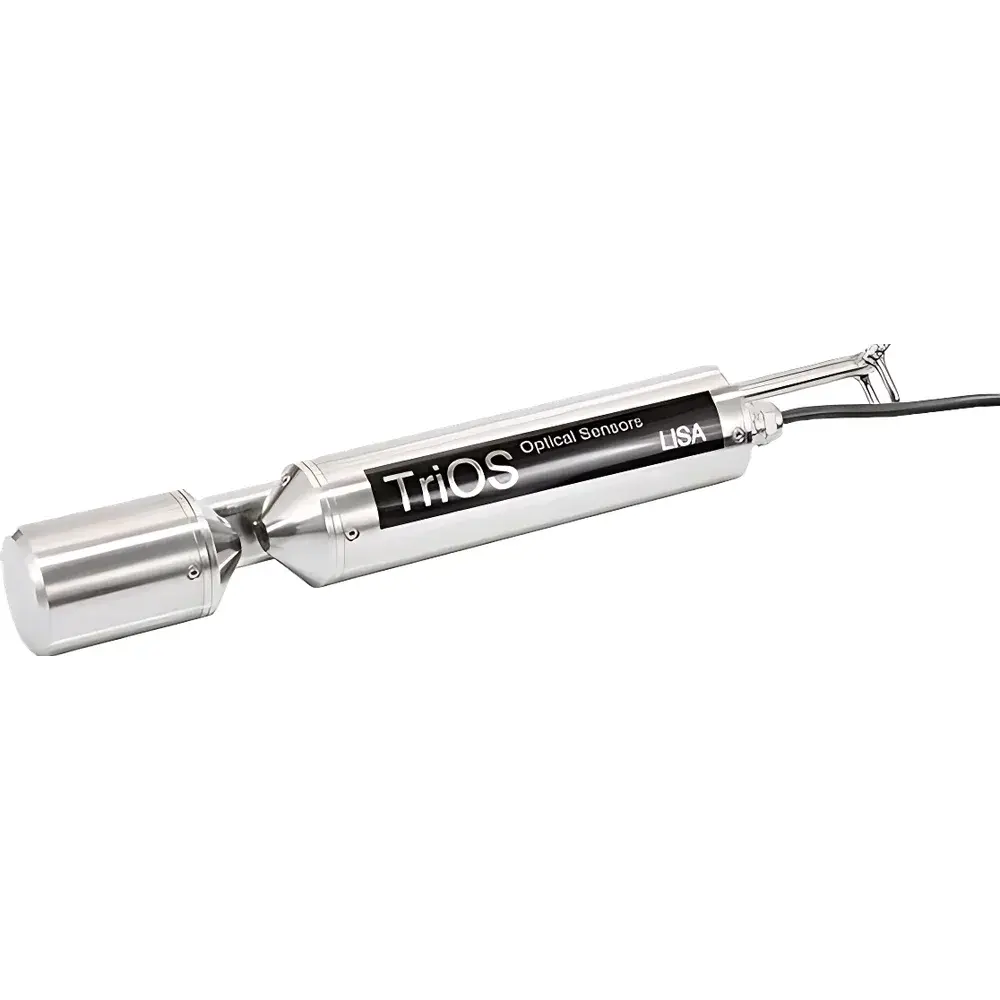
TriOS LISA 254 Online UV-Vis Spectrophotometric COD Analyzer
| Brand | TriOS |
|---|---|
| Origin | Germany |
| Model | LISA 254 |
| Instrument Type | Online Analyzer |
| Measurement Principle | UV Absorption Spectrophotometry at 254 nm |
| Wavelength | 254 nm |
| Measurement Range | 10–5000 mg/L COD<sub>eq</sub> |
| Accuracy | ±5% of reading |
| Repeatability | ±5% RSD |
| LOD | 0.01 mg/L COD<sub>eq</sub> |
| Measurement Interval | 1 s |
| Batch Capacity | 15 samples |
| Optical Path Length Options | 1, 2, 5, 10, or 50 mm |
| Turbidity Compensation | Dual-channel (254 nm + 530 nm) |
| Output Interfaces | 4–20 mA analog, Ethernet (TCP/IP), RS-232/RS-485 (Modbus RTU, TriOS protocol) |
| Power Supply | 12–24 VDC (±10%), ≤1 W |
| Operating Temperature | 2–40 °C (sample & ambient) |
| Pressure Rating | Up to 30 bar (SubConn), 3 bar (fixed cable), 1 bar (flow cell) |
| Enclosure Material | Stainless Steel (1.4571 / 1.4404) or Titanium (3.7035) |
| IP Rating | IP68 |
| Dimensions (10 mm path) | 300 mm × 48 mm |
| Weight (10 mm path, stainless steel) | 1.6 kg |
Overview
The TriOS LISA 254 is an online ultraviolet-visible (UV-Vis) spectrophotometric analyzer engineered for continuous, reagent-free quantification of chemical oxygen demand equivalents (CODeq) in aqueous matrices. It operates on the fundamental principle of UV absorption spectroscopy at 254 nm — a wavelength strongly absorbed by aromatic compounds, unsaturated bonds, and organic chromophores commonly associated with oxidizable organic matter. Unlike wet-chemistry methods (e.g., dichromate reflux per ISO 6060 or EPA 410.4), the LISA 254 delivers real-time, non-invasive measurement without sample digestion, chemical reagents, or waste generation. Its dual-wavelength architecture (254 nm primary + 530 nm reference) enables automatic turbidity correction, mitigating scattering artifacts from suspended solids and ensuring robust performance across variable water clarity conditions. Designed for permanent immersion or flow-cell integration, the LISA 254 meets the operational demands of wastewater treatment plants, drinking water distribution networks, industrial effluent monitoring stations, and UV disinfection process control loops.
Key Features
- Reagent-free, maintenance-minimized operation leveraging high-stability 254 nm UV-LED light sources with >10,000-hour lifetime and low thermal drift.
- Nano-coated optical windows combined with integrated compressed-air purge system eliminate biofouling and particulate deposition—enabling uninterrupted deployment for >6 months without manual cleaning.
- G2 digital interface supports seamless interoperability with TriOS controllers (e.g., RAMSES, OCEAN), handheld readers, and third-party SCADA/DCS systems via Modbus RTU, TCP/IP, or native TriOS protocol.
- Configurable optical path lengths (1–50 mm) allow dynamic range optimization: short paths (1–2 mm) for high-COD industrial streams; longer paths (10–50 mm) for low-concentration surface water or treated effluent.
- Titanium-housed variant (Grade 3.7035) certified for chloride-rich environments (e.g., seawater-influenced estuaries, brine discharge lines) with corrosion resistance exceeding ASTM B348 Class 2 requirements.
- Simultaneous derivation of multiple surrogate parameters—including SAC254, BODeq, TOCeq—from a single spectral acquisition using application-specific calibration models traceable to laboratory reference standards.
Sample Compatibility & Compliance
The LISA 254 is validated for direct in-situ or flow-through measurement in raw sewage, secondary effluent, tertiary treated water, potable supply reservoirs, and UV disinfection influent/effluent streams. It complies with key regulatory and methodological frameworks governing automated water quality instrumentation: ISO 7027 (turbidity compensation methodology), DIN 38404-4 (COD surrogate validation criteria), and US EPA Method 415.3 (UV absorbance as a predictive indicator for organic load). While not a replacement for standardized laboratory COD determination per ISO 6060 in compliance reporting, the LISA 254 satisfies GLP-aligned operational monitoring requirements under EU Water Framework Directive (2000/60/EC) Annex V and supports trend-based process control consistent with IEC 62443-3-3 cybersecurity guidelines for industrial automation systems.
Software & Data Management
Data acquisition and configuration are managed via TriOS’s web-based firmware interface (accessible via Ethernet) or TriOS Control Center desktop software. All measurements include embedded timestamping, sensor diagnostics (LED intensity, detector saturation, window fouling index), and configurable alarm thresholds. The onboard 2 MB flash memory logs time-series data at user-defined intervals (minimum 2 s), supporting gap-filling during network outages. Audit trails record all parameter changes, calibration events, and firmware updates—meeting FDA 21 CFR Part 11 requirements when deployed with TriOS-certified authentication and electronic signature modules. Export formats include CSV, JSON, and Modbus register mapping for integration into PI System, Ignition, or custom MES platforms.
Applications
- Real-time CODeq trending at wastewater plant influent channels to optimize equalization basin loading and chemical dosing (e.g., coagulant, carbon addition).
- Effluent compliance monitoring at discharge points—correlating UV254 signals with lab-verified COD values to reduce frequency of statutory grab sampling.
- Feed-forward control of UV disinfection dose based on real-time organic transmittance (UVT254) and inferred photoreactive load.
- Early detection of industrial slug discharges in municipal sewer networks through rapid (<1 s) deviation alerts in SAC254 baseline.
- Long-term source water quality assessment in reservoirs and rivers, where seasonal DOC fluctuations impact coagulation efficiency and DBP formation potential.
FAQ
Does the LISA 254 require periodic recalibration?
Yes—field calibration against NIST-traceable COD reference standards (e.g., potassium hydrogen phthalate solutions) is recommended every 3–6 months depending on matrix fouling risk and regulatory context. Factory calibration certificates are provided with each unit.
Can it be installed in pressurized pipelines?
Yes—using the SubConn wet-mateable connector variant rated to 30 bar, or the flow-cell assembly (max 1 bar, 2–4 L/min) for low-pressure gravity-fed applications.
Is the 4–20 mA output linear across the full measurement range?
Yes—the analog output is fully programmable and linearized per configured parameter (e.g., CODeq mg/L, SAC254 m⁻¹) with user-defined zero/span scaling.
How does turbidity compensation affect measurement uncertainty?
Dual-wavelength correction reduces relative standard deviation in high-turbidity samples (>100 NTU) from >15% to ≤5%, as verified per ISO 7027 interlaboratory studies.
What validation documentation is supplied for regulatory submissions?
Each unit ships with a Factory Calibration Report, CE Declaration of Conformity, RoHS/REACH compliance statement, and optional UKAS-accredited verification report upon request.







