
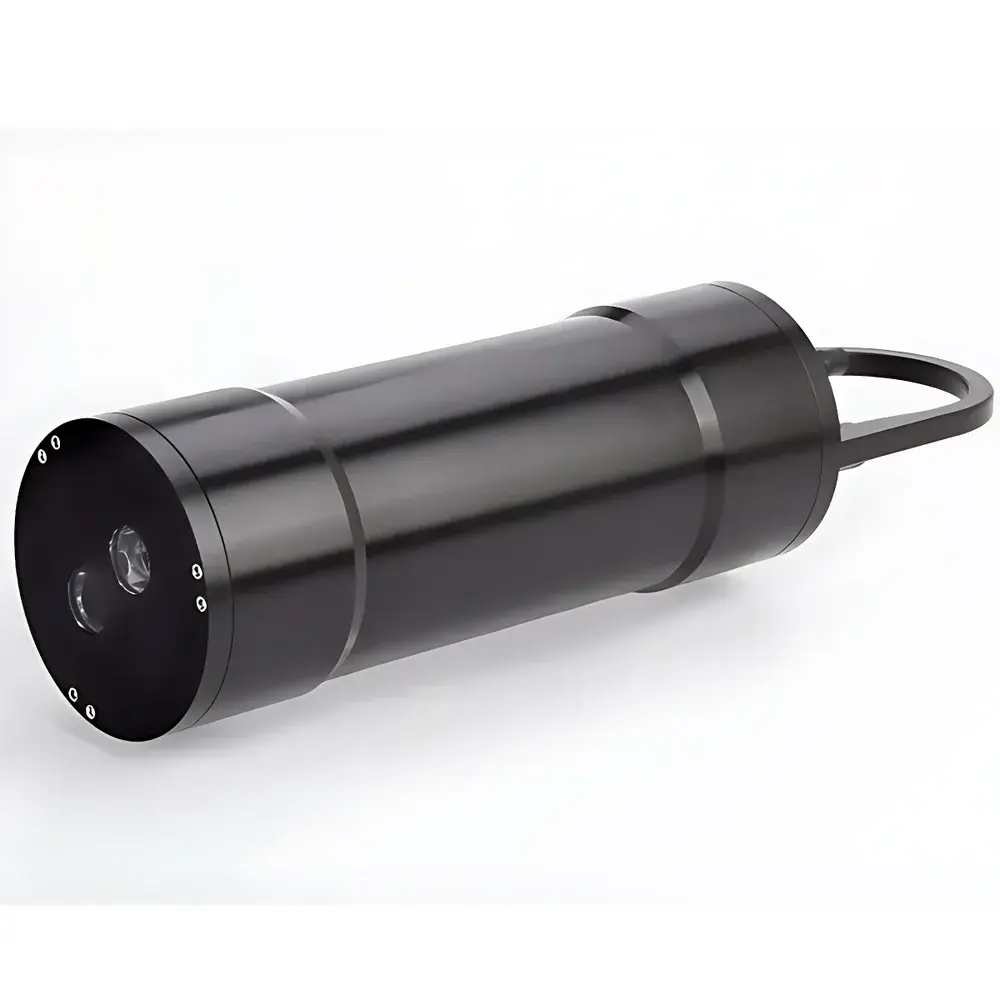
Sequoia HYPER-bb Hyperspectral Backscattering Sensor
| Brand | Sequoia |
|---|---|
| Origin | USA |
| Model | HYPER-bb |
| Spectral Range | 430–700 nm |
| Spectral Bandwidth | 9–17 nm |
| Scattering Centroid Angle | ~135° |
| Measurement Volume | ~2 mL |
| Beam Diameter | ~12 mm |
| Scan Time | 6 s (5 nm interval, 50 channels) / 15 s (10 nm interval, 27 channels) |
| Depth Rating | 600 m |
| Operating Voltage | 8–26 VDC |
| Current Draw | 750 mA @ 12 VDC |
| Communication | RS-232, 9600–115200 baud |
| Internal Storage | 1 GB |
| Temperature Range | –5 to 45 °C |
| Temp Resolution | 0.001 °C |
| Temp Accuracy | ±1 °C |
| Depth Range (seawater) | 0–600 m |
| Depth Resolution | 1 cm |
| Depth Accuracy | ±1% FS |
| Dimensions (Φ × L) | 13.4 × 51.9 cm (incl. handle) |
| Weight (air/water) | 6.0 kg / 1.2 kg |
| Optional Accessories | Calibration Tank with Stepper Motor, Profiling Frame, Lens Brush, Flow-Through Cell, Alkaline Battery Pack (12 h continuous operation) |
Overview
The Sequoia HYPER-bb Hyperspectral Backscattering Sensor is the world’s first commercially available instrument engineered to quantify spectral backscattering coefficients (bb(λ)) in aquatic environments with high angular and spectral fidelity. Based on the principle of single-angle, near-forward-backscattering measurement at a centroid angle of approximately 135°, the HYPER-bb captures volume-scattered light within a well-defined 2 mL measurement volume using a collimated 12 mm beam. Its optical design adheres to the community-standard definition of bb(λ) as defined by the Ocean Optics Community and endorsed in protocols such as IOCCG Protocols for Remote Sensing of Coastal and Inland Waters. The sensor operates across the photosynthetically active radiation (PAR) spectrum (430–700 nm), enabling direct compatibility with bio-optical models, satellite validation datasets, and radiative transfer simulations. Unlike broadband or multispectral backscattering sensors, the HYPER-bb delivers hyperspectral resolution—configurable at 5 nm or 10 nm intervals—allowing rigorous separation of scattering signatures from phytoplankton, mineral sediments, and colored dissolved organic matter (CDOM).
Key Features
- Hyperspectral acquisition from 430 nm to 700 nm with user-selectable channel spacing (5 nm or 10 nm), supporting up to 50 discrete wavelength measurements per scan
- Precision-engineered optical path optimized for scattering centroid angle of ~135°, aligned with standard bb(λ) definition per ASTM E2712 and IOCCG Technical Report No. 25
- Integrated high-stability temperature sensor (±1 °C accuracy, 0.001 °C resolution) and pressure-compensated depth sensor (±1% full scale, 1 cm resolution) co-located with optical measurement volume
- Robust titanium-alloy housing rated to 600 m seawater depth; operational weight in water: 1.2 kg (enabling stable mooring and profiling deployments)
- Onboard 1 GB non-volatile memory for autonomous logging; data retention guaranteed over extended deployment cycles without external power
- RS-232 serial interface supporting dual-baud operation (9600 baud for real-time telemetry; 115200 baud for rapid post-recovery data dump)
- Optional accessories include NIST-traceable calibration tank with motorized angular alignment, profiling frame for CTD-integrated deployments, flow-through cell for lab-based water sample analysis, and alkaline battery pack for >12 h unattended operation
Sample Compatibility & Compliance
The HYPER-bb is designed for direct immersion in natural waters—including oligotrophic open ocean, eutrophic lakes, turbid estuaries, and glacial runoff systems—without requiring sample extraction or filtration. Its 2 mL measurement volume ensures representative integration across particle size distributions typical of marine and freshwater suspensions (0.2 µm to >100 µm). The instrument complies with ISO 17025-aligned calibration traceability when used with the optional calibration tank, and supports GLP-compliant data acquisition through time-stamped, sensor-synchronized metadata embedding (temperature, depth, GPS timestamp if externally triggered). All firmware and data export workflows are compatible with US FDA 21 CFR Part 11 requirements for electronic records and signatures when deployed in regulated environmental monitoring programs.
Software & Data Management
Sequoia’s proprietary HYPER-bb Control & Analysis Suite provides end-to-end support for configuration, real-time monitoring, post-processing, and calibration. The software enables spectral smoothing, dark-current subtraction, temperature/pressure drift correction, and conversion of raw digital counts to SI-unit bb(λ) values (m−1) using factory-determined instrument response functions. Export formats include CF-compliant NetCDF, CSV with embedded metadata headers, and MATLAB-compatible .mat files. Batch processing supports inter-calibration across instrument fleets and temporal normalization against reference profiles. Audit logs record all parameter changes, calibration events, and data export actions—meeting ISO/IEC 17025 documentation requirements for accredited laboratories.
Applications
- Validation and vicarious calibration of ocean color sensors (e.g., Sentinel-3 OLCI, Landsat OLI-2, PACE HARP2)
- Development and refinement of regional bio-optical algorithms for bb(λ) inversion from remote sensing reflectance (Rrs(λ))
- Time-series monitoring of particle aggregation dynamics and sediment resuspension events in coastal zones
- Discrimination of scattering sources in mixed-water environments (e.g., phytoplankton vs. lithogenic vs. detrital contributions)
- Integration into autonomous platforms: moorings, gliders, AUVs, and profiling floats operating under Argo or GO-BGC standards
- Laboratory characterization of standardized suspensions (e.g., microspheres, diatom cultures, kaolinite) using the flow-through cell accessory
FAQ
What defines the “backscattering centroid angle” of 135°, and why is it standardized?
The 135° centroid reflects the integral-weighted mean scattering angle for the nominal bb(λ) measurement geometry, consistent with the widely adopted definition in IOCCG Protocol 2019-01. This angle balances signal strength and angular representativeness for particles dominating aquatic scattering (0.5–50 µm), minimizing sensitivity to forward-peaked artifacts while maintaining compatibility with radiative transfer models.
Can the HYPER-bb be deployed on a profiling CTD system?
Yes—the compact cylindrical form factor (13.4 cm Ø × 51.9 cm L), neutral buoyancy in seawater (1.2 kg), and RS-232 interface allow seamless integration with standard CTD frames. Sequoia provides mechanical mounting templates and synchronization pulse triggers for coordinated sampling.
Is spectral calibration traceable to NIST standards?
Factory calibration uses NIST-traceable tungsten-halogen and deuterium lamps; field recalibration is supported via the optional motorized calibration tank, which enables repeatable angular and irradiance verification per ISO/IEC 17025 Clause 6.4.
How is thermal drift compensated during long-term deployments?
The HYPER-bb performs in situ dark measurements before each spectral scan and applies real-time temperature-dependent gain correction derived from its embedded high-resolution thermistor (0.001 °C resolution), ensuring stability over multi-week deployments across thermal gradients.
Does the instrument support synchronous triggering with external sensors (e.g., fluorometers, transmissometers)?
Yes—TTL-compatible trigger input accepts external start pulses, enabling hardware-synchronized acquisition across multi-sensor packages. Timestamps are embedded in every data packet with microsecond precision relative to the host system clock.
Related Products







