
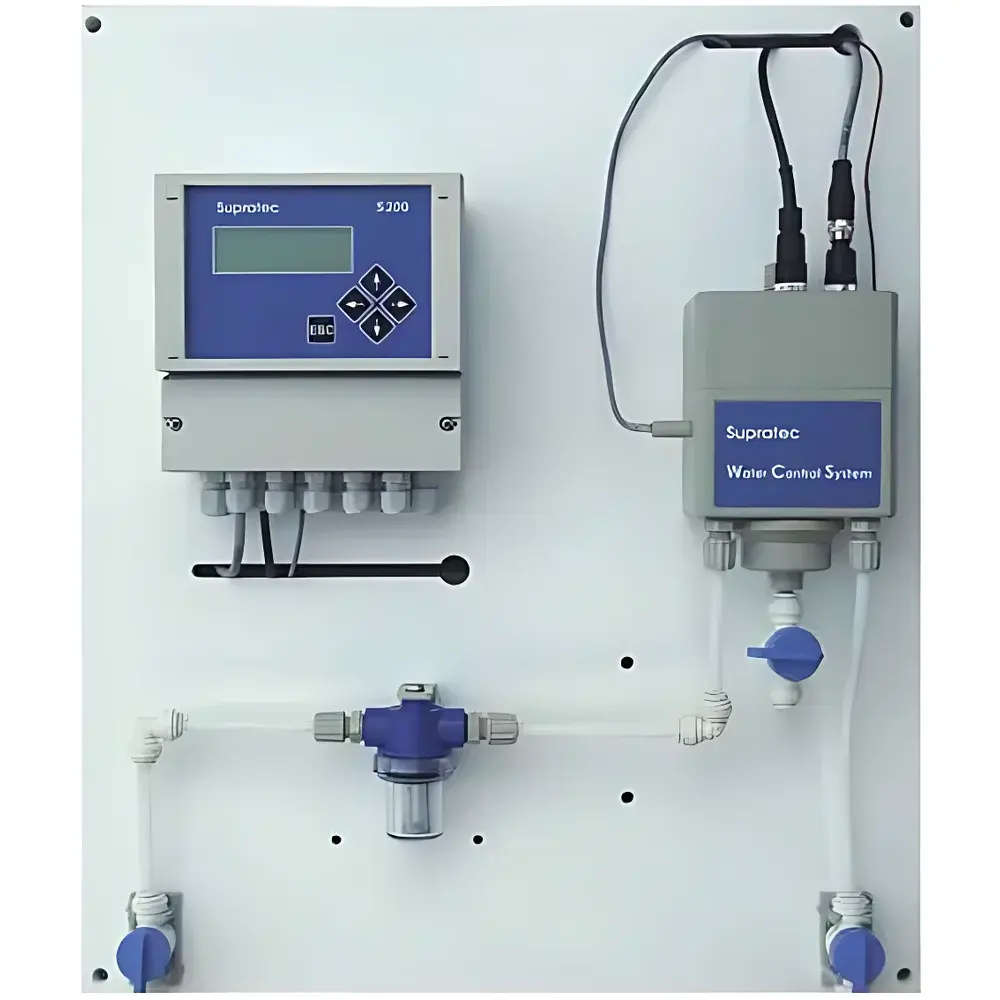
AQUALABO S200 Chlorine Dioxide Online Analyzer
| Brand | AQUALABO |
|---|---|
| Origin | France |
| Model | S200 |
| Instrument Type | Online Analyzer |
| Measurement Principle | Potentiometric (Gold Ring Electrode) |
| Measured Parameter | Chlorine Dioxide (ClO₂) |
| Range | ClO₂: 0.00–5.00 mg/L |
| pH | –2.00 to 16.00 |
| Temperature | –30.00 to 140.00 °C |
| Accuracy | ±2 % of full scale |
| Resolution | ClO₂: 0.01 mg/L |
| pH | 0.01 unit |
| Temperature | 0.1 °C |
| Response Time | ≤30 s |
| Max. Operating Pressure | 8 bar @ 20 °C |
| Max. Fluid Temperature | 70 °C |
| Flow Rate | 40–120 L/h |
| Sensor Material | Glass body with gold-ring working electrode |
| Enclosure Rating | IP65 |
| Power Supply | 110/230 VAC, ±10 %, 50/60 Hz |
| Power Consumption | 16 VA |
| Dimensions (Analyzer) | 160 × 165 × 85 mm |
| Weight | 1.1 kg |
| Display | 4×20-character backlit LCD |
| Analog Outputs | 2 × isolated 4–20 mA (max. 600 Ω load) |
| Digital Inputs | 2 (including pulse input for flow meter) |
| Relay Outputs | 3 configurable (NO/NC/C, 120–240 VAC, 2 A) |
| Digital Outputs | 2 programmable dry-contact outputs (≤12 V, 200 mA) |
| Control Functions | Dual independent on/off, P or PI control, pulse-pause, frequency, and continuous analog output modes |
| Operating Temp. | –20 to 55 °C (≤90 % RH at 40 °C, non-condensing) |
| Storage Temp. | –20 to 65 °C |
Overview
The AQUALABO S200 Chlorine Dioxide Online Analyzer is a fully integrated, potentiometric measurement system engineered for continuous, reagent-free monitoring of aqueous chlorine dioxide (ClO₂) concentration in real time. Based on a stable gold-ring reference electrode architecture and electrochemical potential detection, the S200 operates without chemical reagents, mechanical wipers, or sample diversion—eliminating secondary contamination, maintenance downtime, and consumable costs. Its robust design supports direct in-line installation in pressurized water circuits up to 8 bar at 20 °C, with operational compatibility across a broad thermal range (–30 to 140 °C) and pH spectrum (–2 to 16). The analyzer incorporates automatic temperature and pH compensation algorithms, ensuring measurement integrity under variable process conditions. An integrated pressure-regulation module maintains consistent hydraulic loading across the sensing chamber, contributing to long-term signal stability and repeatability. As a CE-marked instrument compliant with EN 61326-1 (EMC) and EN 61010-1 (safety), the S200 meets foundational requirements for deployment in regulated industrial and municipal water infrastructure.
Key Features
- Potentiometric ClO₂ detection using a glass-bodied sensor with inert gold-ring working electrode—no membrane replacement or electrolyte refilling required
- True zero-maintenance operation: self-cleaning via periodic voltage polarization eliminates fouling from colloids, calcium carbonate, iron oxides, organic films, and biofilm
- Simultaneous, synchronized measurement of ClO₂, pH, and temperature—each parameter independently calibrated and compensated in real time
- Two isolated 4–20 mA analog outputs with configurable scaling, supporting integration into DCS, SCADA, or PLC-based control architectures
- Dual independent PID-capable controllers with adjustable hysteresis, enabling closed-loop dosing control for ClO₂ generators or hypochlorite feed systems
- Modbus RTU slave interface for bidirectional data exchange, facilitating centralized telemetry, remote configuration, and audit-trail logging in GLP/GMP environments
- IP65-rated wall-mount enclosure with 4×20-character alphanumeric LCD and tactile keypad—designed for unattended operation in utility corridors, pump stations, and treatment plant control rooms
Sample Compatibility & Compliance
The S200 is validated for use in potable water, wastewater effluent, industrial cooling water, pharmaceutical process water, and food-grade rinse streams. It complies with ISO 7888 (water quality — determination of residual chlorine compounds), and its measurement methodology aligns with ASTM D1253 and EPA Method 334.1 for oxidant quantification. While not certified to USP or FDA 21 CFR Part 11 out-of-the-box, its digital I/O architecture, event-logged relay actions, and Modbus transaction history support validation protocols required for GxP-compliant facilities when implemented with appropriate SOPs and electronic record controls. All wetted materials—including sensor housing, O-rings (EPDM), and flow cell components—meet NSF/ANSI Standard 61 for drinking water system components.
Software & Data Management
The embedded firmware provides non-volatile storage of calibration logs, alarm events, controller setpoints, and sensor diagnostics. Each analog output can be assigned to any measured or derived parameter (e.g., compensated ClO₂, deviation from target, or calculated oxidation-reduction potential). Relay outputs support configurable high/low alarms with user-defined delay timers and latching behavior. The Modbus RTU interface exposes over 120 registers covering real-time values, historical min/max, calibration coefficients, and hardware status flags (e.g., sensor impedance, temperature drift, cleaning cycle counter). When interfaced with supervisory software such as Ignition SCADA or Siemens Desigo CC, the S200 enables automated trend analysis, deviation reporting, and preventive maintenance scheduling based on sensor health metrics—not just raw readings.
Applications
- Municipal drinking water disinfection: real-time feedback for ClO₂ generator modulation at primary treatment and booster stations
- Secondary distribution network monitoring: early detection of residual decay, nitrification risk, or cross-connection events
- Industrial wastewater disinfection: compliance verification for discharge permits requiring ClO₂ residuals prior to environmental release
- Cooling tower and boiler feedwater management: optimization of biocide dosing to minimize corrosion while maintaining microbial control
- Pharmaceutical purified water (PW) and water-for-injection (WFI) loop monitoring: verification of sanitization efficacy during periodic hot or ozone-based cycles
- Food & beverage CIP rinse validation: confirmation of oxidative residue removal before equipment reuse
FAQ
Does the S200 require daily calibration or manual cleaning?
No. The analyzer performs autonomous electrochemical cleaning cycles at user-configurable intervals (e.g., every 2–24 hours), restoring baseline potential without operator intervention. Field calibration is recommended quarterly using NIST-traceable ClO₂ standards.
Can the S200 operate in seawater or high-TDS brines?
It is rated for conductivity up to 5 mS/cm. For applications exceeding this (e.g., desalination reject streams), optional sensor variants with titanium housings and custom electrode geometry are available upon request.
Is temperature compensation applied automatically during ClO₂ measurement?
Yes. The Pt1000 RTD is integrated directly into the flow cell, and compensation follows the Arrhenius-derived relationship between ClO₂ redox potential and thermal energy—embedded in firmware per ISO 15839 Annex B.
What happens if the flow rate falls below 40 L/h?
The system triggers a low-flow alarm and suspends reporting until nominal flow is restored; this prevents stagnant-sample artifacts and ensures representative measurement kinetics.
How is data integrity ensured during power interruption?
All critical parameters—including calibration constants, controller configurations, and last valid measurement—are retained in EEPROM. Upon restart, the device resumes operation within 45 seconds without manual reset.







