
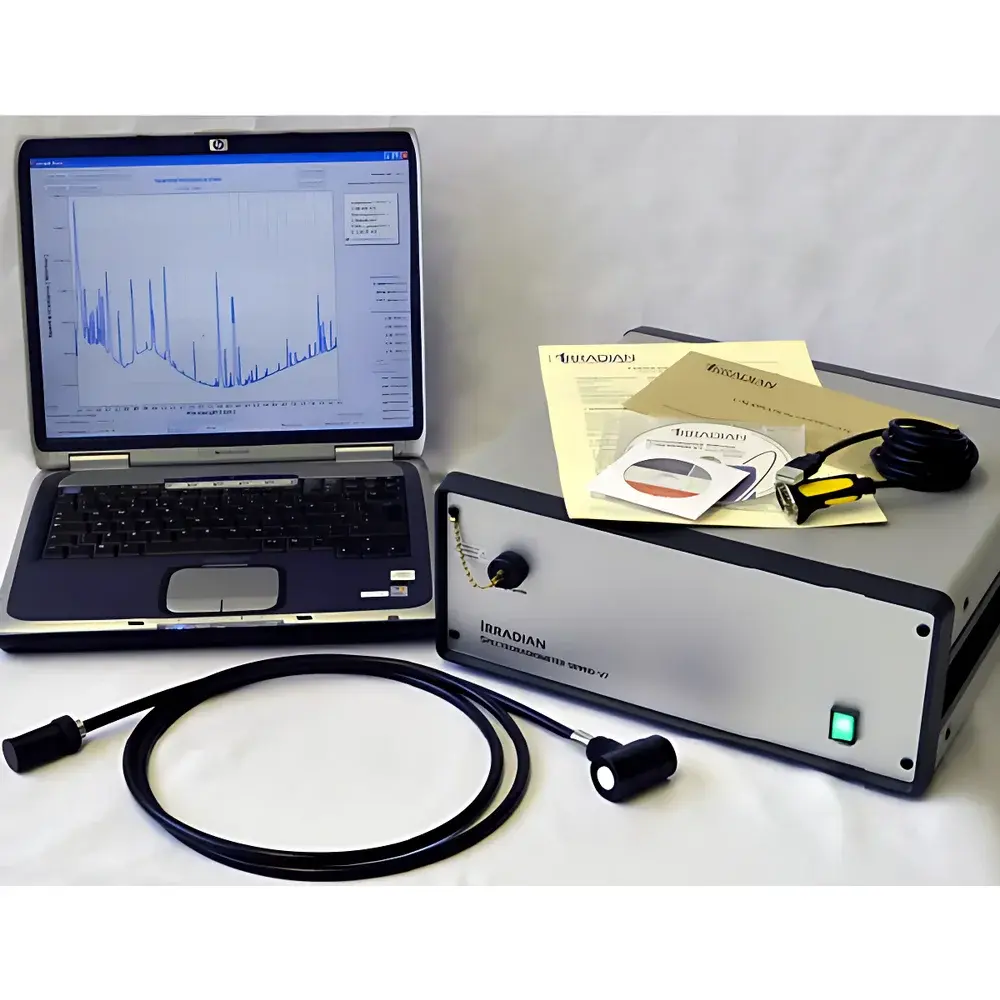
Macam SR9910-V7 UV-Vis-NIR Spectroradiometer
| Brand | Macam |
|---|---|
| Origin | United Kingdom |
| Model | SR9910-V7 |
| Spectral Range | 240 nm – 800 nm |
| Optical Resolution (FWHM) | 0.25 nm |
| Slit Width Options | 2 nm (standard), 1 nm (optional) |
| Wavelength Accuracy | ±0.5 nm |
| Stray Light | <2 × 10⁻⁷ |
| Detector | Thermoelectrically Cooled Multi-Alkali Photomultiplier Tube (PMT) |
| Input Optics | Fiber-Coupled with Cosine Corrector (±3°–70° angular response) |
| Monochromator | Dual-Grating, 100 mm Focal Length |
| Filter Wheel | 4-position |
| Integration Time Range | Adjustable from 1 ms to 10 s (software-controlled) |
| Data Interface | USB 2.0 (with RS-232 adapter included) |
| Dimensions | 36 cm × 36 cm × 16 cm |
| Weight | 10.1 kg |
| Power Supply | 12 V DC |
Overview
The Macam SR9910-V7 is a high-performance spectroradiometer engineered for precision measurement of spectral irradiance and radiance across the ultraviolet, visible, and near-infrared (UV-Vis-NIR) spectrum (240–800 nm). Based on a fiber-coupled, dual-grating scanning monochromator architecture, it delivers laboratory-grade spectral fidelity in field-deployable form. Light enters via a NIST-traceable cosine diffuser (±3° to 70° angular acceptance), is guided through a 1-meter fused silica optical fiber, and dispersed by a thermally stabilized 100 mm focal length monochromator. Wavelength selection is executed via stepper-motor-driven grating rotation, controlled in real time through USB-connected Windows 10 software. Detection relies on a thermoelectrically cooled multi-alkali photomultiplier tube (PMT), providing high quantum efficiency in the UV and low-noise performance across the full range. All raw signals undergo analog integration, digitization, and post-acquisition correction using factory-provided calibration coefficients—ensuring traceable, SI-referenced radiometric output without user intervention.
Key Features
- Fiber-optic coupling enables flexible optical configuration: measurements can be performed remotely, in confined spaces, or under harsh environmental conditions.
- Dual-grating monochromator design minimizes stray light (<2 × 10⁻⁷) and supports high spectral purity—critical for accurate UV irradiance quantification in photobiological safety and lamp characterization.
- Thermoelectric cooling of the PMT stabilizes dark current and improves signal-to-noise ratio, especially during long integrations required for low-flux sources (e.g., solar UV monitoring or LED aging studies).
- Programmable cosine diffuser ensures compliance with CIE S 023/E:2013 and ISO/CIE 13370 for hemispherical irradiance measurement, with angular response validated to ±3° at 0° and ±70° at grazing incidence.
- Integrated 4-position filter wheel allows automatic insertion of order-sorting or bandpass filters—essential for eliminating second-order spectral artifacts above 400 nm.
- Full USB 2.0 interface with embedded RS-232 adapter ensures compatibility with modern industrial PCs and legacy control systems alike.
Sample Compatibility & Compliance
The SR9910-V7 accommodates diverse radiation sources without hardware modification: broadband lamps (Hg/Xe arcs, deuterium, halogen), narrowband emitters (UV-LEDs, laser diodes), and natural daylight. Its modular accessories—including optional radiance telescopes, extended-length quartz fibers (1–10 m), and external broadband monitor inputs—support both irradiance (W·m⁻²·nm⁻¹) and radiance (W·sr⁻¹·m⁻²·nm⁻¹) modes per CIE 127:2007 and IEC 62471. Calibration is traceable to NPL (UK) standards and documented in an ISO/IEC 17025-accredited certificate supplied with each unit. The system meets requirements for GLP-compliant photometric validation and supports audit-ready data logging when used with configured software settings compliant with FDA 21 CFR Part 11 (electronic records/signatures) upon user-defined configuration.
Software & Data Management
The native Windows 10 application provides complete instrument control and quantitative analysis without third-party dependencies. Core functions include programmable scan parameters (start/stop wavelength, step size, integration time, delay-on-start), real-time single-wavelength time-series logging, and multi-curve overlay with independent axis scaling (linear/logarithmic, radiometric/photometric/quantum). Mathematical operations—averaging, normalization, interpolation, ratioing, and spectral subtraction—are applied non-destructively to loaded datasets. All scans are auto-named using timestamped conventions (e.g., “SR9910V7_20240522_143201.irr”) and stored in vendor-neutral CSV format. Export to Microsoft Excel is one-click enabled; no proprietary binary formats are used. Calibration files are embedded within the software environment and automatically applied during data reduction—eliminating manual coefficient entry errors.
Applications
- Solar UV monitoring for environmental health studies and erythemal dose modeling (CIE ERY action spectrum weighting).
- Phototherapy lamp validation per IEC 60601-2-57 and EN 62471, including UVA/UVB spectral power distribution verification.
- LED and OLED spectral stability testing under accelerated aging protocols (e.g., IEC TR 62778).
- Photolithography mercury arc lamp spectral profiling for exposure uniformity assessment in semiconductor manufacturing.
- Material photostability screening per ISO 4892-2 (Xenon arc) and ASTM G154 (UV fluorescent lamp), where precise actinic UV flux quantification is required.
- Calibration transfer between reference and field instruments in metrology labs accredited to ISO/IEC 17025.
FAQ
What calibration standards are used for the SR9910-V7?
Each unit is calibrated against NPL-traceable tungsten halogen and deuterium standard lamps. Certificate includes spectral responsivity, linearity, and stray light characterization—fully compliant with ISO/IEC 17025.
Can the SR9910-V7 measure absolute radiance without additional hardware?
Yes—when paired with the optional radiance telescope accessory and calibrated radiance standard, the system delivers absolute radiance (W·sr⁻¹·m⁻²·nm⁻¹) with expanded uncertainty <3.5% (k=2) across 250–780 nm.
Is the software compatible with Windows 11 and 64-bit architectures?
The current release supports Windows 10 (64-bit) and Windows 11 (64-bit); driver signing and .NET Framework 4.8 dependencies are fully satisfied.
How is thermal drift managed during extended measurements?
The monochromator housing incorporates passive thermal mass stabilization, while the PMT’s thermoelectric cooler maintains detector temperature within ±0.1 °C—verified over 8-hour continuous operation.
Does the system support automated compliance reporting for IEC 62471?
The software includes built-in action spectrum weighting (e.g., UV hazard, blue light, retinal thermal) and generates summary reports aligned with IEC 62471 Annex B tables—exportable as PDF or CSV.
Related Products







