
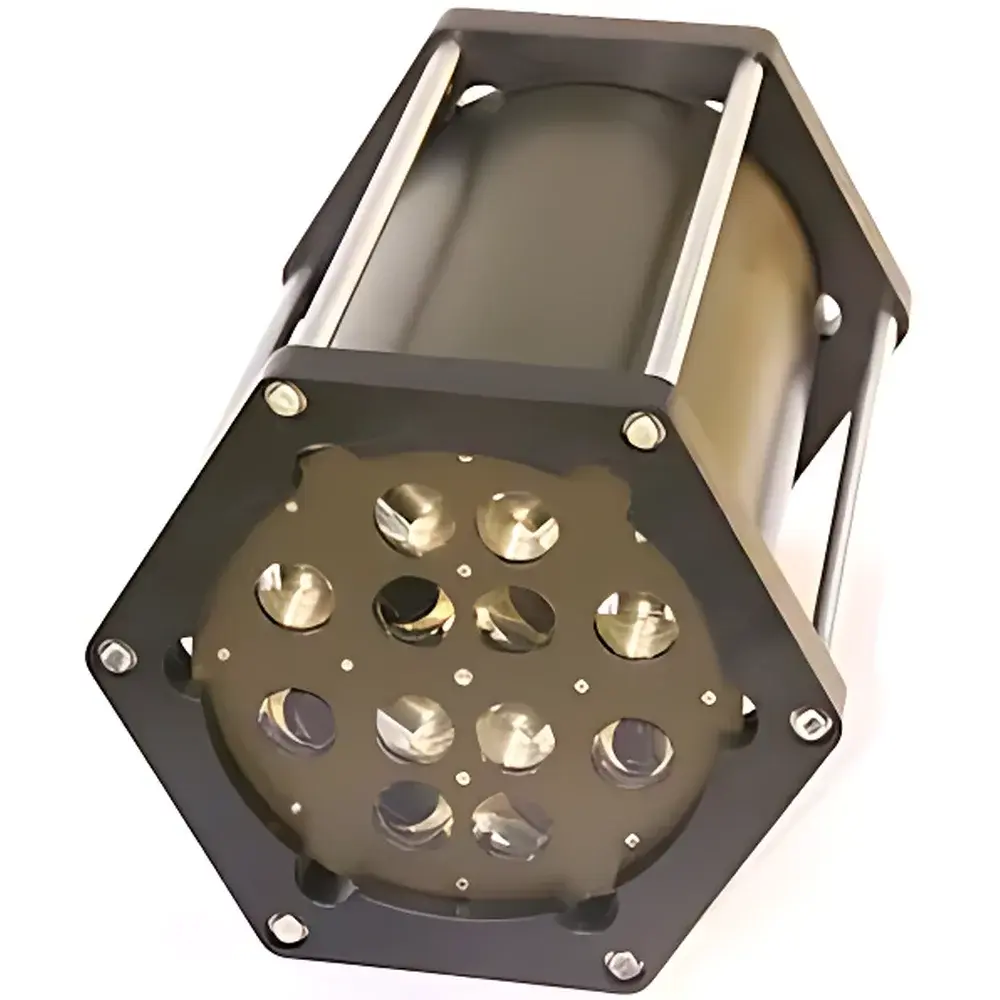
HydroScat-6P Multi-Spectral Backscattering Sensor by HOBI Labs
| Brand | HOBI Labs |
|---|---|
| Origin | USA |
| Model | HydroScat-6P |
| Optical Geometry | 140° backscatter angle |
| Wavelengths | 6 standard (420, 442, 470, 510, 590, 700 nm) + optional extended bands |
| Fluorescence Channels | 700 nm (excited at 442 nm), 510 nm (excited at 420 nm) |
| Spectral Bandwidth | 10 nm (20 nm @ 676 nm |
| Depth Rating | 330 m standard, 550 m optional |
| bb Noise | 2×10⁻⁵–2×10⁻⁴ m⁻¹ RMS |
| bb Offset Uncertainty | 5×10⁻⁵–5×10⁻⁴ m⁻¹ RMS |
| Dimensions | 20.3 cm Ø × 34.5 cm L |
| Weight | 8.4 kg (air), 5.0 kg (water) |
| Power | Rechargeable 12 V battery (10–15 V input), max 3 W |
| Battery Life | ≥20 h continuous, extended in pulsed mode |
| Data Storage | 256 KB standard (expandable to 128 MB), supports ~7,000 spectra + depth records |
| Sampling Interval | 0.1–30,000 s |
| Interface | SubConn MCBH8M / MCIL8F |
| Operating Temperature | 0–35 °C |
| Calibration | In-lab user-performed via four-step protocol (baseline, dark offset, mu, gain ratio) |
| Compliance | Designed for ASTM D7315, ISO 13122, and NASA SeaBASS-compatible data workflows |
Overview
The HydroScat-6P Multi-Spectral Backscattering Sensor is a self-contained, submersible optical instrument engineered for high-fidelity in situ measurement of volume backscattering coefficients (bb(λ)) and fluorescence signals across six discrete spectral channels. Developed by HOBI Labs (USA), it operates on the principle of angularly resolved backscattering detection at a fixed scattering angle of 140°—a geometry optimized for robust retrieval of bb in natural aquatic environments while minimizing near-field artifacts and path-length variability. Unlike broadband turbidity sensors, the HydroScat-6P delivers spectrally resolved bb data traceable to SI units (m⁻¹), enabling direct integration into radiative transfer models, bio-optical inversion algorithms, and satellite validation protocols. Its dual-capability design—simultaneous bb and fluorescence acquisition—supports correlative analysis between particle scattering properties and phytoplankton pigment signatures, particularly chlorophyll-a (via 442 nm excitation → 700 nm emission) and CDOM-associated fluorescence (via 420 nm excitation → 510 nm emission). The sensor’s long-standing deployment history (>10 years) reflects its proven reliability in moored, profiling, and AUV-mounted configurations across estuarine, coastal, lacustrine, and open-ocean settings.
Key Features
- Multi-spectral bb measurement at six factory-aligned wavelengths: 420, 442, 470, 510, 590, and 700 nm—with optional extended band selection up to 13 wavelengths including 394 nm and 852 nm.
- Dual-channel fluorescence detection: synchronized excitation/emission pairs for chlorophyll-a (442/700 nm) and general organic fluorophores (420/510 nm), with dedicated bandpass filtering and Si photodetector optimization.
- Self-contained architecture: integrated rechargeable battery pack (12 V, 10–15 V tolerance), internal data logger (256 KB base memory, expandable to 128 MB), and non-volatile storage supporting >7,000 full-spectrum records with depth-stamped metadata.
- Five-stage automatic gain control: dynamically adjusts detector amplification to maintain signal fidelity across bb ranges spanning 10⁻⁵ to 10⁻² m⁻¹ without manual intervention.
- Sigma correction algorithm embedded in firmware: compensates for instrumental polarization sensitivity and LED intensity drift, reducing systematic uncertainty in bb retrievals by up to 15% under variable thermal or pressure conditions.
- Field-deployable calibration suite: supports full four-step in-lab calibration (baseline, dark offset, mu coefficient, gain ratio) using HOBI-provided calibration fixtures—no external lab service required.
- Robust mechanical design: titanium-housed pressure vessel rated to 330 m (optionally 550 m), 20.3 cm diameter × 34.5 cm length, neutrally buoyant in seawater (5.0 kg submerged).
Sample Compatibility & Compliance
The HydroScat-6P is validated for operation in freshwater, brackish, and marine matrices—including highly turbid estuaries, chromophoric dissolved organic matter (CDOM)-rich lakes, and oligotrophic oceanic waters. Its 140° scattering geometry minimizes sensitivity to bubble interference and small-angle forward scatter contamination, making it suitable for profiling applications where traditional 90° or 180° instruments exhibit elevated noise floors. The sensor conforms to optical measurement best practices outlined in ASTM D7315 (Standard Test Method for Determination of Volume Scattering Function of Water), ISO 13122 (Water quality — Measurement of light scattering), and NASA’s SeaBASS metadata standards. While not intrinsically GLP/GMP-certified, its deterministic calibration traceability, audit-ready logging (timestamped raw counts, gain state, temperature, pressure), and firmware-implemented Sigma correction support compliance with QA/QC requirements for environmental monitoring programs subject to EPA, NOAA, or EU WFD reporting frameworks.
Software & Data Management
Data acquisition and configuration are managed via HOBI’s HydroView™ software (Windows-based), which supports real-time telemetry over RS-232 (or RS-485 with adapter), command-line scripting, and automated mission scheduling. All raw digital counts, gain settings, thermistor readings, and pressure timestamps are stored in binary format with embedded header metadata compliant with netCDF-4 conventions upon export. The software includes built-in bb conversion routines applying manufacturer-supplied mu coefficients and dark-offset corrections. For turbidity derivation, HydroView implements the empirically validated NTU = Kntu × bb(λ) relationship, with wavelength-specific Kntu values preloaded (e.g., 24.2 at 420 nm; 58.5 at 700 nm) and an interpolation function for non-standard bands (Kntu = 32.7 × (λ/500)1.73). Export options include CSV, MATLAB .mat, and SeaBASS-compliant ASCII formats. Firmware updates and calibration file management are performed through secure USB-to-serial interface; no internet connection is required for field recalibration.
Applications
- Optical modeling: Input of spectrally resolved bb data into Hydrolight, EcoSim, or custom Monte Carlo radiative transfer codes to simulate underwater light fields and validate inherent optical property (IOP) parameterizations.
- Backscattering coefficient inversion: Coupling with absorption (a(λ)) measurements from AC-S or ECO-series sensors to derive particulate backscattering ratios (bbp/bp) and infer particle size distribution (PSD) and composition.
- Ocean color remote sensing validation: Match-up datasets for VIIRS, Sentinel-3 OLCI, and PACE mission vicarious calibration—particularly critical for atmospheric correction and bb-driven water class discrimination.
- Estuarine and coastal dynamics: Quantifying resuspension events, sediment plume tracking, and flocculation kinetics via high-temporal-resolution bb time series at multiple wavelengths.
- Lake and reservoir monitoring: Correlating bb(470) and bb(700) with suspended mineral vs. organic load; detecting cyanobacterial blooms via concurrent 700 nm fluorescence and 442 nm bb anomalies.
- Autonomous platform integration: Native compatibility with Slocum gliders, Wave Gliders, and Nortek Aquadopp profilers via serial command protocol and low-power sleep/wake cycling.
FAQ
What is the significance of the 140° scattering angle?
The 140° geometry balances signal strength and angular specificity: it avoids the dominant forward lobe (<30°) where Mie theory assumptions break down, excludes the specular reflection peak at 180°, and captures a region where bb exhibits strong correlation with particle size and refractive index—making it optimal for inversion-based IOP retrieval.
Can the HydroScat-6P be used for turbidity reporting in regulatory compliance?
Yes—when paired with the validated Kntu coefficients, bb outputs are directly convertible to NTU equivalents per ASTM D7315 Annex A3; however, users must document calibration frequency (recommended every 6 months or after storage >30 days) and apply temperature/pressure corrections as specified in the user manual.
How is dark current stability maintained during long deployments?
The instrument performs autonomous dark offset acquisition at user-defined intervals (e.g., every 100 profiles); combined with thermal drift compensation in firmware, this ensures RMS offset uncertainty remains within 5×10⁻⁵ m⁻¹ over 30-day missions at constant temperature.
Is firmware upgrade capability available in situ?
No—firmware updates require physical connection to a Windows host via RS-232 and the HydroView™ utility; however, all calibration parameters, sampling schedules, and gain tables can be modified remotely via serial command set without firmware change.
What is the recommended procedure for post-deployment data validation?
HOBI recommends comparing pre- and post-deployment dark offsets and baseline stability; reviewing raw count histograms for saturation or clipping; and cross-checking bb trends against co-located CTD or OBS data to identify biofouling-induced drift exceeding 0.5% per week.
Related Products







