
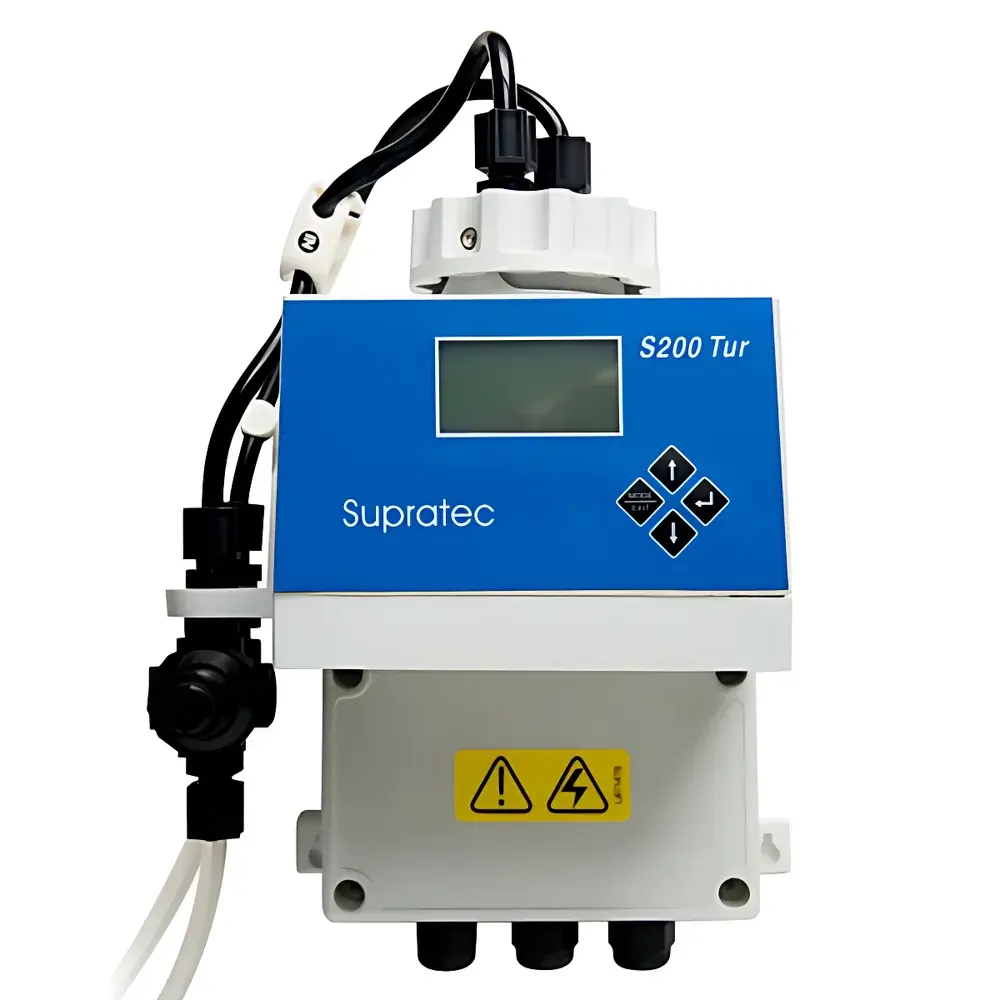
AQUALABO S200 TUr Online Turbidimeter
| Brand | AQUALABO |
|---|---|
| Origin | France |
| Model | S200 TUr |
| Instrument Type | Online |
| Turbidity Range | 0–10 NTU and 0–100 NTU |
| Measurement Principle | Nephelometric (90° scattered light, ISO 7027 compliant) |
| Resolution | 0.0001 NTU (0–10 NTU range) |
| Accuracy | ±2% of reading or ±0.02 NTU (0–40 NTU) |
| Response Time | 5–500 s |
| Sample Temperature Range | 1–50 °C |
| Operating Pressure Range | 104–1380 kPa (15–200 psi, factory-set default 15 psi) |
| Flow Rate | 100 mL/min–1 L/min |
| Analog Output | 4–20 mA (galvanically isolated, max. load 600 Ω) |
| Digital Interface | RS485 Modbus RTU |
| Relay Outputs | 2 configurable (NO/NC/C, 120–240 VAC, 2 A) |
| Power Supply | 100–240 VAC, 47–63 Hz, 80 VA |
| Display | 4×20-character backlit alphanumeric LCD |
| Enclosure Rating | IP66 |
| Weight | 2.5 kg |
| Environmental Limits | Indoor use only |
| Compliance | ISO 7027, CE, ETL Listed to UL 61010-1, CSA C22.2 No. 1010-1 |
Overview
The AQUALABO S200 TUr is an online turbidimeter engineered for continuous, high-stability monitoring of low-to-moderate turbidity in potable water, process water, and treated effluent streams. It operates on the nephelometric principle defined in ISO 7027:2016 — measuring the intensity of light scattered at a 90° angle from a collimated infrared beam passing through the sample. This optical configuration minimizes interference from color, particle absorption, and stray light, ensuring metrological traceability and long-term repeatability in regulated environments. Unlike white-light systems, the S200 TUr employs a stable infrared LED source, eliminating spectral drift and enabling consistent calibration across instrument lifecycles. Its integrated pressure regulation module (104–1380 kPa) maintains laminar flow conditions within the measurement chamber, critical for minimizing bubble entrapment and sediment disturbance during real-time operation.
Key Features
- Integrated ultrasonic cleaning system that automatically activates at user-defined intervals to prevent fouling of the optical windows and maintain signal integrity over extended deployments.
- Compact, low-volume measurement cell (<15 mL) optimized for rapid response (T90 as low as 5 s), essential for detecting transient turbidity spikes in filtration breakthrough events.
- Pressure-regulated flow path with built-in adjustable regulator (factory preset to 15 psi / 104 kPa), compatible with pressurized distribution networks without external booster pumps.
- Robust single-body housing (IP66-rated) combining sensor, electronics, and display in one sealed unit — reducing installation complexity and eliminating cable interface points prone to moisture ingress.
- Fail-safe optical design: infrared emitter and photodetector are mechanically decoupled from thermal expansion effects and protected against mechanical shock and condensation-induced lens fogging.
- Front-panel 4-key navigation and 4×20-character backlit LCD enable local configuration, alarm acknowledgment, and real-time diagnostics without external software.
Sample Compatibility & Compliance
The S200 TUr is validated for aqueous matrices with suspended solids ranging from colloidal clay and diatomaceous earth to coagulated flocs and biofilm fragments. It meets ISO 7027 requirements for wavelength (860 nm ±30 nm), detector angular acceptance (±30° around 90°), and stray light rejection (>40 dB). The instrument carries CE marking under the EU Electromagnetic Compatibility and Low Voltage Directives, and is ETL certified to UL 61010-1 and CSA C22.2 No. 1010-1 for safety in laboratory and industrial control environments. While not intrinsically rated for hazardous locations, its IP66 enclosure and galvanically isolated 4–20 mA output support deployment in damp utility rooms, pump stations, and cleanroom perimeter monitoring zones. Calibration verification is supported via optional certified formazin or AMCO-AE standards traceable to NIST SRM 2102.
Software & Data Management
Data acquisition and alarm management are handled locally via the onboard microcontroller; no external PC or proprietary software is required for basic operation. The RS485 Modbus RTU interface enables seamless integration into SCADA, DCS, or PLC-based supervisory systems (e.g., Siemens SIMATIC, Rockwell Automation ControlLogix, or Schneider EcoStruxure). All relay actions — including high/low limit alarms and maintenance alerts — are timestamped and logged in non-volatile memory with configurable retention (up to 30 days). The analog output supports linear or square-root scaling per user specification, facilitating compatibility with legacy chart recorders or analog input modules lacking digital communication capability. Audit trails for calibration events, parameter changes, and alarm resets are retained in accordance with GLP-aligned data integrity practices, though full 21 CFR Part 11 compliance requires external validation of the host control system.
Applications
- Municipal drinking water treatment: real-time monitoring of raw intake, flocculation basin effluent, sand filter backwash clarity, clearwell outlet, and distribution system nodes — supporting early detection of filter failure or pipe corrosion events.
- Wastewater reclamation: post-tertiary filtration and membrane bioreactor (MBR) permeate quality assurance, particularly where turbidity serves as a surrogate for pathogen removal efficiency (per US EPA Guidance Manual for Validation of Membrane Filtration Plants).
- Industrial process water: closed-loop cooling tower make-up, pharmaceutical purified water (PW) and water-for-injection (WFI) distribution loop surveillance, and beverage rinse-water clarity verification prior to bottling.
- Swimming pool and spa management: automated dosing control linked to turbidity-triggered backwash cycles and coagulant feed optimization.
FAQ
What turbidity standards are recommended for calibration and verification?
NIST-traceable AMCO-AE polymer suspension or formazin standards (e.g., StablCal® 0.1, 1.0, 10, and 100 NTU) are recommended. Calibration should be performed at two points spanning the intended operating range (e.g., 0.1 and 10 NTU for low-range applications).
Can the S200 TUr operate continuously under variable inlet pressure?
Yes — the integrated pressure regulator maintains constant measurement chamber pressure regardless of upstream fluctuations between 104 kPa and 1380 kPa, provided minimum flow rate (100 mL/min) is sustained.
Is the ultrasonic cleaning cycle programmable?
Yes — cleaning frequency, duration, and activation trigger (time-based or turbidity-hysteresis) are configurable via the front-panel interface or Modbus register mapping.
Does the instrument support temperature compensation?
No — the S200 TUr does not apply automatic temperature correction, as ISO 7027 specifies measurement at 25 °C and defines turbidity as a temperature-independent optical property; users must ensure sample temperature remains within 1–50 °C per specification.
How is maintenance access designed for field service?
The optical chamber is accessible via a single captive screw; quartz windows are replaceable without recalibration. All electronics reside behind a gasketed front panel, and the ultrasonic transducer is potted for lifetime reliability without scheduled replacement.
Related Products







