
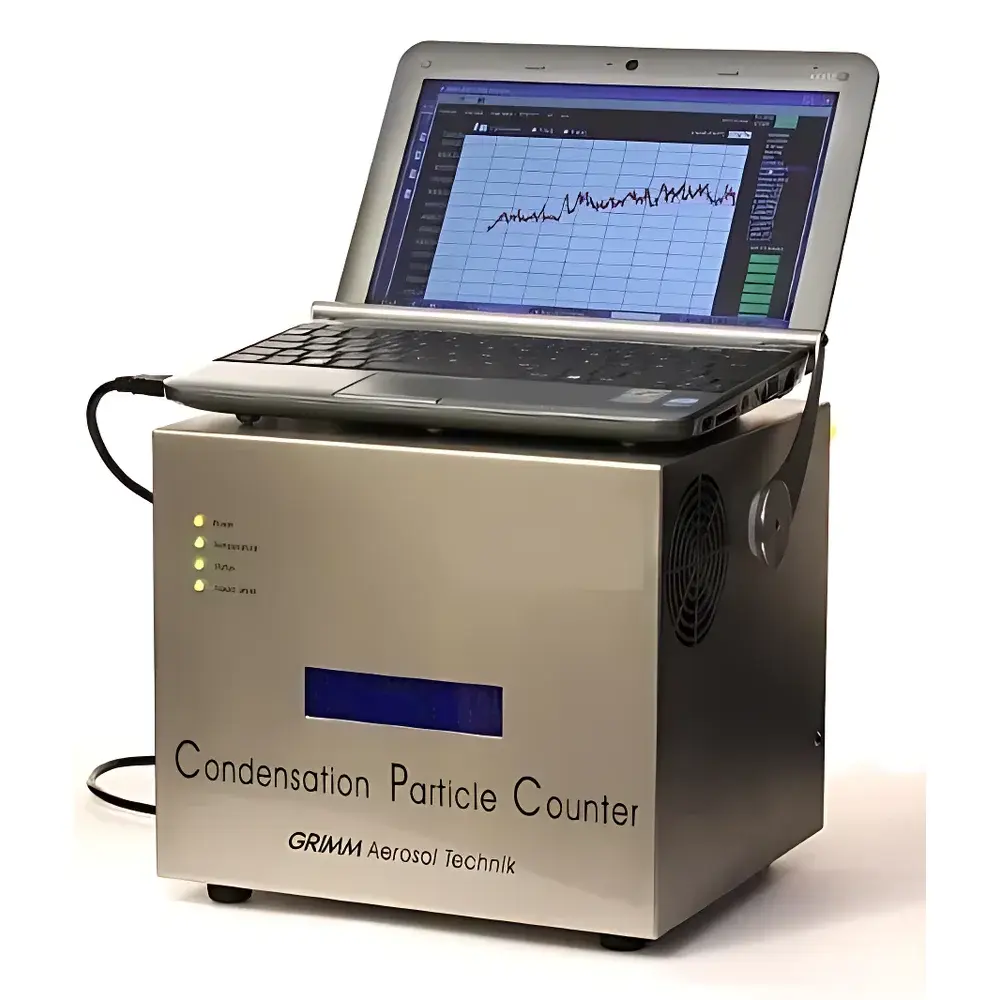
GRIMM 5412 Mobile Condensation Particle Counter (CPC)
| Brand | GRIMM |
|---|---|
| Origin | Germany |
| Model | 5412 |
| Instrument Type | Laboratory |
| Flow Rate | 0.6 L/min |
| Detection Limit (D50) | 4.0 nm (using tungsten oxide particles) |
| Concentration Range | 0–10⁵ P/cm³ (single-particle counting mode), 0–10⁷ P/cm³ (photometric mode) |
| Accuracy | ±5% (counting mode), ±10% (photometric mode) |
| Response Time (t₁₀–t₉₀) | <3 s |
| Sheath Air Flow | 3 L/min |
| Working Fluid | n-Butanol |
| Operating Temperature | 10–40 °C |
| Power Supply | 90–264 VAC, 47–63 Hz, 80–130 W |
| Dimensions | 23 × 25 × 29 cm |
| Weight | 8.9 kg |
Overview
The GRIMM 5412 Mobile Condensation Particle Counter (CPC) is a high-precision, compact aerosol instrumentation system engineered for real-time detection and quantification of ultrafine particles in the nanometer size range. Based on the well-established condensation nucleation principle, the instrument grows sub-visible nanoparticles via controlled supersaturation of n-butanol vapor, enabling optical detection of individual particles as they pass through a laser beam. Its core design targets applications requiring mobility, field-deployable reliability, and metrological traceability—particularly where particle number concentration below 10 nm is critical. With a verified 50% detection efficiency (D50) at 4.0 nm using tungsten oxide reference aerosols—and adjustable to 7.0 nm to comply with CEN/TS 16976:2016 for atmospheric aerosol characterization—the 5412 meets stringent requirements for fundamental aerosol science and regulatory-aligned monitoring.
Key Features
- Integrated, temperature-stabilized critical orifice and volumetric flow control ensures constant sample flow (0.6 L/min) independent of ambient pressure and temperature fluctuations.
- Dual-mode operation: single-particle counting up to 105 P/cm³ and photometric (light-scattering-integrated) mode extending dynamic range to 107 P/cm³.
- Optimized saturator architecture with integrated louvers enables safe transport without removal of the saturated wick—eliminating downtime and contamination risk.
- Continuous condensate removal via micro-peristaltic pump maintains long-term operational stability under high-humidity conditions (up to 95% RH, non-condensing).
- Robust thermal management supports continuous operation at ambient temperatures up to 40 °C—validated for extended field deployments including vehicle-mounted and rooftop monitoring setups.
- Onboard diagnostics and automated self-check routines ensure measurement integrity and reduce operator dependency on external calibration protocols.
- Compact footprint (23 × 25 × 29 cm) and low mass (8.9 kg) facilitate integration into mobile laboratories, drone-based platforms, and portable air quality stations.
Sample Compatibility & Compliance
The GRIMM 5412 is compatible with ambient air, diluted exhaust streams, cleanroom environments, and process gases—provided no corrosive or polymerizing vapors are present. It conforms to ISO 27891:2019 for nanoparticle measurement instrumentation and supports compliance with EU Directive 2008/50/EC (ambient air quality), US EPA PM2.5 research guidance, and WHO Air Quality Guidelines (AQG) for ultrafine particle exposure assessment. Its D50 adjustability to 7.0 nm aligns with CEN/TS 16976:2016 for standardized atmospheric aerosol number concentration reporting. While not intrinsically certified for hazardous area use (e.g., ATEX), it may be deployed in Zone 2 environments when installed with appropriate enclosure and grounding per IEC 60079-14.
Software & Data Management
The instrument operates with GRIMM’s proprietary firmware and includes an embedded mini-PC with preloaded software for real-time visualization and local data logging. Output parameters include particle number concentration (P/cm³), surface area concentration (µm²/cm³), and derived mass estimates (ng/m³) based on user-defined density and shape assumptions. Data export is supported via USB or RS232 interface in CSV format; time-synchronized logging allows correlation with co-located instruments (e.g., SMPS, APS, or gas analyzers). All raw counts and diagnostic flags—including saturator saturation status, flow deviation alerts, and laser alignment warnings—are timestamped and stored with audit-trail capability. The system supports GLP-compliant workflows through optional firmware upgrades enabling 21 CFR Part 11–compliant electronic signatures and secure user access levels.
Applications
- Atmospheric nucleation and new particle formation (NPF) studies in field campaigns and mountain-top observatories.
- Filter efficiency testing (HEPA/ULPA) per ISO 14644-3 and EN 1822 standards using challenge aerosols down to 4 nm.
- Engine exhaust characterization (diesel, gasoline, aviation) for EU Stage V and EPA Tier 4 certification support.
- Nanomaterial handling safety assessments in occupational hygiene programs—aligned with ISO/TR 12885 and NIOSH Current Intelligence Bulletins.
- Indoor air quality (IAQ) investigations in printing facilities, semiconductor fabs, and 3D printing labs.
- Mobile aerosol mapping using vehicle-mounted or backpack configurations for urban pollution hot-spot identification.
- Process monitoring during nanoparticle synthesis (e.g., flame spray pyrolysis, laser ablation) for real-time feedback control.
- Exposure assessment in inhalation toxicology studies, supporting OECD Test Guideline 412 and ISO 10993-12.
FAQ
What is the minimum detectable particle size, and how is it verified?
The GRIMM 5412 achieves a D50 of 4.0 nm using tungsten oxide reference particles, as validated per ISO 27891 Annex B. Calibration traceability is maintained through GRIMM’s accredited reference laboratory.
Can the instrument operate unattended for extended periods?
Yes—its integrated pump, continuous condensate removal, and thermal stabilization enable continuous operation for >72 hours without manual intervention, provided power and butanol supply are maintained.
Is the 5412 suitable for use in high-humidity environments?
It is rated for operation up to 95% relative humidity (non-condensing); the active condensate removal system prevents saturator flooding and maintains counting efficiency across this range.
Does the device meet regulatory requirements for ambient air monitoring networks?
While not a certified reference method per EU QA/QC frameworks, its performance characteristics satisfy technical criteria for indicative monitoring under CEN/TS 16976:2016 and support supplementary data collection in national air quality networks.
How is data integrity ensured during field deployment?
All measurements include embedded timestamps, hardware-level error flags, and checksum-verified data packets. Optional firmware enables encrypted storage and digital signature logging compliant with GLP and 21 CFR Part 11.







