
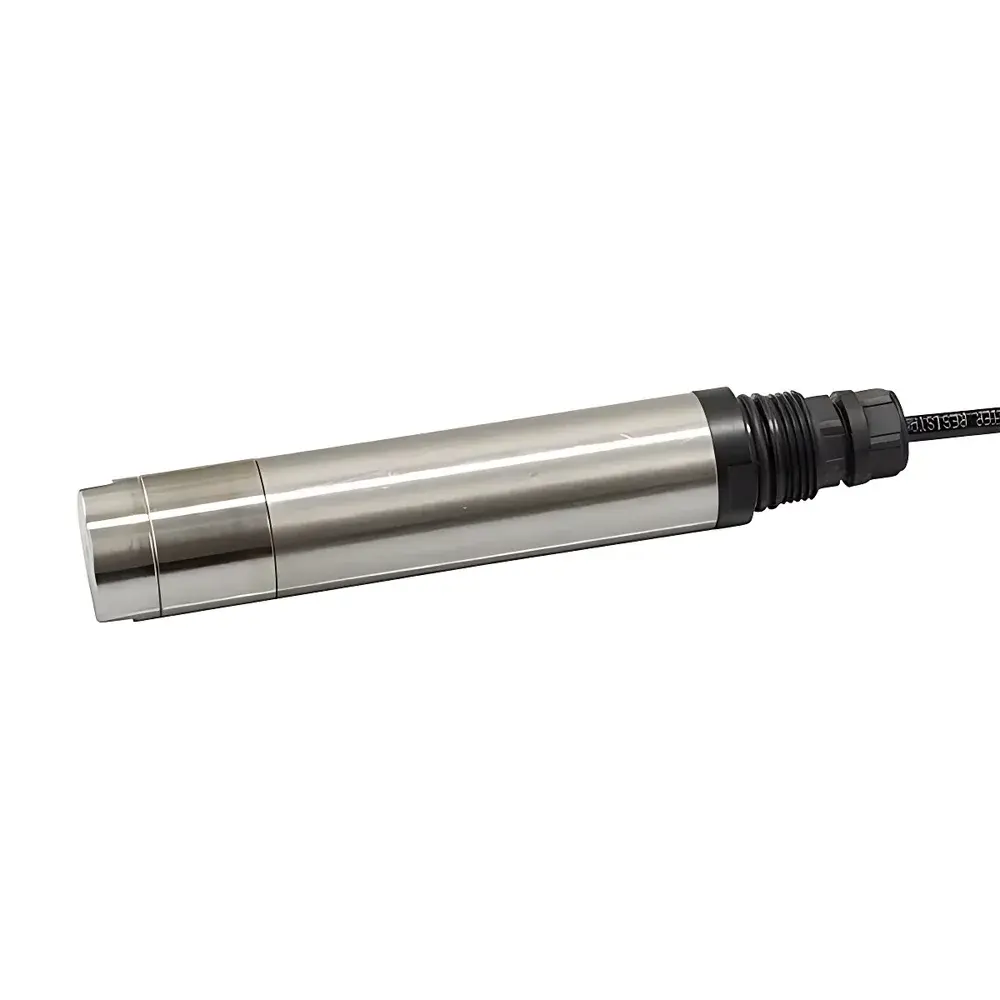
TriOS eCHEM Dissolved Oxygen Sensor
| Brand | TriOS |
|---|---|
| Origin | Germany |
| Model | eCHEM DO |
| Type | Portable Optical Dissolved Oxygen Sensor |
| Measurement Principle | Luminescence-based (Optical Quenching) |
| Range | 0–20 mg/L (0–20 ppm, 0–200% saturation) |
| Accuracy | ±0.1 mg/L (±0.1 ppm, ±1% saturation) |
| Response Time (T90) | <60 s |
| Resolution | 0.01 mg/L |
| Temperature Compensation | NTC thermistor (0.01 °C resolution, ±0.5 °C accuracy) |
| Output Interface | RS-485 (Modbus RTU) |
| Power Supply | 12 V ±10%, 1 W |
| Cable Options | 2 m or 10 m polyurethane-sheathed |
| Pressure Rating | 5 bar |
| IP Rating | IP68 |
| Operating Temp | 0–50 °C |
| Storage Temp | −10–60 °C |
| Housing Material | Passivated Stainless Steel 316L (standard) / Titanium Alloy (marine version) |
| Membrane | Optically isolated silicone |
| Dimensions | 146 mm × 25 mm |
| Weight | 450 g (SS), 300 g (Ti) |
| Maintenance Interval | ≤0.5 h/month |
| Calibration Interval | Up to 2 years |
| Cross-Sensitivity | None for pH (1–14), CO₂, H₂S, SO₂ |
Overview
The TriOS eCHEM Dissolved Oxygen Sensor is a high-stability, maintenance-free optical sensor engineered for continuous, high-fidelity dissolved oxygen (DO) measurement in natural and engineered water systems. Unlike electrochemical Clark-type sensors, the eCHEM employs luminescence quenching technology—where molecular oxygen modulates the intensity and lifetime of light emitted by a ruthenium-based luminophore immobilized on an optically isolated silicone membrane. This principle eliminates dependence on oxygen diffusion, electrolyte consumption, or polarizing voltage, resulting in zero oxygen demand at the sensing surface and immunity to common interferents such as hydrogen sulfide (H₂S), oxidizing agents (e.g., chlorine, ozone), and reducing species. The sensor delivers stable output across broad environmental conditions—from freshwater lakes and drinking water distribution networks to saline estuaries and aquaculture recirculation systems—without signal drift or membrane fouling-induced hysteresis.
Key Features
- True maintenance-free operation: No electrolyte replacement, no membrane cleaning cycles, and no anode/cathode degradation.
- Extended calibration interval: Factory-calibrated with traceable NIST-traceable standards; field verification required only every 24 months under normal deployment conditions per ISO 5814 and ASTM D888 guidelines.
- Zero oxygen consumption: Enables accurate low-flow and static measurements without perturbing local DO gradients—critical for benthic chamber studies and low-velocity pipe monitoring.
- Robust optical architecture: Silicone-based sensing layer provides chemical inertness across pH 1–14 and resistance to CO₂, SO₂, and H₂S—validated per DIN EN ISO 15839 for wastewater sensor reliability.
- High-resolution digital output: RS-485 interface with Modbus RTU protocol ensures noise-immune transmission over distances up to 1,200 m; supports multi-sensor daisy-chaining in distributed monitoring networks.
- Material flexibility: Standard 316L stainless steel housing for freshwater applications; optional titanium alloy construction (Grade 2) certified to ASTM B348 for long-term immersion in seawater and brackish environments.
Sample Compatibility & Compliance
The eCHEM sensor operates reliably across diverse aqueous matrices including raw surface water, potable water, activated sludge effluent, marine sediment porewater, and aquaculture tank inflow. It exhibits no measurable cross-sensitivity to common water quality parameters—verified per EPA Method 4500-O G and ISO 5814 Annex A. Its optical design complies with GLP data integrity requirements: all raw luminescence decay curves and temperature-compensated DO values are timestamped and stored onboard (when paired with TriBox3 controller). Full audit trails—including calibration events, firmware updates, and sensor diagnostics—are exportable in CSV/JSON format for FDA 21 CFR Part 11–compliant reporting workflows.
Software & Data Management
When integrated with TriOS TriBox3 or TriBox Mini controllers, the eCHEM enables automated temperature compensation using embedded NTC thermistors (±0.5 °C accuracy), real-time saturation calculation (based on salinity, atmospheric pressure, and temperature), and configurable logging intervals down to 5 seconds. The TriOS SensorSuite software provides live spectral diagnostics, drift trending, and predictive maintenance alerts based on signal-to-noise ratio degradation. All data exports support SI unit consistency (mg/L, % saturation, ppm) and can be ingested directly into SCADA platforms via Modbus TCP gateways or cloud-based telemetry services (MQTT/HTTPS).
Applications
- Long-term unattended monitoring of DO profiles in rivers, reservoirs, and coastal zones—supporting WFD (EU Water Framework Directive) compliance reporting.
- Real-time control of aeration basins in municipal and industrial wastewater treatment plants (WWTPs), enabling energy optimization per ISO 5667-3.
- Closed-loop oxygen dosing in RAS (Recirculating Aquaculture Systems), where sub-mg/L resolution and rapid T90 response (<60 s) prevent hypoxic stress in high-density fish culture.
- Drinking water quality assurance during storage and distribution, particularly in chloraminated systems where electrochemical sensors suffer from false positives.
- Research-grade benthic flux studies using non-invasive static deployment—validated in peer-reviewed limnological field trials (e.g., Limnology and Oceanography: Methods, 2022).
FAQ
Does the eCHEM require zero-point or span calibration in the field?
No. The sensor is factory-calibrated against gravimetrically prepared saturated air and water standards. Field verification—using a certified Winkler titration or traceable DO standard solution—is recommended annually but not mandatory unless regulatory protocols (e.g., US EPA NPDES) specify otherwise.
Can the eCHEM be used in turbid or biofouling-prone waters?
Yes. The optical sensing mechanism is unaffected by suspended solids. For extended deployments (>30 days) in high-fouling environments (e.g., wastewater influent), optional mechanical wipers or ultrasonic anti-fouling modules (TriOS CleanSonic) may be integrated via the TriBox3 I/O interface.
Is pressure compensation automatic?
The eCHEM does not include a built-in barometer. However, TriBox3 and HS100 controllers accept external barometric pressure input (via analog or SDI-12) to compute % saturation accurately up to 5 bar hydrostatic pressure—validating use in deep-water moorings and pressurized process lines.
What is the expected service life under continuous operation?
The luminophore exhibits <2% signal decay per year under typical ambient light exposure. With proper handling and adherence to specified thermal limits (0–50 °C), the functional service life exceeds 5 years—documented in TriOS’s accelerated aging tests per IEC 60721-3-3 Class 3K5.







