
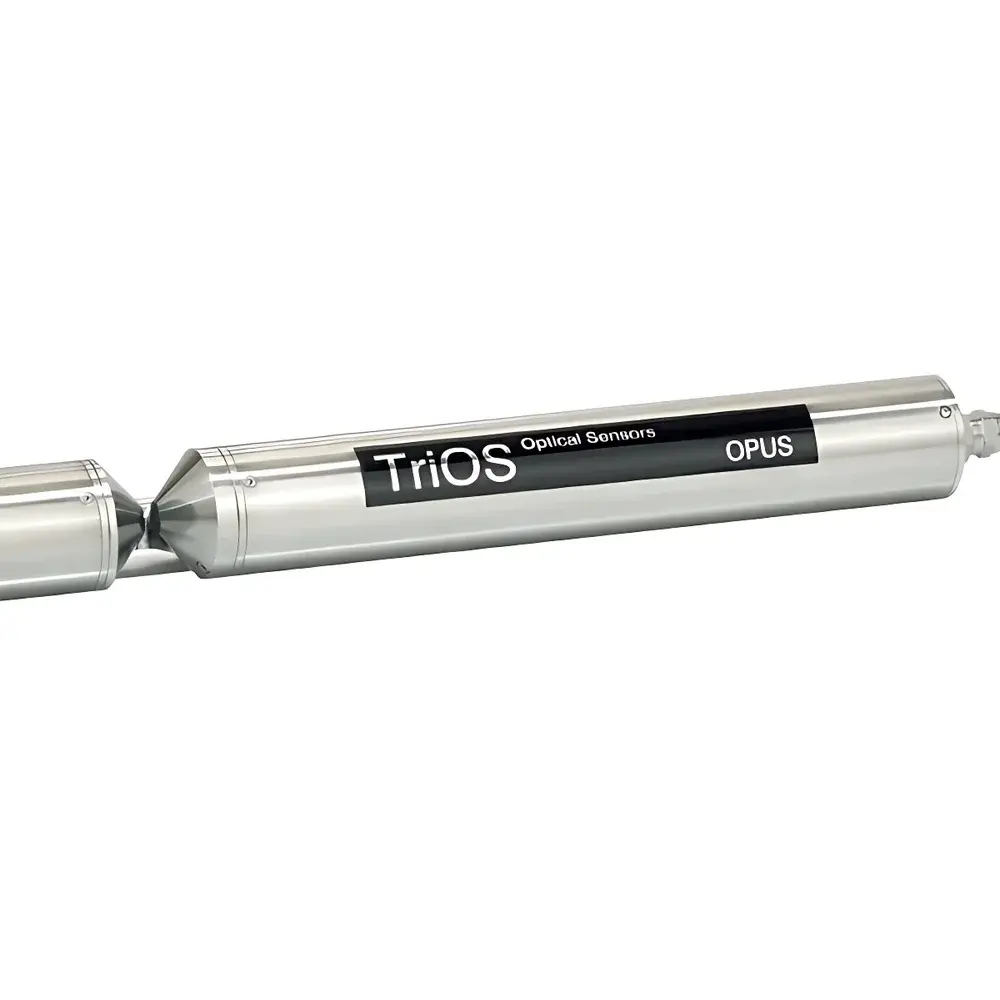
TriOS OPUS UV Deep-Sea Nitrate Spectrophotometer
| Brand | TriOS |
|---|---|
| Origin | Germany |
| Model | OPUS Deep-Sea Edition |
| Housing Material | Titanium Alloy (Grade 3.7035) |
| Optical Path Length | 10 mm |
| Wavelength Range | 200–360 nm |
| Spectral Resolution | 0.8 nm/pixel |
| Detector | High-Performance Miniature Spectrometer (256 channels) |
| Light Source | Pulsed Xenon Lamp |
| Measurement Principle | Linear Spectral Analysis (LSA) based on Beer–Lambert absorption spectroscopy |
| Turbidity Compensation | Yes |
| Depth Rating | 600 bar / 6000 m |
| IP Rating | IP68 |
| Operating Temperature | +2 °C to +40 °C |
| Storage Temperature | −20 °C to +80 °C |
| Flow Rate Compatibility | 0.1–10 m/s |
| Digital Interface | RS-232 / RS-485 (Modbus RTU) |
| Connector | SubConn 8-pin |
| Power Supply | 12–24 VDC (±10 %) |
| Power Consumption | ≤ 8 W |
| Response Time | 2 min |
| Minimum Measurement Interval | ≥ 1 min |
| Internal Data Storage | 2 GB |
| Calibration Interval | 24 months |
| Seawater-Specific Calibration Modules | OPUS cal seawater series |
| Detection Limits (10 mm path) | NO₃⁻: 0.1 mg/L |
| COD-SACeq | 2.2 mg/L |
| DOC | 0.5 mg/L |
| Quantification Ranges (10 mm path) | NO₃⁻: 0–44 mg/L |
| COD-SACeq | 0–320 mg/L |
| DOC | 0–100 mg/L |
| Accuracy (NO₃⁻) | ±0.73 mg/L (based on certified seawater reference standards) |
Overview
The TriOS OPUS UV Deep-Sea Nitrate Spectrophotometer is a submersible, in-situ high-resolution ultraviolet spectrophotometer engineered for continuous, reagent-free quantification of key nitrogen and carbon species in marine environments. It operates on the principle of Linear Spectral Analysis (LSA), a robust implementation of absorption spectroscopy grounded in the Beer–Lambert law. Unlike conventional single-wavelength or filtered photometers, the OPUS UV acquires full UV spectra (200–360 nm) at 0.8 nm/pixel resolution using a pulsed xenon light source and a 256-channel miniature spectrometer. This enables simultaneous, multi-analyte determination—including nitrate (NO₃⁻), spectral absorbance coefficient equivalent chemical oxygen demand (COD-SACeq), dissolved organic carbon (DOC), and humic substance (HS-) indices—without physical sampling, chemical reagents, or laboratory intervention. Its titanium alloy (3.7035) pressure housing, hermetically sealed optical windows with nano-coated quartz, and SubConn 8-pin wet-mateable interface ensure structural integrity and optical stability under hydrostatic pressures up to 600 bar (6000 m depth). The instrument is factory-calibrated using TriOS’s traceable seawater-specific calibration modules (OPUS cal seawater series), ensuring metrological validity across variable salinity, temperature, and turbidity conditions.
Key Features
- Submersible operation certified to 6000 m depth (600 bar), compliant with ISO 85042-1 for deep-ocean instrumentation
- Titanium alloy (3.7035) monocoque housing with laser-welded seams and dual O-ring compression sealing at optical and electrical interfaces
- Nano-coated fused silica optical window providing UV transmission stability and biofouling resistance
- Integrated turbidity compensation algorithm correcting for scattering effects in optically complex seawater matrices
- Modbus RTU protocol over RS-232/RS-485 enabling direct integration into existing SCADA, observatory control systems (e.g., TRIBox), or autonomous platforms (AUVs, moorings, profilers)
- Onboard 2 GB non-volatile memory supporting time-stamped spectral logging and diagnostic data archiving
- Low-power design (≤8 W) optimized for battery- or energy-harvesting–powered deployments
- Factory-applied seawater calibration validated against NIST-traceable reference materials and inter-laboratory round-robin studies
Sample Compatibility & Compliance
The OPUS UV Deep-Sea Edition is validated for direct immersion in natural seawater, brackish estuaries, and coastal upwelling zones. Its 10 mm optical path length and LSA-based multivariate regression models account for matrix effects including variable salinity (0–40 PSU), temperature (+2 to +40 °C), and particulate load (up to 100 NTU). All calibration functions adhere to ASTM D5129–21 (Standard Test Method for Nitrate in Water by UV Spectrophotometry) and ISO 15681-2:2022 (Water Quality — Determination of Phosphorus and Nitrogen Compounds — Part 2: Spectrophotometric Methods). Instrument firmware supports audit-trail logging and user-accessible calibration history, facilitating GLP-compliant field operations and regulatory reporting under EU Marine Strategy Framework Directive (MSFD) and US EPA National Coastal Assessment protocols.
Software & Data Management
TriOS SensorControl software provides configuration, real-time spectral visualization, and post-processing of raw absorbance spectra using proprietary chemometric algorithms. Raw spectral files (ASCII .csv or binary .spc format) are exportable for third-party analysis in MATLAB, Python (SciPy/Pandas), or R. The embedded Modbus register map includes calibrated concentration outputs (NO₃⁻, COD-SACeq, DOC), raw intensity arrays, lamp health diagnostics, temperature-compensated absorbance residuals, and system uptime counters. Data timestamps are synchronized via internal RTC (±1 s/month drift) and optionally via external GPS pulse-per-second (PPS) input when integrated with TRIBox controllers. Firmware updates are delivered via secure signed packages compliant with IEC 62443-3-3 requirements for industrial cyber security.
Applications
- Long-term nitrate flux monitoring at hydrothermal vent fields and cold seep ecosystems
- Autonomous profiling of nitrate depletion zones in mesopelagic and bathypelagic layers
- Real-time validation of biogeochemical model outputs in coupled physical-biogeochemical ocean models (e.g., ROMS-NPZD, MITgcm)
- Calibration and ground-truthing of satellite-derived ocean color products (e.g., Sentinel-3 OLCI, PACE HARP)
- Early detection of anthropogenic nutrient intrusion in continental shelf waters and fjord systems
- Integration into cabled observatories (e.g., Ocean Networks Canada, EMSO) for high-frequency, multi-year time-series
FAQ
Does the OPUS UV require periodic recalibration in situ?
No—field recalibration is not required. The 24-month calibration interval is validated under accelerated aging tests per IEC 60068-2-60 and confirmed through comparative deployments against discrete bottle analyses using ion chromatography (IC) and high-temperature catalytic oxidation (HTCO).
Can the OPUS UV distinguish nitrate from nitrite or other UV-absorbing interferents?
Yes—LSA employs full-spectrum deconvolution rather than fixed-band ratioing. Its 256-channel resolution resolves overlapping absorption features (e.g., NO₂⁻ peak at 210 nm vs. NO₃⁻ shoulder at 220 nm), and chemometric models are trained on multi-component synthetic seawater matrices.
Is the instrument compatible with third-party data loggers beyond TRIBox?
Yes—any Modbus RTU–capable controller (e.g., Campbell Scientific CR6, Sea-Bird Electronics SBE-37, iSentek ISM-200) can poll registers for calibrated concentrations, spectral metadata, and status flags without proprietary drivers.
What maintenance is required between deployments?
Post-recovery inspection includes visual verification of optical window integrity, cleaning with deionized water and lint-free wipes, and functional verification using TriOS’s portable test kit (OPUS-TEST-KIT-UV), which includes certified reference standards and spectral validation slides.
Related Products







