
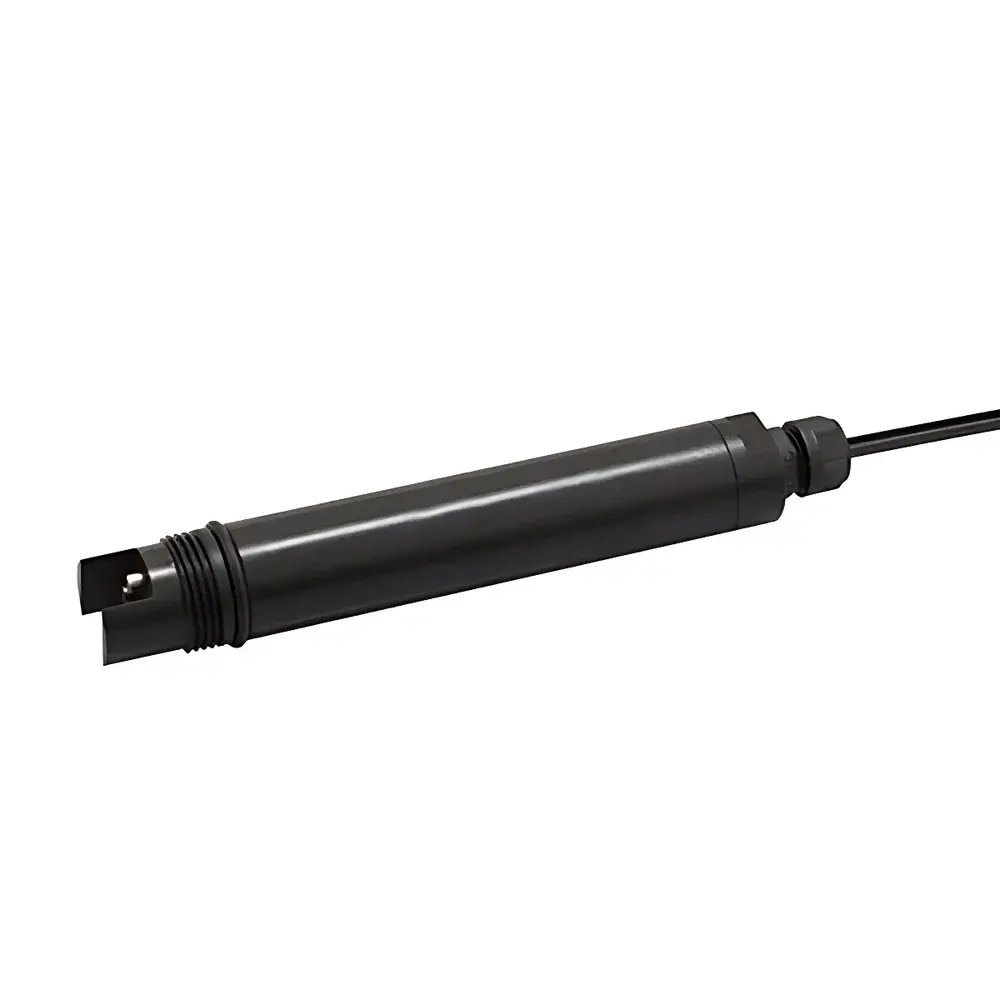
TriOS Tcon eCHEM Conductivity Sensor
| Brand | TriOS |
|---|---|
| Origin | Germany |
| Manufacturer Type | Authorized Distributor |
| Origin Category | Imported |
| Model | Tcon |
| Price | Upon Request |
Overview
The TriOS Tcon eCHEM Conductivity Sensor is a precision digital instrument engineered for continuous, in-situ measurement of electrical conductivity in aqueous media—principally targeting municipal wastewater effluent, industrial process water, and closed-loop cooling or boiler feed systems. It operates on the two-electrode principle: an alternating current is applied across two graphite electrodes immersed in the sample; the resulting conductance is directly proportional to the concentration and mobility of dissolved ionic species (e.g., Na⁺, Cl⁻, Ca²⁺, SO₄²⁻). Unlike traditional analog sensors, the Tcon integrates real-time NTC-based temperature compensation and outputs digitally via Modbus RTU over RS-485, eliminating signal degradation over long cable runs and ensuring traceable, noise-immune data transmission. Its design adheres to fundamental electrochemical measurement standards—including ISO 7888 (water quality — determination of electrical conductivity) and ASTM D1125—and supports compliance with regulatory monitoring frameworks such as EU Urban Wastewater Treatment Directive (91/271/EEC) and EPA Method 120.1.
Key Features
- Two-graphite electrode configuration ensures stable polarization resistance and long-term reproducibility in low-to-mid conductivity ranges (0.00–20,000 µS/cm)
- Integrated NTC thermistor (10 kΩ at 25 °C) enables automatic temperature compensation per DIN EN 27888, referenced to 25 °C
- PVC housing (IP68-rated) provides chemical resistance to chlorinated water, mild acids, and alkaline solutions; suitable for submersion up to 10 bar pressure
- No moving parts or consumable membranes—eliminates drift from fouling or clogging; maintenance limited to periodic cleaning and single-point calibration
- Modbus RTU protocol (slave ID configurable) allows seamless integration into SCADA, PLC, or DCS architectures without additional signal converters
- Compact cylindrical form factor (220 mm × 33 mm) facilitates installation in inline flow cells (e.g., TriOS FlowCell-F or third-party DIN G2-compatible housings) or direct immersion in open channels/tanks
Sample Compatibility & Compliance
The Tcon sensor is validated for use in non-aggressive aqueous matrices including treated wastewater, reverse osmosis permeate, demineralized process water, and surface water with suspended solids 0.5 ppm). All materials in contact with the sample—graphite electrodes, PVC body, and EPDM O-rings—comply with EU Regulation (EC) No. 1935/2004 for materials intended to come into contact with drinking water. The sensor meets IEC 61000-6-2 (immunity) and IEC 61000-6-4 (emission) for industrial environments and carries CE marking under the EMC and RoHS directives.
Software & Data Management
When paired with TriOS TriBox3 or TriBox Mini controllers—or third-party Modbus masters—the Tcon delivers timestamped, linearized conductivity values with embedded temperature readings. TriOS’ proprietary TriSoft Suite (v4.2+) supports automated calibration logging, alarm threshold configuration (e.g., high-conductivity deviation alerts), and audit-trail generation compliant with GLP and FDA 21 CFR Part 11 requirements (when deployed with electronic signature-enabled controllers). Raw Modbus registers include conductivity (µS/cm), temperature (°C), sensor status flags, and calibration date—enabling direct ingestion into LIMS or cloud-based IIoT platforms (e.g., Siemens MindSphere, PTC ThingWorx) via standard Modbus TCP gateways.
Applications
- Real-time effluent monitoring at wastewater treatment plant discharge points per national permit limits
- Conductivity control in industrial cooling towers to prevent scaling and corrosion
- Leak detection in heat exchanger systems via sudden conductivity spikes indicating coolant-water mixing
- Monitoring deionized water purity in pharmaceutical clean steam generation loops (USP support)
- Environmental compliance reporting for surface water bodies impacted by agricultural or urban runoff
FAQ
What calibration method does the Tcon require?
A single-point calibration using a certified KCl standard solution (e.g., 1413 µS/cm at 25 °C) is sufficient for routine operation. The sensor stores calibration offset and slope internally.
Can the Tcon be used in seawater?
No—it is rated up to 20,000 µS/cm, whereas typical seawater exceeds 50,000 µS/cm; extended exposure may saturate the measurement range and accelerate electrode oxidation.
Is temperature compensation mandatory?
Yes; conductivity is inherently temperature-dependent. The integrated NTC ensures compensation per the standard linearization formula defined in ISO 7888, with coefficients stored in firmware.
What is the minimum cable length available?
Standard configurations include 0.3 m, 2 m, 10 m, and 25 m shielded twisted-pair cables with IP68-rated M12 connectors—no field termination required.
Does the sensor support HART or analog 4–20 mA output?
No—only digital Modbus RTU over RS-485. Analog output requires an external converter (e.g., TriOS TriBox3 with analog module).







