
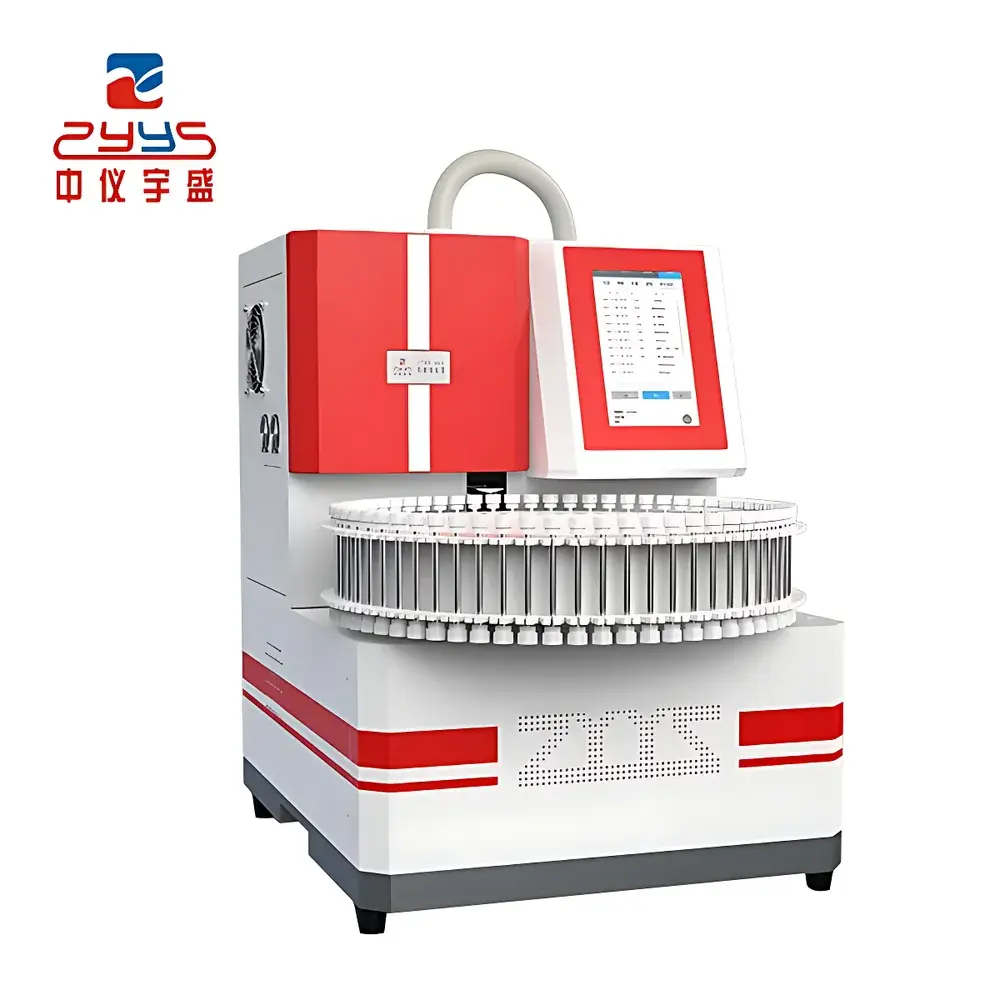
Zoeyun ATDS-60A Fully Automated Thermal Desorber
| Brand | Zoeyun |
|---|---|
| Origin | Beijing, China |
| Manufacturer Type | Direct Manufacturer |
| Instrument Type | Dual-Stage Thermal Desorber |
| Automation Level | Fully Automated |
| Sample Capacity | 64 Positions |
| Heating Zones | 4 Independent Zones (Desorption Chamber, Injection Valve, Transfer Line, Secondary Desorption Trap) |
| Cooling Method | Electronic Peltier Cooling (No Liquid Nitrogen Required) |
| Sample Tube Material Compatibility | Standard 1/4" OD Stainless Steel or Silica Tubes |
| Gas Flow Control | Mass Flow Controllers (MFCs) |
| Leak Detection | Automatic Tube Integrity Check |
| Interface | GC/GC-MS Synchronization with Start/Stop & Remote Control Signal Support |
| Software Features | Method Programming, Queue Management, Audit Trail, Event Logging, Tube Aging & Calibration Simulation |
| Compliance Standards | ASTM D6196, ISO 16017-1, US EPA TO-17, HJ 583–2010, HJ 644–2013, HJ 734–2014, GB/T 18883–2022, GB 50325–2020 |
Overview
The Zoeyun ATDS-60A Fully Automated Thermal Desorber is an engineered solution for quantitative trace-level volatile organic compound (VOC) and semi-volatile organic compound (SVOC) analysis in environmental, occupational health, indoor air quality (IAQ), and materials emission testing laboratories. Based on dual-stage thermal desorption (TSD) principle, the system thermally releases analytes pre-concentrated on sorbent tubes—typically Tenax TA, Carbopack B/C, or multi-bed configurations—then refocuses them cryogenically or via cold trap onto a narrow GC column head. Unlike single-stage desorption, the ATDS-60A implements precise temperature-programmed secondary desorption to minimize band broadening and maximize chromatographic resolution, especially critical for complex mixtures such as BTEX, aldehydes, terpenes, and C6–C20 hydrocarbons. Its architecture supports seamless integration with any commercial gas chromatograph (GC) or gas chromatography–mass spectrometry (GC-MS) platform via TTL/RS-232/ethernet synchronization, enabling unattended batch processing of up to 64 samples per run.
Key Features
- Fully automated operation with self-diagnostic startup sequence and real-time status monitoring via a 7-inch industrial-grade touchscreen interface
- Four independently controlled heating zones: primary desorption furnace (up to 400 °C), injection valve (up to 350 °C), transfer line (up to 300 °C), and secondary desorption trap (−30 °C to 400 °C, Peltier-cooled)
- Auto-seal cap handling mechanism eliminates manual septum replacement; quick-connect fittings ensure tool-free installation and gas-tight integrity
- Integrated tube leak detection: system verifies seal integrity prior to desorption and automatically skips empty or defective tubes
- Precision mass flow controllers (MFCs) regulate carrier, purge, and desorption gases with ±1% full-scale accuracy and long-term stability
- Inert flow path: all internal tubing subjected to electropolished passivation; trap body fabricated from low-adsorption stainless steel
- Programmable sample tube aging protocol with adjustable temperature ramping, hold time, and inert gas flow—supports overnight conditioning of new or reused tubes
- On-board internal standard introduction module with programmable timing and volume control for quantitative compensation of matrix effects
- Split functionality with user-defined split ratios (1:5 to 1:100) to prevent detector saturation during high-concentration sample analysis
- Multi-cycle desorption capability: same tube can undergo sequential thermal desorption at different temperature steps to profile thermal release behavior
Sample Compatibility & Compliance
The ATDS-60A accommodates industry-standard 1/4″ OD stainless steel or fused silica sorbent tubes (e.g., SKC, Markes, PerkinElmer), including single- and multi-bed configurations compliant with EPA TO-17 and ISO 16017-1 requirements. It meets analytical validation criteria outlined in multiple regulatory frameworks: Chinese national standards GB/T 18883–2022 (Indoor Air Quality), GB 50325–2020 (Civil Building IAQ), HJ 583–2010, HJ 644–2013, and HJ 734–2014 (environmental and stack emission VOC testing); as well as occupational exposure standards GBZ/T 300.62–2017 through GBZ/T 300.68–2017. System design adheres to GLP-aligned data integrity principles—full audit trail logging, method versioning, electronic signatures, and event timestamping satisfy basic FDA 21 CFR Part 11 readiness when deployed with compliant LIMS or chromatography data systems.
Software & Data Management
The embedded control software provides comprehensive method development tools: temperature ramp profiles, gas flow sequences, valve timing diagrams, and GC synchronization triggers. Users define analytical queues with priority-based scheduling, monitor live status of each tube position (e.g., “heating”, “desorbing”, “cooling”, “error”), and access historical logs filtered by date, operator, or method ID. All parameter changes are recorded with user ID and timestamp. Exportable CSV reports include desorption temperatures, flow rates, leak test results, and system diagnostic codes. Optional API integration enables remote monitoring and script-based method deployment in centralized lab automation environments.
Applications
The ATDS-60A serves routine and research applications across regulated and non-regulated sectors: indoor air and building material emission profiling (e.g., carpets, adhesives, coatings per GB 36246–2018); ambient and workplace air monitoring for benzene, formaldehyde, and chlorinated solvents; automotive cabin air characterization (HJ/T 400–2007); forensic fire debris analysis; and polymer off-gassing studies. Its reproducible trapping efficiency and low carryover (<0.1%) make it suitable for method validation under ISO/IEC 17025-accredited laboratories performing VOC quantitation down to sub-pptv levels.
FAQ
Does the ATDS-60A require liquid nitrogen for cold trapping?
No. Secondary desorption employs solid-state Peltier cooling capable of reaching −30 °C without cryogens.
Can the system be integrated with third-party GC or GC-MS instruments?
Yes. Hardware-level TTL/RS-232 and software-level Ethernet protocols support bidirectional triggering with Agilent, Thermo Fisher, Shimadzu, and PerkinElmer platforms.
Is tube leak detection performed before every analysis?
Yes. A dedicated pressure decay test runs automatically on each loaded tube prior to thermal desorption.
What is the maximum operating temperature of the primary desorption furnace?
400 °C, with ±0.5 °C stability over 60-minute holds.
Does the system support audit trail and electronic record retention per 21 CFR Part 11?
The local software records all user actions and instrument events with timestamps and IDs; full Part 11 compliance requires integration with a validated chromatography data system (CDS) or LIMS.






