
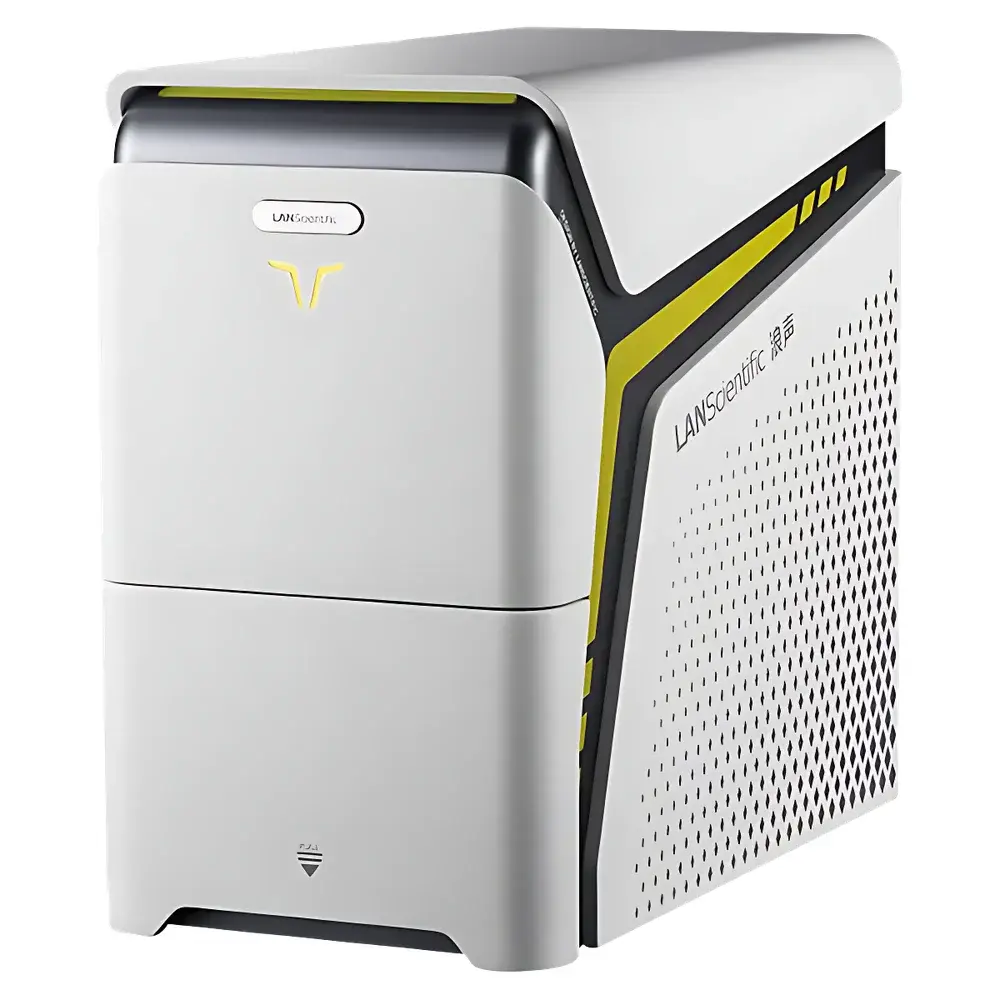
Brookfield LANScientific SuperSEM N10eV Desktop Tungsten-Filament Scanning Electron Microscope
| Brand | LANScientific |
|---|---|
| Origin | Jiangsu, China |
| Manufacturer Type | Direct Manufacturer |
| Country of Origin | Domestic (China) |
| Model | SuperSEM N10eV |
| Instrument Type | Desktop / Benchtop SEM |
| Electron Gun Type | Tungsten Filament |
| Microscope Class | Entry-Level Tungsten-Filament SEM |
| Maximum Sample Dimensions | 90 mm (diameter) × 40 mm (thickness) |
| Stage Travel Range | X: 25 mm, Y: 25 mm, Z: 30 mm |
Overview
The Brookfield LANScientific SuperSEM N10eV is a compact, benchtop scanning electron microscope engineered for high-fidelity surface morphology imaging and simultaneous elemental characterization. Utilizing a thermionic tungsten-filament electron source, it delivers stable beam current and consistent performance across routine laboratory and industrial QA/QC environments. Unlike conventional standalone SEMs, the SuperSEM N10eV integrates an energy-dispersive X-ray spectrometer (EDS) directly into its column architecture—enabling true concurrent acquisition of secondary electron (SE), backscattered electron (BSE), and characteristic X-ray signals. This synchronized detection framework is built upon a real-time signal processing engine capable of handling up to 10 MHz data bandwidth, supporting video-rate imaging without motion artifacts or temporal lag. Designed for rapid deployment, the system operates on standard 220 V AC power and requires no dedicated vibration isolation or HVAC conditioning—making it suitable for shared labs, teaching facilities, and production-floor quality control stations.
Key Features
- Integrated tungsten-filament electron optical column with optimized condenser lens design—eliminates manual aperture alignment and beam alignment routines
- Three-axis motorized stage (X/Y/Z: 25/25/30 mm) with precision stepper control and positional repeatability < ±1 µm
- High-sensitivity quadrant BSE detector enabling compositional contrast imaging and signal mixing for phase discrimination
- Dual-mode imaging: high-resolution SE mode for topographic detail + BSE-EDS fusion mode for atomic number contrast and elemental mapping
- Real-time EDS spectral rendering: live spectrum display during acquisition, dynamic comparison against reference libraries, and on-the-fly quantitative ZAF correction
- True-color pseudo-elemental mapping: pixel-by-pixel X-ray intensity assignment rendered as overlayed false-color images synchronized with video-frame acquisition
- Infrared CCD navigation camera integrated into chamber viewport—enables macro-to-micro sample positioning without breaking vacuum
- One-click automation suite: auto-focus, auto-stigmation, auto-contrast/brightness, large-area mosaic stitching (up to 16×16 tiles), and beam alignment recovery
Sample Compatibility & Compliance
The SuperSEM N10eV accommodates samples up to 90 mm in diameter and 40 mm in height, supporting conductive, semi-conductive, and non-conductive specimens (with optional carbon or gold sputter coating). Its low-vacuum capability (optional upgrade) extends usability to hydrated or outgassing-prone materials such as polymers, biological tissues, and cementitious composites. The instrument complies with IEC 61000-6-3 (EMC emissions) and IEC 61000-6-2 (immunity), and its software architecture supports audit trail logging per FDA 21 CFR Part 11 requirements when configured with user authentication and electronic signature modules. Routine operation meets ISO/IEC 17025 documentation standards for accredited testing laboratories conducting material composition verification per ASTM E1508 or ISO 16574.
Software & Data Management
The proprietary SEM-EDS acquisition and analysis platform features a role-based GUI with intuitive workflow wizards—designed for both novice users and experienced microscopists. All image and spectrum metadata (including kV, probe current, dwell time, working distance, and detector geometry) are embedded in TIFF and .spc file headers. Data export supports industry-standard formats: .emsa (for spectral interchange), .tiff (with 16-bit depth and spatial calibration tags), and .csv (quantitative elemental tables). Batch processing includes automated particle analysis, layer-thickness measurement via line-scan deconvolution, and statistical reporting compliant with GLP/GMP documentation templates. Raw data files are stored in a hierarchical project structure with timestamped versioning and optional network drive synchronization.
Applications
- Materials Science: Phase identification in metallurgical alloys, grain boundary analysis in ceramics, coating thickness and adhesion assessment
- Battery R&D: Cathode/anode particle morphology, SEI layer inspection, lithium dendrite detection, and cross-sectional failure analysis
- Geosciences: Mineralogical mapping of rock thin sections, porosity quantification in shale cores, clay mineral differentiation
- Forensics: Fiber and paint chip elemental fingerprinting, gunshot residue (GSR) morphology and composition screening
- Life Sciences: Freeze-dried tissue ultrastructure, biomaterial scaffold porosity evaluation, nanoparticle-cell interaction studies
- Construction Materials: Hydration product distribution in cement paste, aggregate interface transition zone (ITZ) characterization
FAQ
What vacuum level does the SuperSEM N10eV operate at?
The system maintains a high vacuum of ≤5 × 10⁻³ Pa in the electron column using a turbomolecular pump backed by a dry scroll pump.
Is EDS quantification certified to international standards?
Yes—when operated with certified reference standards (e.g., NIST SRM 2100 series), quantitative results meet ISO 14705 and ASTM E1508 accuracy tolerances for major and minor elements (>0.1 wt%).
Can the instrument be upgraded to field emission capability?
No—the N10eV is fundamentally designed around a tungsten-filament architecture; field emission upgrades require column replacement and are not supported.
Does the software support remote operation and multi-user access?
Yes—via secure RDP or VNC protocols; concurrent session management and permission tiers (operator, supervisor, administrator) are configurable.
What maintenance intervals are recommended for the tungsten filament?
Filament lifetime averages 150–200 hours under typical 15–20 kV operating conditions; replacement is a <15-minute procedure requiring only basic vacuum venting and alignment verification.



