
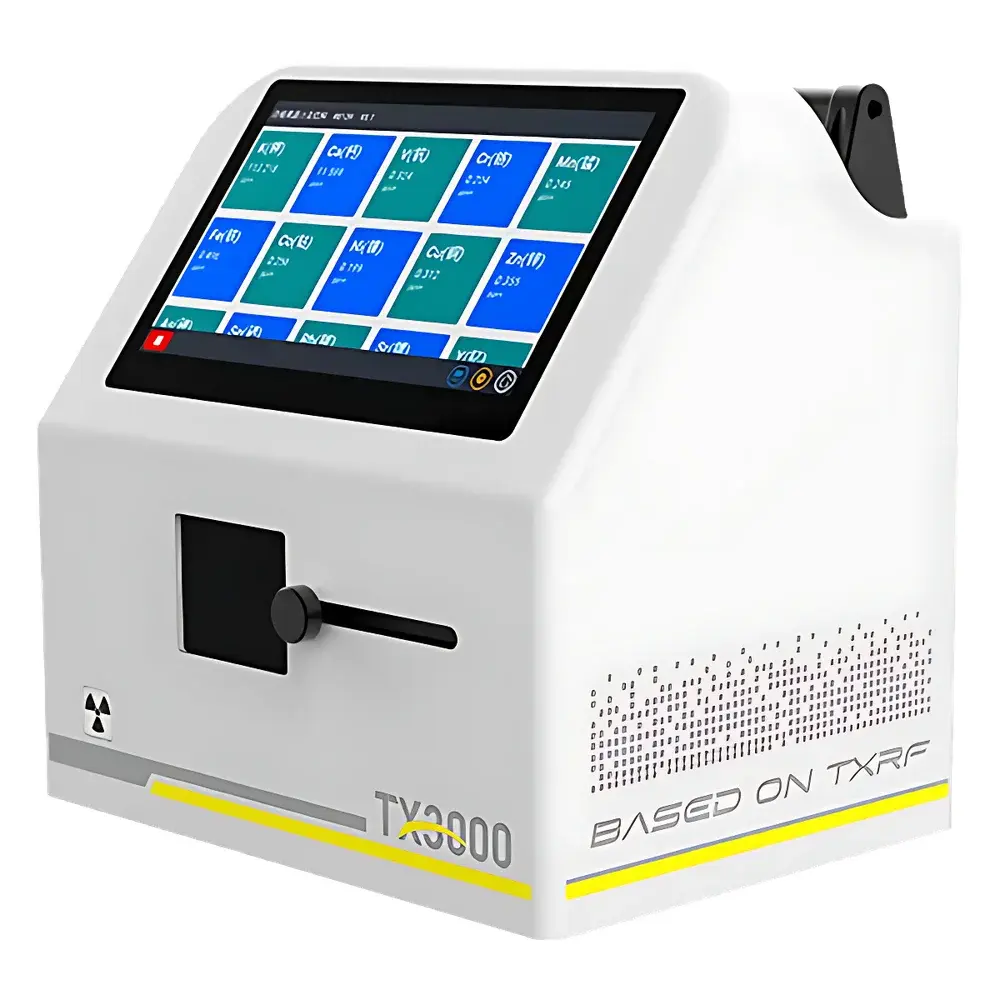
Brookfield LANScientific TX3000 Portable Total Reflection X-Ray Fluorescence (TXRF) Spectrometer
| Brand | LANScientific |
|---|---|
| Origin | Jiangsu, China |
| Manufacturer Type | Direct Manufacturer |
| Instrument Type | Total Reflection XRF (TXRF) |
| Configuration | Portable / Field-Deployable |
| Sample Forms | Liquids, Suspensions, Solid Thin Films, Particulates |
| Primary Application Domains | Environmental Monitoring (Soil & Atmospheric Aerosols), Regulatory Compliance Screening, Trace Element Analysis |
Overview
The LANScientific TX3000 is a field-deployable total reflection X-ray fluorescence (TXRF) spectrometer engineered for ultra-trace elemental quantification in environmental and regulatory applications. Unlike conventional energy-dispersive XRF (ED-XRF), TXRF operates on the principle of total external reflection: an incident monochromatic X-ray beam strikes the sample carrier—typically a polished quartz or silicon wafer—at a grazing incidence angle (99.5% relative to conventional ED-XRF, enabling detection limits in the sub-attogram (10−18 g) range for many elements. The TX3000 integrates a multilayer monochromator to deliver highly collimated Cu Kα (8.04 keV) excitation, minimizing spectral interferences and optimizing signal-to-background ratio for simultaneous multi-element analysis of Cr, Pb, As, Cd, Hg, Ni, Zn, and Cu—extendable to up to 30 elements including transition metals, rare earths, and halogens.
Key Features
- Field-Ready Portability: Compact monolithic chassis (≤ 12 kg), battery-operated option available; no liquid nitrogen, vacuum pumps, or external gas supplies required.
- Minimal Sample Consumption: Requires only 1–10 µL of liquid or ≤ 100 ng of solid residue per analysis—ideal for precious, limited, or hazardous samples.
- Low-Dose Radiation Safety: Grazing-incidence geometry confines primary beam path within the sample carrier surface; measured dose rate at operator position is < 0.1 µSv/h (per IEC 62495 compliance testing).
- Automated Workflow Integration: One-touch acquisition with embedded calibration routines; supports internal standardization (e.g., Ga or Y addition) for matrix-independent quantification.
- Robust Optical Architecture: Fixed-beam monochromator + Peltier-cooled silicon drift detector (SDD) with 125 eV Mn Kα resolution ensures long-term stability without recalibration drift.
Sample Compatibility & Compliance
The TX3000 accepts dried droplets on flat substrates (quartz, Si wafers), filter-collected airborne particulates (e.g., PM2.5 on polycarbonate filters), digested soil extracts, leachates, and biological fluids (urine, serum). It complies with ASTM D7724–22 (Standard Guide for TXRF Analysis of Trace Elements in Environmental Waters) and supports method validation per ISO/IEC 17025:2017 requirements. Data integrity meets FDA 21 CFR Part 11 expectations through audit-trail-enabled software with user-level access control and electronic signature capability.
Software & Data Management
Acquisition and quantification are managed via LANScientific’s TXRF-Suite v3.2—a Windows-based application supporting spectral deconvolution using fundamental parameter (FP) algorithms with optional empirical calibration. Raw spectra, peak integration tables, limit-of-detection (LOD) reports, and uncertainty budgets (k = 2) are exportable in CSV, PDF, and XML formats compatible with LIMS integration. Batch processing enables automated reporting aligned with EPA Method 6020B or ISO 17294-2 workflows.
Applications
- Environmental Monitoring: Quantification of heavy metals (Pb, As, Cd) in soil leachates, atmospheric deposition filters, and surface water at sub-ppq levels—supporting EU WFD and US Clean Water Act compliance.
- Regulatory Screening: Rapid field verification of RoHS-restricted elements in contaminated land surveys or industrial site remediation projects.
- Geochemical Research: Multi-element profiling of trace metal distributions in sediment cores or mineralogical fractions without acid digestion artifacts.
- Food & Agricultural Safety: Detection of toxic element migration from packaging into food simulants or irrigation water.
- Cultural Heritage Science: Non-destructive analysis of pigment layers, corrosion products, or ceramic glazes with minimal sampling impact.
FAQ
What sample preparation is required for soil analysis?
Liquid-phase extraction (e.g., aqua regia or EDTA leaching) followed by deposition of 5 µL onto a clean quartz carrier and air-drying under laminar flow.
Can the TX3000 analyze particulate matter collected on filters?
Yes—filters (e.g., Nuclepore™ or Teflon®) can be directly mounted; no ashing or dissolution needed if particle loading is sufficient (>10 ng/cm²).
Is certified reference material (CRM) calibration mandatory?
Not mandatory for screening; however, quantitative analysis requires CRM-matched calibration standards or internal standard addition (e.g., 100 pg Ga per µL) for accuracy validation.
How does TXRF differ from conventional ED-XRF for trace analysis?
TXRF eliminates bulk scattering via total reflection geometry, reducing background by 3–4 orders of magnitude—enabling LODs 100× lower than benchtop ED-XRF for elements like As and Se in complex matrices.
Does the instrument support GLP/GMP documentation requirements?
Yes—full electronic audit trail, user authentication logs, instrument performance verification (IPV) reports, and raw data archiving meet GLP Annex 11 and GMP Annex 11 expectations.






