
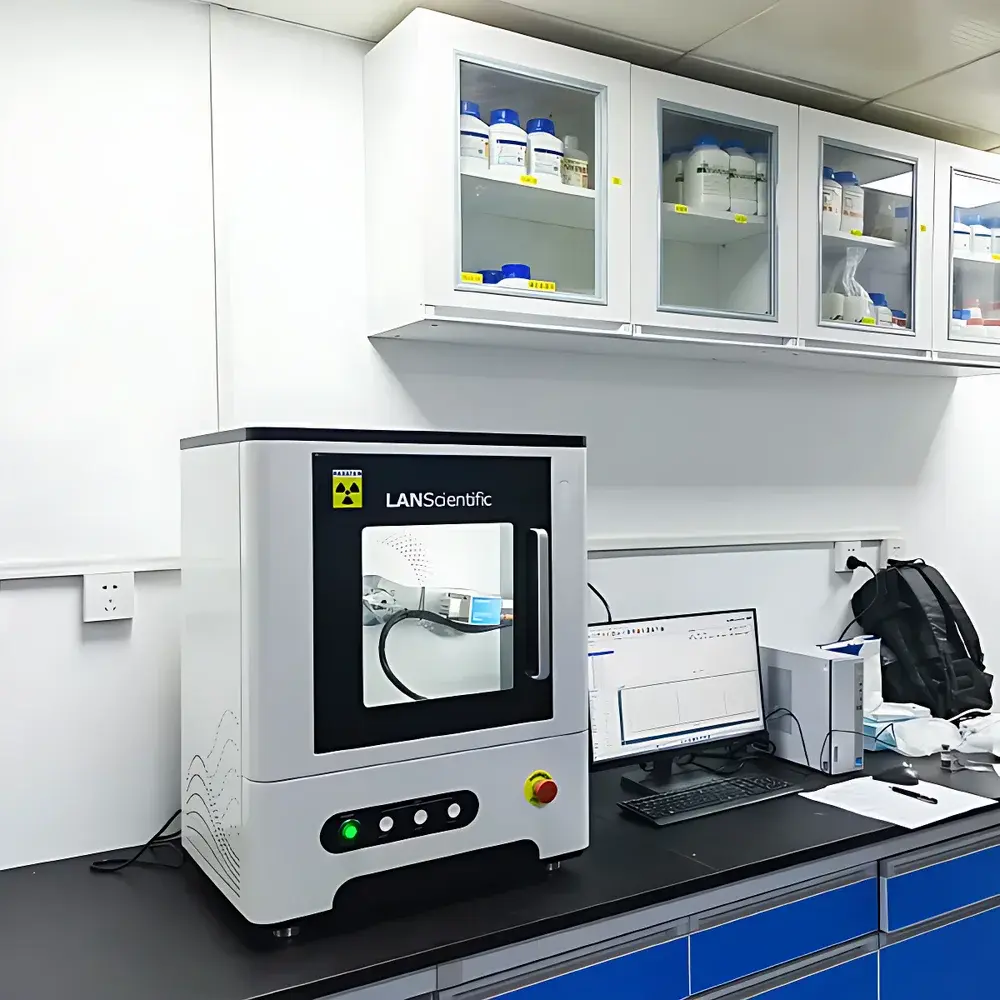
LANScientific FRINGE EV Desktop X-ray Diffractometer
| Brand | LANScientific |
|---|---|
| Origin | Jiangsu, China |
| Manufacturer Type | Original Equipment Manufacturer (OEM) |
| Product Category | Domestic |
| Model | FRINGE EV |
| Instrument Type | Powder X-ray Diffractometer |
| Power Rating | kW-class (rated for continuous high-intensity operation) |
| Detector | Digital Pulse Processing Counter (DPPC), ≥1×10⁷ counts per second (CPS) |
| Optical Configuration | Integrated fixed Soller slits, θ–2θ reflection geometry |
| Safety Compliance | Interlocked sample chamber with automatic beam shutter, full enclosure when closed |
| Software | CrystalX — automated phase identification, quantitative Rietveld refinement, crystallinity calculation, and EDS-enabled hybrid data acquisition |
Overview
The LANScientific FRINGE EV is a benchtop X-ray diffractometer engineered for precision crystallographic analysis under laboratory-scale constraints. It operates on Bragg’s law (nλ = 2d sinθ) using Cu-Kα radiation (λ = 1.5418 Å) in a fixed-geometry θ–2θ reflection configuration. X-rays emitted from the sealed-tube anode pass through integrated Soller slits and divergence slits before impinging on the sample mounted at the goniometer center. Diffracted beams are collimated by anti-scatter and receiving slits, then detected by a high-throughput Digital Pulse Processing Counter (DPPC). Unlike conventional scintillation or Si(Li) detectors, the DPPC simultaneously delivers high-resolution diffraction intensity data and energy-dispersive spectral (EDS) information—enabling rapid elemental correlation without secondary monochromators. Designed for structural metrology rather than throughput alone, the FRINGE EV maintains angular reproducibility better than ±0.01° over extended thermal cycles, supporting rigorous materials characterization workflows in academic, industrial, and regulatory environments.
Key Features
- kW-class X-ray source: Delivers stable, high-flux output suitable for low-abundance phase detection and time-resolved measurements without liquid nitrogen cooling.
- Integrated fixed Soller slits: Eliminates mechanical adjustment points, enhancing long-term angular stability and enabling vibration-tolerant deployment—including integration into mobile or vehicle-mounted analytical platforms.
- DPPC detector system: Achieves ≥1×10⁷ CPS count rate with pulse-height discrimination; supports concurrent XRD + EDS acquisition for correlative phase–composition analysis.
- Air-spring assisted large-window hinged door: Provides unobstructed sample access while minimizing footprint; optimized for standard laboratory desks (depth ≤600 mm).
- Interlocked safety architecture: Beam shutter deactivates automatically upon chamber opening; real-time GUI status indicator confirms full enclosure prior to exposure initiation.
- Thermally stabilized goniometer base: Minimizes drift during multi-hour scans; calibrated per ISO 17873:2015 for angular accuracy verification.
Sample Compatibility & Compliance
The FRINGE EV accommodates powder, solid块状 (flat solids), thin-film, and coated substrate specimens up to 50 mm in diameter. Its low-divergence optics and variable incident beam height support grazing-incidence XRD (GIXRD) for depth-resolved thin-film analysis down to ~5 nm penetration depth. All mechanical and electrical subsystems comply with IEC 61010-1:2010 for laboratory equipment safety. The instrument meets essential requirements of the EU Machinery Directive 2006/42/EC and electromagnetic compatibility standards EN 61326-1:2013. Data integrity features—including audit-trail logging, user-access controls, and electronic signature support in CrystalX—are aligned with FDA 21 CFR Part 11 and GLP/GMP documentation frameworks.
Software & Data Management
CrystalX is a purpose-built, Windows-based analytical suite developed in-house for the FRINGE EV platform. It provides automated peak search, ICDD PDF-4+ database matching (2023 edition), semi-quantitative phase analysis via Reference Intensity Ratio (RIR), and full-profile Rietveld refinement using GSAS-II core libraries. Raw data are stored in industry-standard .raw/.udf formats compatible with TOPAS, HighScore Plus, and DIFFRAC.SUITE. All processing steps—including background subtraction, Kα₂ stripping, and microstrain analysis—are scriptable and repeatable. Audit logs record operator ID, timestamp, parameter changes, and raw-to-final report lineage—ensuring traceability for ISO/IEC 17025 accreditation.
Applications
The FRINGE EV serves as a primary tool for crystallographic validation across regulated and research-intensive domains: polymorph screening and quantitative phase analysis in pharmaceutical development (per USP ); residual stress and texture evaluation in metallurgical QA/QC; crystallinity index determination in polymer composites (ASTM D4292); mineralogical quantification in cementitious systems (ASTM C1365); epitaxial quality assessment of semiconductor thin films; and forensic mineral identification in geological surveys. Its compact form factor and robust optical design make it suitable for field-deployable labs, teaching laboratories requiring hands-on XRD pedagogy, and satellite R&D facilities where floor space and infrastructure are constrained.
FAQ
Does the FRINGE EV require external water cooling or cryogenic systems?
No. The kW-class tube is air-cooled with intelligent thermal load balancing; no chiller or LN₂ infrastructure is needed.
Can CrystalX perform Rietveld refinement on unknown structures?
Yes—CrystalX supports user-defined space group input, lattice parameter optimization, and atomic position refinement; however, initial structural models must be provided.
Is the DPPC detector capable of distinguishing overlapping diffraction peaks from different elements?
While the DPPC provides energy-resolved detection, its primary function is intensity-weighted spectral deconvolution—not elemental peak deconvolution. Phase identification relies on d-spacing matching; elemental cross-validation uses complementary EDS spectra.
What calibration standards are supplied with the system?
NIST-traceable silicon SRM 640e is included for angular calibration; certified alumina (Al₂O₃) and corundum standards are available optionally for intensity calibration and linearity verification.
How is data export handled for third-party statistical analysis?
CrystalX exports ASCII-aligned XY data (.csv), CIF-formatted structure files, and XML metadata bundles compliant with the IUCr Diffraction Data Deposition Standard (ddds).
Related Products




