
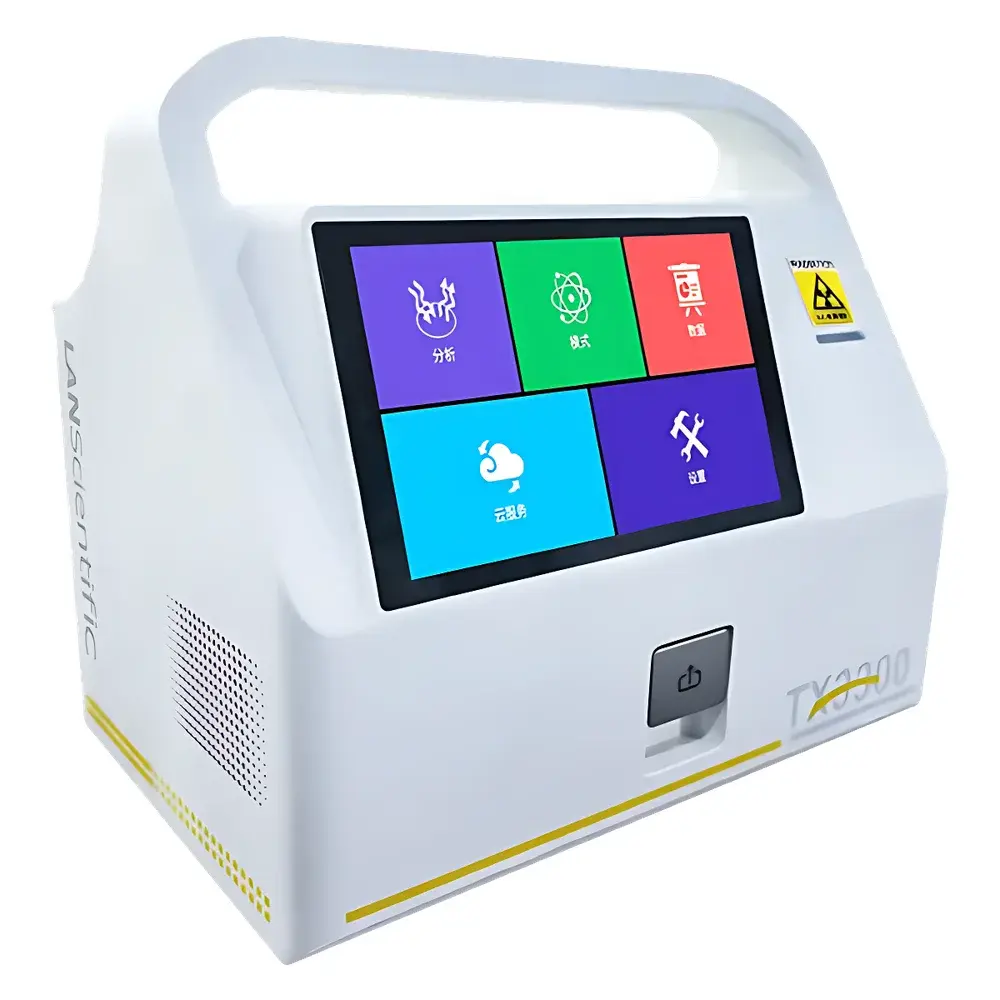
LANScientific TX3300 Total Reflection X-Ray Fluorescence Spectrometer
| Brand | LANScientific |
|---|---|
| Origin | Jiangsu, China |
| Manufacturer Type | Original Equipment Manufacturer (OEM) |
| Product Category | Domestic |
| Model | TX3300 |
| Application | Portable/Field-Deployable |
| Instrument Type | Total Reflection X-Ray Fluorescence (TXRF) |
| Elemental Range | Mg (12) to U (92) |
| Detection Limit | 20 pg/mL (ppb) in liquid matrix |
| Detector | 20 mm² Silicon Drift Detector (SDD) |
Overview
The LANScientific TX3300 Total Reflection X-Ray Fluorescence (TXRF) Spectrometer is a field-deployable, benchtop-capable analytical instrument engineered for ultra-trace multi-element quantification in micro-volume samples. Unlike conventional energy-dispersive X-ray fluorescence (ED-XRF) systems, the TX3300 operates on the physical principle of total external reflection: incident X-rays strike the sample—deposited as a thin film on a polished quartz carrier—at a grazing incidence angle (< 0.1°), minimizing substrate scattering and background continuum. This geometry yields an exceptionally low background-to-signal ratio, enabling detection limits down to 20 pg/mL (equivalent to ~20 ppb in aqueous standards) for elements from magnesium (Z=12) to uranium (Z=92). Designed for rapid, non-destructive analysis without digestion, acid treatment, or calibration curves, the TX3300 delivers quantitative results within two minutes per sample—making it suitable for real-time decision support in environmental monitoring, regulatory compliance, and process control environments where laboratory turnaround is impractical.
Key Features
- Ultra-low detection capability: Achieves sub-ppb sensitivity (20 pg/mL) for trace metals via optimized TXRF geometry and high-resolution 20 mm² SDD detector
- Micro-sample compatibility: Requires only 1–10 µL of liquid, suspension, or digested residue; solid particulates can be suspended and deposited directly
- True multi-element analysis: Simultaneously quantifies up to 30 elements—including Cr, Pb, Cd, As, Hg, Ni, Cu, Zn—without sequential scanning or hardware reconfiguration
- Portable architecture: Compact footprint (< 35 cm × 30 cm × 25 cm), weight 4 hours continuous operation
- Grazing-incidence optics: Minimizes Bremsstrahlung background and enhances peak-to-background ratio by >10³ versus conventional ED-XRF
- Zero-consumables operation: No vacuum pumps, helium purge, or cryogenic cooling required; detector maintained at Peltier-stabilized -20°C
- Low-power design: Operates at < 25 W average power draw, compatible with solar-charged mobile power stations
Sample Compatibility & Compliance
The TX3300 accepts liquid samples (aqueous, organic solvents, digestates), colloidal suspensions, dried residues, and homogenized biological matrices (e.g., serum, urine filtrates). Solid powders are dispersed ultrasonically prior to deposition. All analyses comply with ISO 20575:2021 (XRF — Quantitative analysis using total-reflection geometry), and methodology aligns with EPA Method 6020B (ICP-MS) and ASTM D7724–22 (Trace metal determination in fuels) for cross-platform validation. For regulated environments, data acquisition supports audit-ready metadata logging (user ID, timestamp, location GPS tag, instrument ID), satisfying GLP/GMP documentation requirements and enabling traceability under FDA 21 CFR Part 11 when paired with LANScientific’s optional secure software license.
Software & Data Management
The embedded TX3300 Control Suite v3.2 provides intuitive workflow-driven operation: automated peak deconvolution (based on fundamental parameter algorithms), internal standard correction (e.g., Ga or Y spike), and matrix-matched calibration libraries for water, soil extract, blood serum, and fuel matrices. Raw spectral data (CIF, .rxf) and processed reports (PDF, CSV) are exportable via USB-C or Wi-Fi. Cloud synchronization (optional LANCloud Connect module) enables remote instrument monitoring, centralized method deployment across multi-site deployments, and version-controlled SOP distribution. All spectral processing adheres to IUPAC recommendations for uncertainty propagation in TXRF quantification.
Applications
- Environmental Monitoring: Field screening of heavy metals in surface water, leachates, airborne particulate filters (PM2.5/PM10), and soil pore water—supporting ISO 17294-2 and EU WFD compliance
- Materials Science: Surface contamination analysis on silicon wafers (≤ 10¹⁰ atoms/cm² sensitivity), catalyst residue profiling in battery cathode slurries, and impurity mapping in optical glass batches
- Food & Beverage Safety: Direct quantification of toxic elements (Pb, As, Cd, Hg) in wine, fruit juice, edible oils, and infant formula without digestion—validated against AOAC 2017.16 and EN 17246:2020
- Pharmaceutical Quality Control: Residual catalyst (Pd, Pt, Rh) testing in API intermediates; elemental impurities in excipients per ICH Q3D Stage 4 guidelines
- Fuel & Energy: Trace metal speciation (Na, V, Ni, Fe) in methanol, ethanol, biodiesel, and aviation turbine fuels per ASTM D482 and ISO 8217 Annex D
- Forensics & Cosmetics: Micro-trace evidence analysis (hair, gunshot residue, textile fibers); heavy metal verification in lipstick, foundation, and eye shadow per SCCS/EC 1223/2009 Annex II
FAQ
What sample preparation is required for TXRF analysis?
Minimal preparation: liquids are pipetted directly onto quartz carriers; solids require dissolution or suspension in ultrapure water/methanol followed by spin-coating. No acid digestion, filtration, or matrix modifiers are needed.
Can the TX3300 quantify light elements below magnesium?
No—due to absorption in air and detector window constraints, the practical lower limit remains Mg (Z=12). Beryllium (Z=4) through sodium (Z=11) require vacuum or He-purged configurations not supported by this portable platform.
How is calibration performed?
Using single- or multi-element standard solutions deposited alongside samples. Internal standard addition (e.g., 100 ng/mL Ga) corrects for film thickness variation and instrumental drift—eliminating need for daily recalibration.
Is spectral interference correction available?
Yes—the software applies iterative least-squares fitting with reference spectra libraries (NIST SRM 2783, BAM BCR-715) and accounts for L-line overlaps (e.g., Pb Mα vs As Kα) and Compton scatter contributions.
Does the system support regulatory reporting formats?
Yes: PDF reports include full metadata (instrument serial, operator ID, GPS coordinates, uncertainty estimates), digital signatures, and optional e-signature integration compliant with 21 CFR Part 11 when enabled via licensed firmware module.
Related Products





