
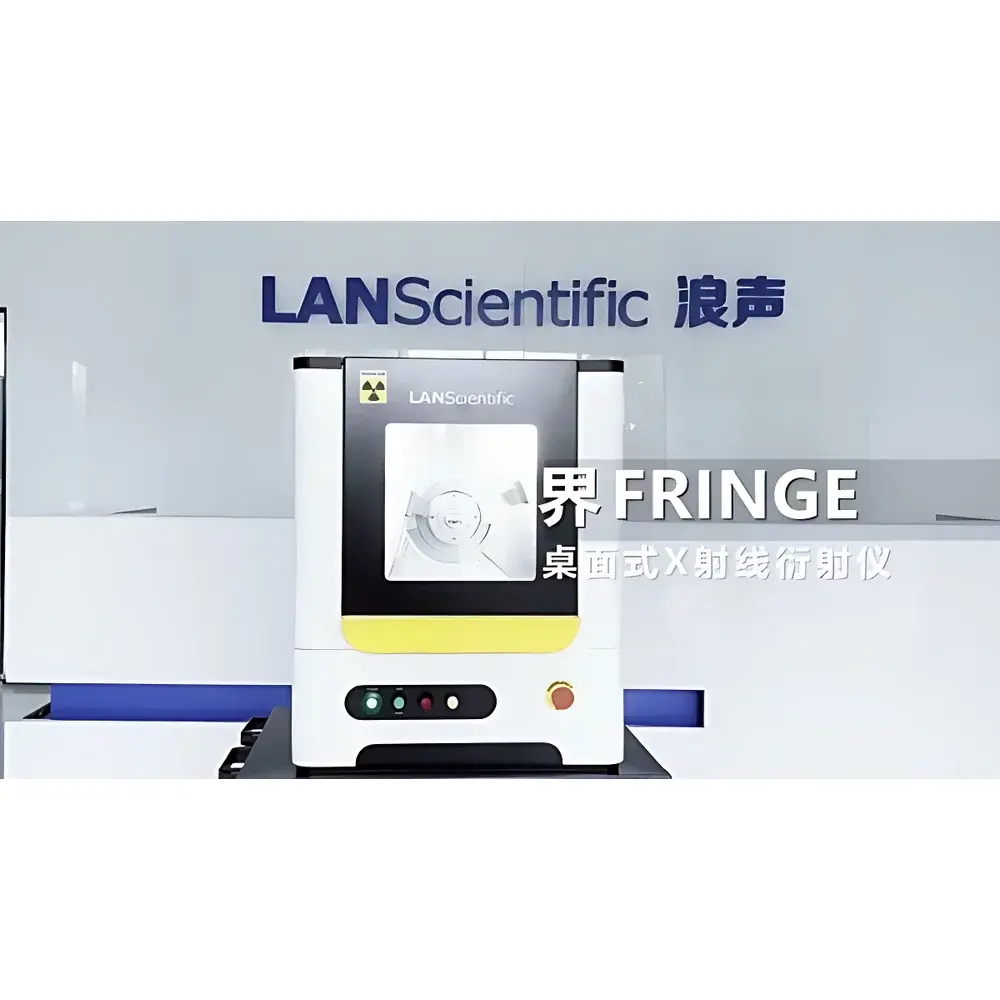
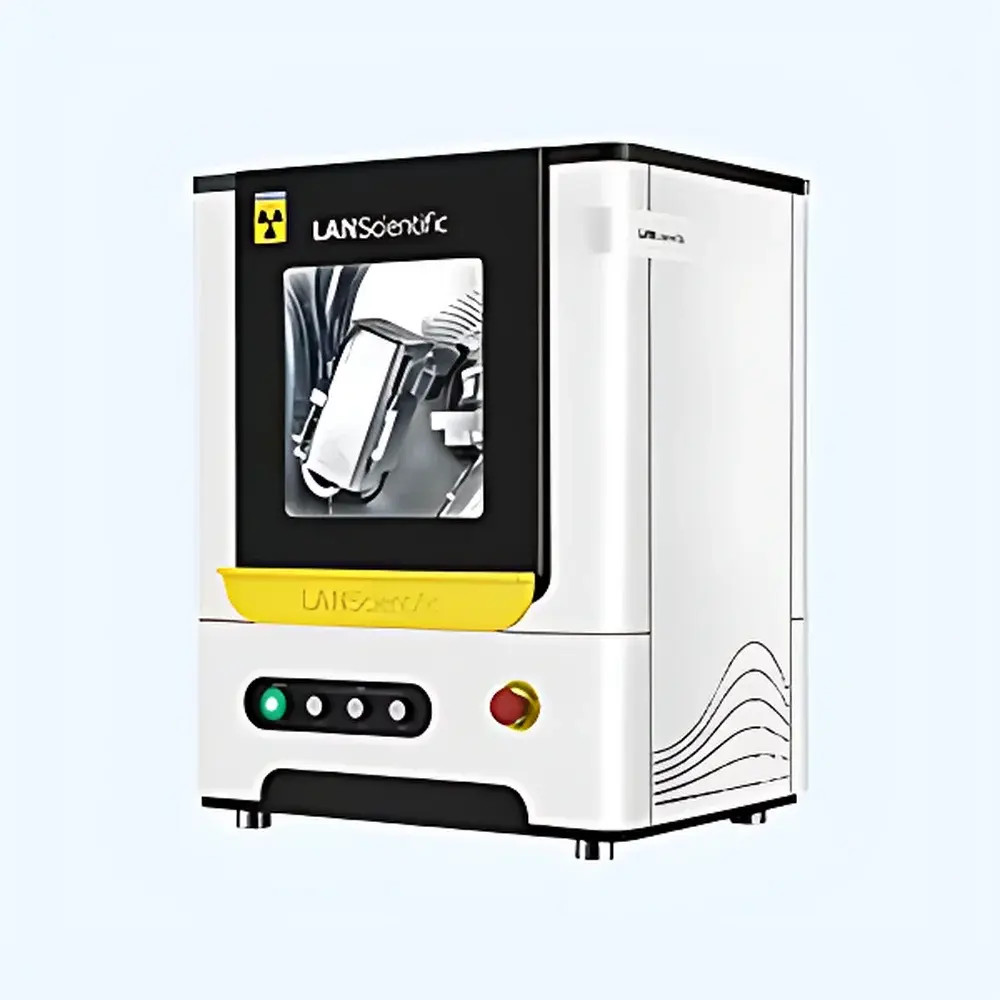
Brookfield FRINGE Benchtop X-ray Diffractometer
| Brand | LANScientific |
|---|---|
| Origin | Jiangsu, China |
| Manufacturer Type | Original Equipment Manufacturer (OEM) |
| Product Category | Domestic |
| Model | FRINGE |
| Instrument Type | Powder X-ray Diffractometer |
| Configuration | Benchtop |
| Power Supply | Standard 220 V AC, 50/60 Hz (cooling integrated |
| Detector | Digital Pulse Processing Counter (DPPC), ≥1×10⁷ counts per second (CPS), energy-dispersive capability enabled |
| Optical Geometry | Bragg–Brentano θ–2θ reflection mode with fixed divergence slit, Soller slits, anti-scatter slit, and receiving slit |
| Sample Stage | Motorized goniometer with ±0.001° angular reproducibility |
| Software | CrystalX — automated phase identification, quantitative Rietveld refinement, crystallinity index calculation, and elemental spectral overlay (EDS-compatible) |
Overview
The Brookfield FRINGE Benchtop X-ray Diffractometer is a compact, high-integrity powder X-ray diffractometer engineered for precision crystallographic analysis in space-constrained laboratory environments. Operating on the Bragg–Brentano θ–2θ reflection geometry, the system directs a collimated Cu Kα X-ray beam—generated by a sealed-tube source—through a fixed divergence slit and dual Soller collimators onto the sample mounted at the center of a high-stability goniometer. Diffracted intensities satisfying Bragg’s law (nλ = 2d sinθ) are collected by a high-throughput Digital Pulse Processing Counter (DPPC) detector, which simultaneously delivers diffraction intensity data and energy-dispersive spectral information without requiring secondary monochromators. This architecture enables robust phase identification, semi-quantitative and Rietveld-based quantitative phase analysis, lattice parameter refinement, crystallite size estimation (Scherrer analysis), microstrain evaluation, and bulk crystallinity assessment—all within a footprint smaller than 0.5 m².
Key Features
- Benchtop form factor with integrated water-cooling loop—eliminates dependency on external chillers and reduces ambient thermal drift
- Air-spring assisted large-window hinged door—enables unobstructed sample access while maintaining full radiation shielding compliance when closed
- Fixed-component optical path: monolithic Soller slit assembly with no moving or adjustable parts—enhances long-term angular calibration stability and supports mobile deployment (e.g., vehicle-mounted labs)
- DPPC detector with ≥1×10⁷ CPS counting rate and intrinsic fluorescence suppression—delivers high peak-to-background ratios even for Fe-, Mn-, or rare-earth-rich samples
- Real-time thermal monitoring interface within CrystalX software—displays coolant temperature, flow rate, and anode thermal load to support predictive maintenance and protocol validation
- Interlocked safety architecture: automatic X-ray cutoff upon door opening, hardware-enforced shutter control, and GUI-based status feedback confirming interlock integrity prior to exposure
Sample Compatibility & Compliance
The FRINGE platform accommodates diverse physical sample formats—including loose powders (packed or spun), solid pellets, polished bulk metals, thin films (on Si wafers or glass substrates), and geological core fragments—via optional stage adapters (reflection, transmission, and grazing-incidence modules). All configurations maintain alignment traceability to NIST-traceable Si SRM 640e reference material. The system conforms to IEC 61000-6-3 (EMC), IEC 61000-6-4 (immunity), and national Class II radiation safety regulations (GBZ 138–2002). Its fully enclosed sample chamber meets ISO 20816-1 vibration sensitivity requirements for benchtop operation and supports GLP-compliant audit trails when paired with CrystalX’s 21 CFR Part 11–enabled user authentication and electronic signature modules.
Software & Data Management
CrystalX is a purpose-built analytical suite supporting ISO 17025-aligned workflows. It features automated background subtraction (adaptive polynomial fitting), Le Bail and Pawley profile fitting, full-pattern Rietveld refinement (using GSAS-II engine integration), and crystallinity index calculation via reference intensity ratio (RIR) or whole-pattern deconvolution methods. Raw .raw and .xy files are exportable in CIF, PDF-4+, and ICDD database-compatible formats. Audit logs record operator ID, timestamp, instrument parameters, and post-processing steps—including manual peak masking or constraint adjustments—with SHA-256 hashing for data integrity verification. Network-enabled deployment allows centralized license management and remote diagnostics via TLS-encrypted HTTP(S) API endpoints.
Applications
The FRINGE system serves routine and research-grade structural characterization across regulated and academic domains: quantitative phase analysis of cathode materials (LiCoO₂, NMC, LFP) and sintered ceramic electrolytes in battery development; polymorph screening and hydrate quantification in pharmaceutical APIs per USP ; clinker phase quantification (alite, belite, ferrite) in cement QA/QC per ASTM C150; mineralogical mapping of drill core samples in geochemical exploration; texture analysis of rolled metal alloys; and thin-film strain profiling in semiconductor packaging R&D. Its rapid setup (<5 min from power-on to first scan) and low operational overhead make it suitable for teaching laboratories conducting undergraduate crystallography courses aligned with ACS and RSC curriculum standards.
FAQ
Does the FRINGE require external cooling infrastructure?
No. It integrates a closed-loop water recirculation system with real-time thermal telemetry—no chiller, no plumbing, and no floor space allocation beyond the instrument footprint.
Can CrystalX perform quantitative analysis without user-defined Rietveld models?
Yes. The software includes pre-compiled ICDD PDF-4+ libraries and supports auto-phase matching with internal standard normalization (e.g., corundum spike method) for rapid semi-quantitative results without full structural modeling.
Is the DPPC detector capable of simultaneous XRD and XRF acquisition?
Yes. The detector outputs both angle-resolved diffraction intensity and photon-energy histograms per acquisition cycle—enabling correlative crystallographic and elemental analysis without hardware reconfiguration.
What safety certifications does the FRINGE hold for international shipment?
It carries CE marking under the EU Radiation Protection Directive 2013/59/Euratom and complies with RoHS 2015/863 and REACH SVHC disclosure requirements—documentation available upon request for customs clearance.
How is angular calibration maintained over time?
The fixed Soller slit design and motorized goniometer with optical encoder feedback eliminate mechanical drift sources; annual verification against NIST SRM 640e is recommended and supported by built-in calibration routines in CrystalX.





