
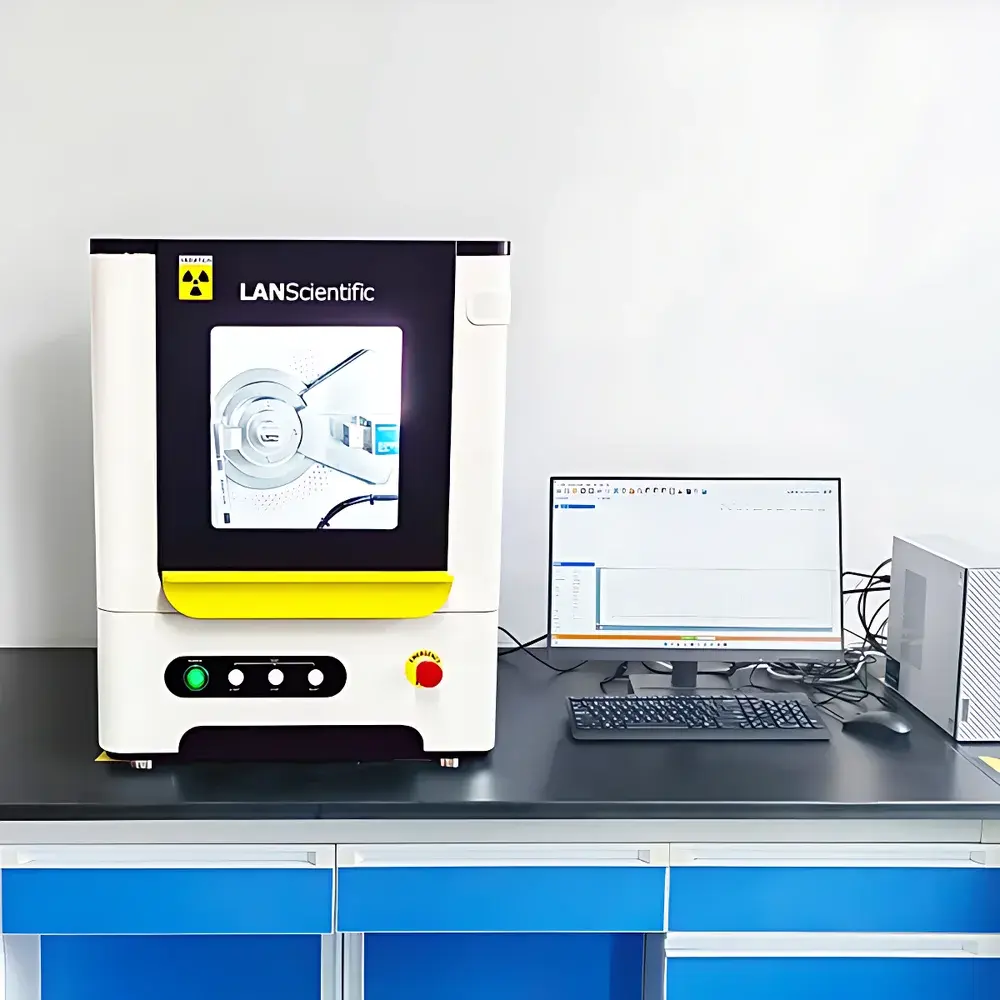
LANScientific FRINGE EV Desktop X-ray Diffractometer for Graphitization Degree Analysis
| Brand | LANScientific |
|---|---|
| Origin | Jiangsu, China |
| Manufacturer Type | Original Equipment Manufacturer (OEM) |
| Instrument Type | Powder X-ray Diffractometer |
| Geometry | Bragg-Brentano θ–2θ reflection mode |
| Power | kW-class sealed-tube X-ray source (rated output ≥ 1.8 kW) |
| Detector | Digital Pulse Processing Counter (DPPC), count rate capacity ≥ 1×10⁷ cps |
| Sample Stage | Motorized goniometer with integrated Soller slits, fixed divergence slit, anti-scatter slit, and receiving slit |
| Compliance | CE-marked, IEC 61010-1 safety certified, radiation-shielded enclosure with interlocked safety door and real-time chamber status feedback |
| Software | CrystalX™ v3.x — automated phase identification (ICDD PDF-4+ database), quantitative Rietveld refinement, crystallinity index calculation (e.g., Lc, La, graphitization degree via (002) peak FWHM & d-spacing), energy-dispersive spectroscopy (EDS) co-acquisition support |
| Sample Forms | Powders, solid blocks, thin films, coatings |
| Dimensions | 620 × 540 × 480 mm (W × D × H) |
| weight | ~95 kg |
Overview
The LANScientific FRINGE EV is a benchtop X-ray diffractometer engineered specifically for quantitative structural characterization of carbon-based materials, with primary application in graphitization degree analysis of graphite, graphene precursors, carbon black, coke, and synthetic carbons. Operating on the Bragg-Brentano θ–2θ reflection geometry, the system utilizes monochromatic Cu-Kα radiation (λ = 1.5418 Å) generated by a high-stability, air-cooled kW-class sealed X-ray tube. Diffraction patterns are acquired across 2θ ranges from 5° to 90°, enabling precise determination of the (002) interplanar spacing (d₀₀₂), full width at half maximum (FWHM) of the (002) peak, and lattice parameter c-axis expansion—key parameters directly correlated to graphitic domain size and stacking order. The instrument adheres to ISO 13292:2017 (Carbonaceous materials — Determination of degree of graphitization by X-ray diffraction) and supports ASTM D5025 (Standard Test Method for Determining the Degree of Graphitization of Carbon and Graphite Materials) workflows through standardized data reduction protocols.
Key Features
- kW-class X-ray source delivering stable, high-flux irradiation without water cooling—enabling rapid data acquisition (< 5 min per scan) while maintaining thermal stability over extended operation cycles.
- Integrated Soller slit assembly with fixed divergence and anti-scatter geometry—eliminates mechanical adjustment points, enhancing angular reproducibility (±0.01° 2θ) and long-term goniometer reliability for field-deployable or mobile lab use.
- Digital Pulse Processing Counter (DPPC) detector with ≥1×10⁷ counts per second throughput—provides simultaneous XRD pattern acquisition and energy-dispersive spectral fingerprinting without secondary monochromators, supporting elemental co-localization during structural analysis.
- Air-spring assisted large-window sliding door—fully encloses the sample chamber during operation; interlock circuitry cuts X-ray emission instantly upon door opening, complying with IEC 62495 and national radiation safety regulations.
- Compact footprint (0.34 m²) and low-height design—optimized for standard laboratory desks, cleanrooms, and vehicle-mounted analytical platforms without requiring dedicated floor space or structural reinforcement.
Sample Compatibility & Compliance
The FRINGE EV accommodates diverse sample formats including pressed powder pellets (Ø 13–25 mm), bulk solids (max. thickness 10 mm), free-standing films (≥5 µm thick), and coated substrates. No vacuum or inert atmosphere is required for routine operation, though optional He-purged or vacuum sample chambers are available for moisture-sensitive or low-Z materials. All hardware and firmware conform to GLP-compliant audit trail requirements: software logs user ID, timestamp, instrument configuration, raw data checksums, and processing history. CrystalX™ supports 21 CFR Part 11–compliant electronic signatures, role-based access control, and encrypted data storage—validated for regulated environments in pharmaceutical excipient QC, battery anode material release testing, and nuclear-grade graphite certification.
Software & Data Management
CrystalX™ v3.x integrates three core analytical engines: (1) Automated phase identification using ICDD PDF-4+ (2023 release) with confidence-index ranking and Z-score validation; (2) Rietveld-based quantitative phase analysis (QPA) with internal standard calibration and preferred orientation correction; (3) Graphitization-specific modules calculating La (crystallite size perpendicular to basal planes), Lc (stacking height), d₀₀₂ deviation from ideal graphite (3.354 Å), and the Tuinstra–Koenig empirical ratio (ID/IG equivalent via XRD peak deconvolution). Raw .raw/.xy files are stored in NeXus-compatible HDF5 format; processed reports export to PDF, CSV, and CIF—compatible with LIMS integration via RESTful API.
Applications
- Quantitative assessment of graphitization degree in lithium-ion battery anode materials (e.g., synthetic graphite, hard carbon, silicon-carbon composites).
- Quality control of nuclear graphite moderators—monitoring irradiation-induced lattice distortion and thermal annealing recovery.
- Characterization of carbon fiber precursors (PAN-, pitch-based) during stabilization and carbonization processes.
- Crystallinity mapping of graphene oxide reduction pathways and defect density evolution.
- Mineralogical analysis of natural graphite ores and flotation concentrates for beneficiation optimization.
- Pharmaceutical polymorph screening where carbon-containing excipients (e.g., microcrystalline cellulose, croscarmellose sodium) require baseline crystallinity referencing.
FAQ
What standards does the FRINGE EV support for graphitization degree calculation?
It implements ISO 13292:2017 and ASTM D5025 methodologies, including d₀₀₂-based calibration curves and FWHM-derived crystallite size models.
Can the DPPC detector acquire EDS data simultaneously with XRD?
Yes—the detector outputs pulse-height spectra synchronized with diffraction angle position, enabling correlative structural + elemental analysis without hardware switching.
Is remote operation supported?
CrystalX™ includes secure VNC-enabled remote desktop control and scheduled batch acquisition via Windows Task Scheduler or command-line interface.
Does the system require external chiller or compressed air?
No—kW-class tube is air-cooled; only standard 230 V / 16 A single-phase power and ambient lab ventilation are required.
How is measurement reproducibility validated?
Built-in NIST-traceable Si standard (SRM 640e) is included for daily angular calibration; long-term drift monitoring is automated within CrystalX™’s QA/QC dashboard.






