
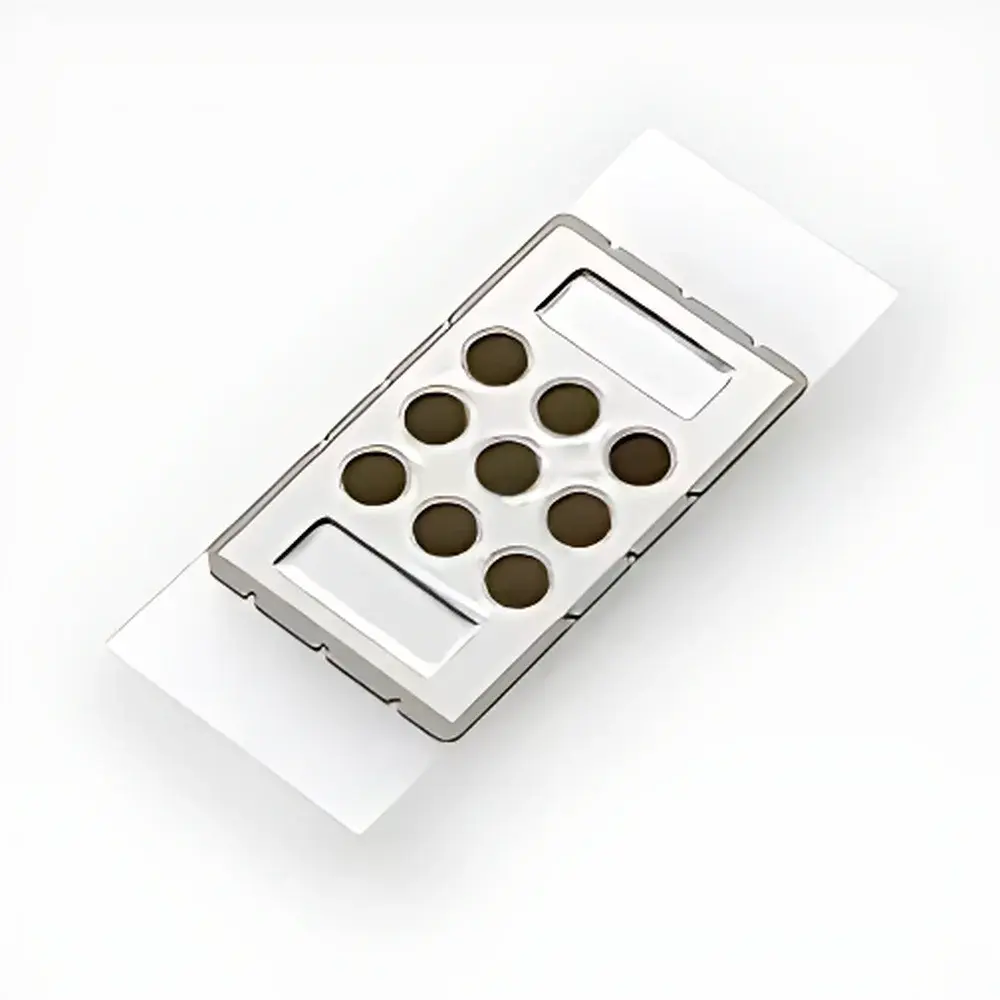
Hamamatsu DIUTHAME A14111-3-1 Porous Anodic Aluminum Oxide (AAO) Substrate for Matrix-Free Laser Desorption/Ionization Mass Spectrometry
| Brand | Hamamatsu |
|---|---|
| Origin | Japan |
| Manufacturer | Hamamatsu Photonics K.K. |
| Product Type | Imported |
| Model | A14111-3-1 |
| Pricing | Available Upon Request |
Overview
The Hamamatsu DIUTHAME A14111-3-1 is a precision-engineered porous anodic aluminum oxide (AAO) membrane substrate designed for matrix-free surface-assisted laser desorption/ionization (SA-LDI) in mass spectrometry imaging (MSI). Unlike conventional MALDI, which requires homogeneous crystallization of organic matrix compounds onto the sample surface—a step introducing spatial heterogeneity, chemical background noise, and analytical variability—DIUTHAME leverages its ordered nanochannel architecture (pore diameter ~50–100 nm, aspect ratio >100) to enable direct analyte adsorption and efficient energy transfer under UV laser irradiation (typically 337 nm or 355 nm). This physical ionization mechanism eliminates matrix-related adducts, suppression effects, and spectral interference below <500 Da, making it especially suitable for low-molecular-weight metabolite, lipid, and small-molecule drug distribution mapping in biological and industrial samples. The A14111-3-1 variant features nine discrete 3 mm-diameter active ionization zones arranged in a standardized 9-hole plate layout, enabling parallel or sequential analysis of multiple tissue sections or material spots without cross-contamination.
Key Features
- Matrix-free ionization platform: Removes dependence on crystalline organic matrices, eliminating matrix-derived chemical noise and improving signal-to-noise ratio for endogenous low-MW species.
- High spatial reproducibility: Nanoscale pore uniformity ensures consistent laser energy coupling and analyte desorption across repeated acquisitions—critical for quantitative MSI workflows.
- Reduced sample preparation time: Enables direct blotting or vapor-phase extraction protocols; typical pre-analysis handling time reduced to ≤10% of standard MALDI workflow duration.
- Compatible with commercial MALDI-TOF, MALDI-QTOF, and MALDI-FTICR instruments: No hardware modification required; functions as a drop-in replacement for conventional stainless steel or conductive glass target plates.
- Chemically inert and thermally stable: Anodized alumina substrate withstands repeated laser pulses and common solvent rinsing (e.g., acetonitrile, methanol, water), supporting rigorous cleaning between runs.
- Batch-certified manufacturing: Produced under Hamamatsu’s ISO 9001-certified cleanroom processes; each A14111-3-1 lot undergoes SEM verification of pore morphology and dimensional tolerance (±0.1 mm per channel).
Sample Compatibility & Compliance
The A14111-3-1 supports diverse sample types including frozen tissue sections (mouse brain, chicken muscle, strawberry, black rice), polymer films, industrial coatings, pharmaceutical tablets, and blot-transfer membranes. It has been validated in peer-reviewed studies for both direct-contact blotting and non-contact vapor-phase extraction methods. As a passive consumable substrate—not an active electronic component—it complies with IEC 61010-1 (safety requirements for laboratory equipment) and meets RoHS Directive 2011/65/EU restrictions on hazardous substances. While not a medical device, its use in GLP-compliant preclinical research environments aligns with FDA 21 CFR Part 11 data integrity expectations when paired with audit-trail-enabled acquisition software (e.g., Bruker flexImaging, Shimadzu Imaging MS Solution).
Software & Data Management
No proprietary software is required. The A14111-3-1 integrates natively with all major vendor MSI platforms—including Bruker flexControl/flexImaging, Waters MassLynx/HDMS, Shimadzu Imaging MS Solution, and Thermo Scientific Xcalibur—and third-party open-source tools such as SCiLS Lab, MSiReader, and Cardinal. Raw spectral data are acquired in standard formats (.fid, .raw, .imzML), ensuring full traceability and compatibility with downstream multivariate statistical analysis (PCA, t-SNE, clustering). When used in regulated environments, instrument control logs, acquisition timestamps, and user authentication records must be maintained per ALCOA+ principles; Hamamatsu provides lot-specific CoA documentation upon request to support method validation.
Applications
- High-fidelity metabolic mapping of fresh/frozen plant and animal tissues without matrix interference.
- Quantitative distribution profiling of additives, plasticizers, and degradation products in polymer composites and packaging materials.
- Label-free spatial pharmacokinetics of small-molecule therapeutics in skin, cornea, or tumor xenograft sections.
- Rapid quality control screening of food authenticity (e.g., anthocyanin localization in black rice) and adulteration detection.
- Surface characterization of functionalized industrial surfaces, catalysts, and battery electrode coatings.
- Method development for ambient ionization workflows requiring minimal sample manipulation and high throughput.
FAQ
Is the A14111-3-1 compatible with high-vacuum MALDI sources?
Yes—its low outgassing rate (<1×10⁻⁹ mbar·L/s at 25°C, measured per ASTM E595) ensures stable vacuum performance across TOF, Q-TOF, and FTICR systems.
Can the same DIUTHAME substrate be reused?
No—each A14111-3-1 is intended for single-use to prevent carryover and maintain reproducibility; however, unused channels within the 9-hole array may be reserved for subsequent analyses if properly stored under desiccated conditions.
What laser fluence range is recommended?
Optimal performance is achieved at 10–50 µJ/pulse (337 nm, 3–5 ns pulse width); excessive fluence (>80 µJ) may induce local pore collapse, degrading ion yield consistency.
Does Hamamatsu provide application support for method optimization?
Yes—technical application notes, SOP templates, and reference datasets (including mouse brain, strawberry, and polymer imaging examples) are available through Hamamatsu’s global technical support portal and ASMS-published literature archive.
How does DIUTHAME compare to other SA-LDI substrates like silicon nanopost arrays or graphene oxide films?
DIUTHAME offers superior batch-to-batch uniformity, higher thermal conductivity than carbon-based substrates, and intrinsic electrical insulation—reducing arcing risks during high-repetition-rate laser operation. Its pore geometry also enables controlled analyte confinement, enhancing sensitivity for volatile species relative to planar nanostructures.





