
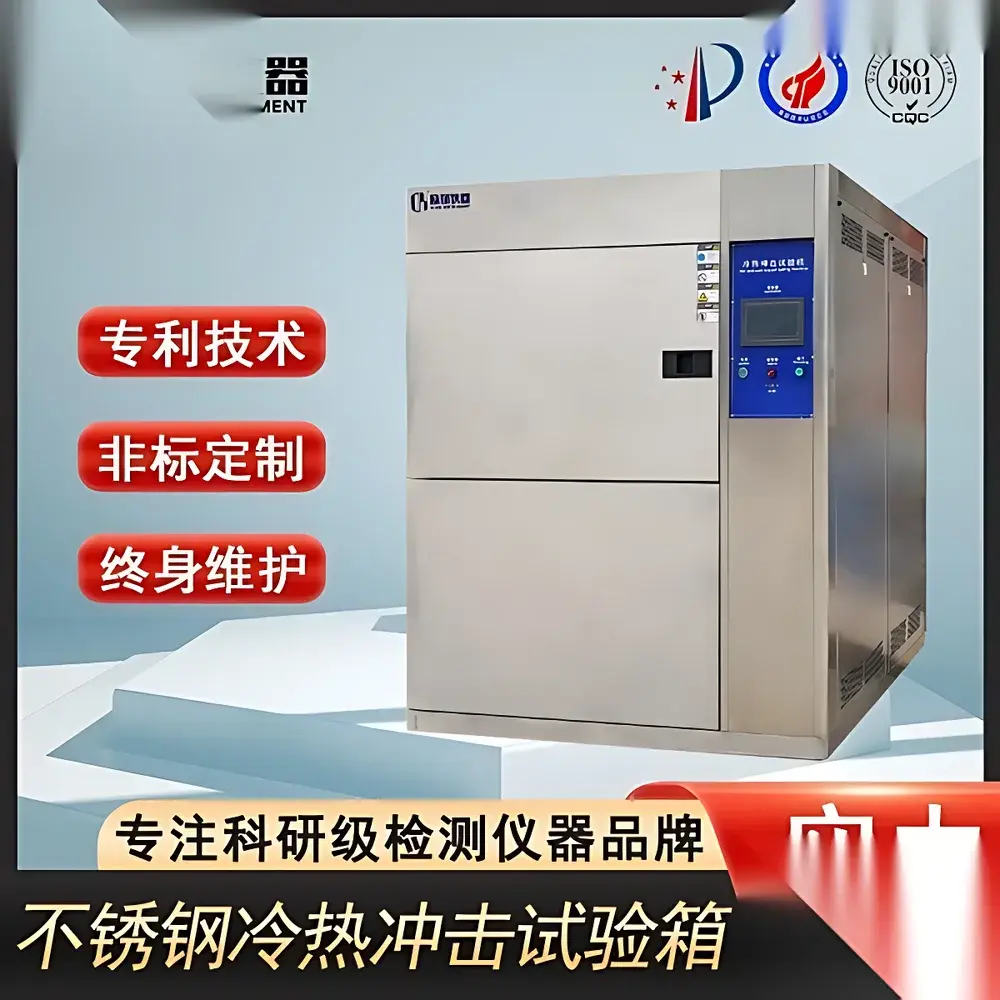
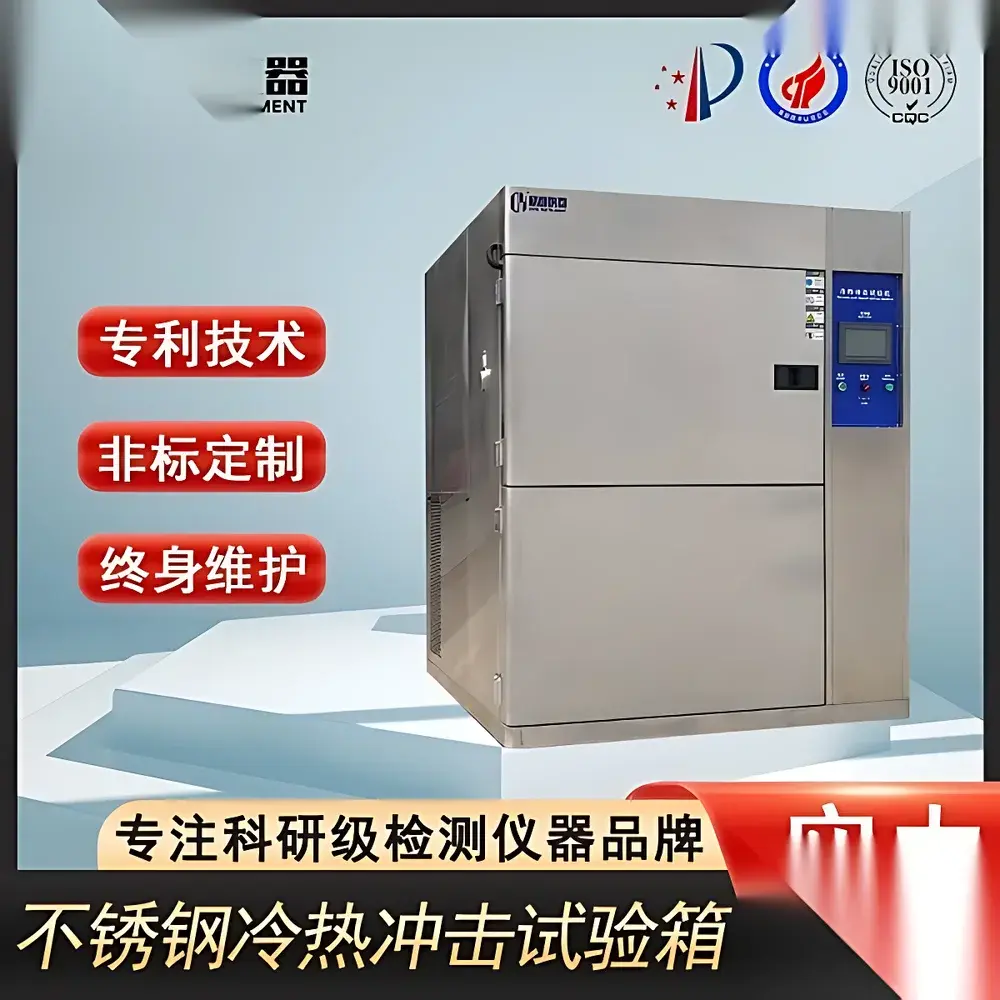
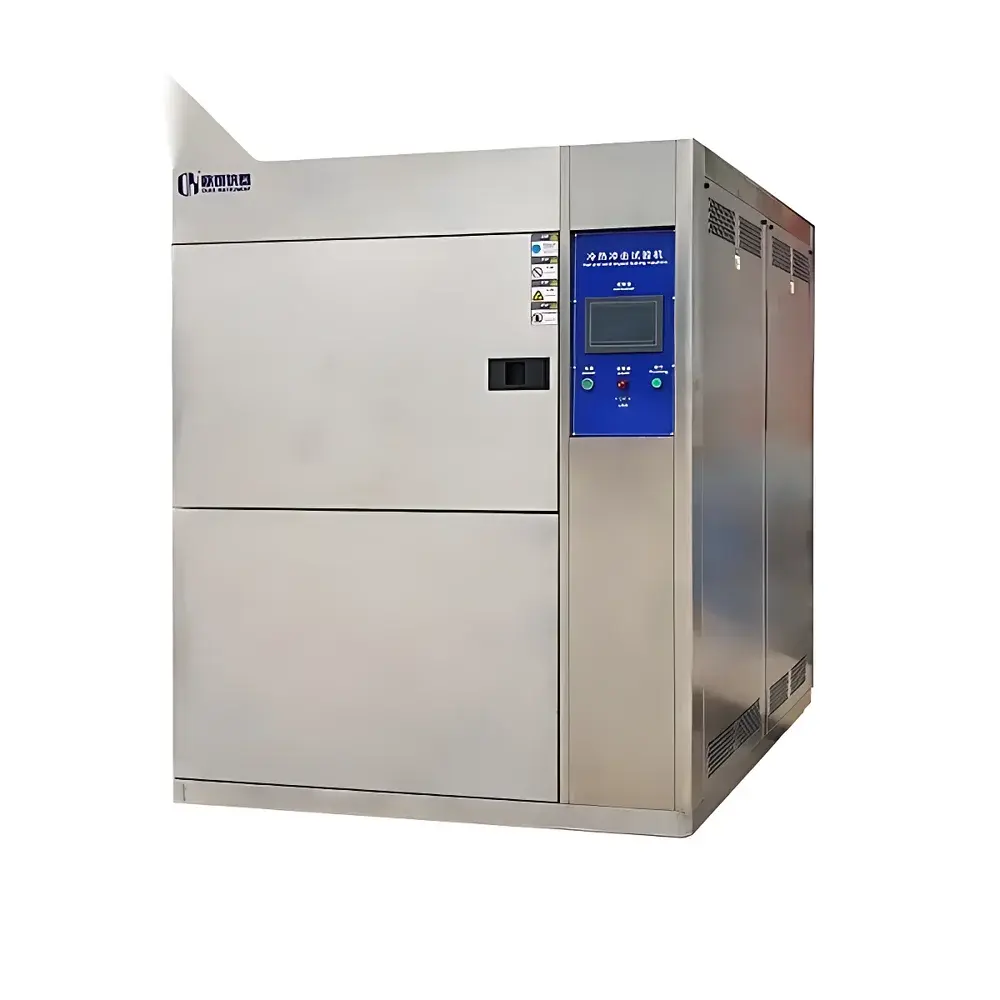
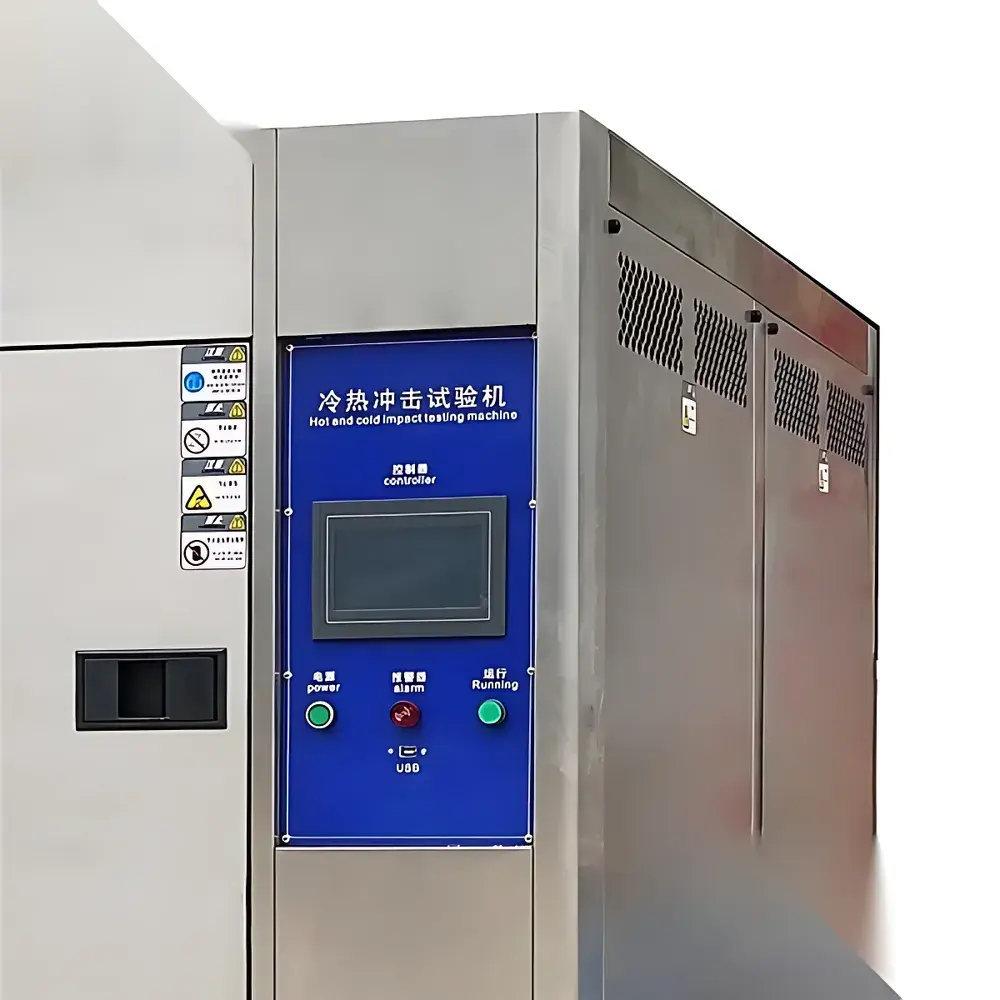
Stainless Steel Thermal Shock Test Chamber
| Key | Brand: Other Brands |
|---|---|
| Origin | Imported |
| Manufacturer Type | General Distributor |
| Price | USD 12,500 (FOB) |
| Internal Dimensions (W×H×D) | 40×35×30 cm to 70×60×60 cm |
| External Dimensions (W×H×D) | 145×180×140 cm to 190×170×270 cm |
| Hot Zone Temperature Range | RT to +200 °C |
| Cold Zone Temperature Range | RT to −70 °C |
| Test Zone Temperature Range | +60 °C to +150 °C (hot shock) |
| Switching Mechanism | Pneumatic damper–actuated air door, static test specimen |
| Preheating Time (RT→150 °C) | ~30 min |
| Precooling Time (RT→−70 °C) | ~85 min |
| Recovery Time | <5 min |
| Temperature Control Accuracy | ±0.5 °C |
| Temperature Uniformity | ±2.0 °C |
| Refrigeration System | Dual-stage cascade refrigeration with semi-hermetic compressors (Germany-sourced), R404A/R23 refrigerants |
| Inner Chamber Material | SUS#304 mirror-finish stainless steel |
| Outer Chamber Material | SUS#304 stainless steel or powder-coated steel |
| Insulation | High-density fire-retardant PU foam |
| Power Supply | AC 380 V ±5%, 50 Hz ±0.5 Hz, 3-phase 5-wire, 2.5 m cable |
| Accessories | One Φ50 mm cable port |
Overview
The Stainless Steel Thermal Shock Test Chamber is an engineered environmental test system designed to evaluate the structural integrity and functional reliability of materials and components subjected to rapid, repetitive transitions between extreme high and low temperatures. Operating on the principle of accelerated thermal stress induction—via controlled, high-rate temperature cycling—the chamber subjects test specimens to abrupt thermal gradients that simulate real-world operational extremes encountered in aerospace, automotive, electronics, and defense applications. Unlike conventional temperature cycling chambers, this unit implements a three-zone architecture (hot soak, cold soak, and test zone) or optional two-zone configuration with mechanical basket transfer, enabling precise, repeatable thermal shock profiles per international standards including IEC 60068-2-14 (Test N), MIL-STD-810H Method 503.5, and GJB 150.5A–2009. Its stainless steel construction ensures long-term corrosion resistance in humid or chemically aggressive laboratory environments, while its cascade refrigeration system delivers stable, low-temperature performance down to −70 °C without cryogenic consumables.
Key Features
- Triple-chamber design (standard) with independent hot zone (RT to +200 °C), cold zone (RT to −70 °C), and insulated test chamber—eliminates specimen movement and minimizes thermal inertia effects during transition.
- Dual-stage cascade refrigeration system using semi-hermetic compressors (Germany-sourced), optimized for rapid thermal recovery (<5 minutes) and stable low-temperature hold capability.
- Pneumatically actuated damper doors ensure precise, contamination-free air path switching between zones—no mechanical contact with test specimens, preserving positional repeatability and measurement fidelity.
- High-precision PID-controlled temperature regulation with ±0.5 °C accuracy and ±2.0 °C uniformity across the test volume—validated per ISO/IEC 17025 calibration traceability protocols.
- SUS#304 mirror-finish stainless steel interior and exterior surfaces—resistant to oxidation, cleaning agents, and condensate accumulation; compatible with cleanroom-grade maintenance practices.
- Energy-regulated refrigeration control logic dynamically modulates compressor load and expansion valve duty cycle—reducing power consumption by up to 22% during partial-load operation without compromising ramp rate or stability.
Sample Compatibility & Compliance
This chamber accommodates rigid and semi-rigid samples up to 70 cm × 60 cm × 60 cm (custom configurations available), including printed circuit boards (PCBs), semiconductor packages, battery modules, polymer housings, and metallic fasteners. It supports both non-powered and powered-in situ testing via the standard Φ50 mm feedthrough port and dual-tier stainless steel shelves. The system complies with critical industry-specific test requirements: GB/T 2423.22–2002 (Temperature Change), GJB 150.5A–2009 (Temperature Shock), MIL-STD-810H Method 503.5, IEC 60068-2-14, EIA-364-32 (Connector Thermal Shock), and QC/T 17–1992 (Automotive Component Environmental Testing). All thermal profiles are programmable and auditable, supporting GLP/GMP-aligned validation documentation for regulated sectors such as medical device manufacturing and avionics qualification.
Software & Data Management
The integrated controller features a 10.1-inch capacitive touchscreen HMI with embedded real-time data logging (1 Hz sampling rate), configurable alarm thresholds, and password-protected user roles. Test sequences—including dwell time, ramp rate, cycle count, and zone activation order—are defined via intuitive graphical programming. Raw temperature data (hot zone, cold zone, test zone, and chamber wall sensors) are exported in CSV format with UTC timestamps. Optional Ethernet/IP connectivity enables remote monitoring, SCADA integration, and secure data archival compliant with FDA 21 CFR Part 11 requirements—including electronic signatures, audit trails, and immutable record retention. Firmware updates are performed via USB or network, with version history and change logs maintained internally.
Applications
- Failure mode analysis of solder joints and interconnects in high-reliability electronics under thermal fatigue conditions.
- Validation of encapsulant adhesion and delamination resistance in optoelectronic assemblies (e.g., LED modules, laser diodes).
- Assessment of seal integrity and gasket performance in automotive powertrain components exposed to under-hood thermal transients.
- Qualification of composite material laminates for UAV airframes per MIL-STD-810H thermal shock criteria.
- Accelerated aging studies of lithium-ion battery cells to quantify capacity fade and internal resistance shift following repeated thermal excursions.
- Verification of coating adhesion and substrate cohesion in aerospace-grade aluminum alloys post-anodizing or plasma electrolytic oxidation (PEO).
FAQ
What is the difference between two-zone and three-zone thermal shock configurations?
The three-zone design maintains test specimens statically in a dedicated test chamber while rapidly alternating airflow from independently conditioned hot and cold reservoirs—ideal for high-precision metrology and vibration-sensitive devices. The two-zone variant uses a motorized basket to physically shuttle specimens between hot and cold chambers, offering faster transition times but introducing mechanical motion artifacts.
Is external cooling water required for operation?
Yes. The dual-stage cascade refrigeration system requires a continuous supply of chilled water at ≤32 °C, delivered via an external cooling tower (10 m³/h capacity recommended). This ensures sustained compressor efficiency and prevents high-side pressure excursions during extended low-temperature holds.
Can the chamber be validated for IQ/OQ/PQ protocols?
Yes. Factory-installed Class A PT100 sensors (traceable to NIST standards), documented uncertainty budgets, and pre-qualified calibration templates support full installation qualification (IQ), operational qualification (OQ), and performance qualification (PQ) per ISO/IEC 17025 and ASTM E2297 guidelines.
What safety interlocks are implemented?
Dual redundant door safety switches, over-temperature cutoffs (±5 °C deviation threshold), refrigerant high-pressure cutouts, and emergency power-off (EPO) circuitry conform to IEC 61000-6-2 EMC and UL 61010-1 electrical safety standards.
Does the system support automated reporting for regulatory submissions?
Yes. The embedded software generates PDF test reports containing operator ID, timestamped temperature curves, pass/fail status against selected standards (e.g., GJB 150.5A), and digital signature fields—all exportable with embedded metadata for FDA eCTD or AS9100 Rev D compliance.



