
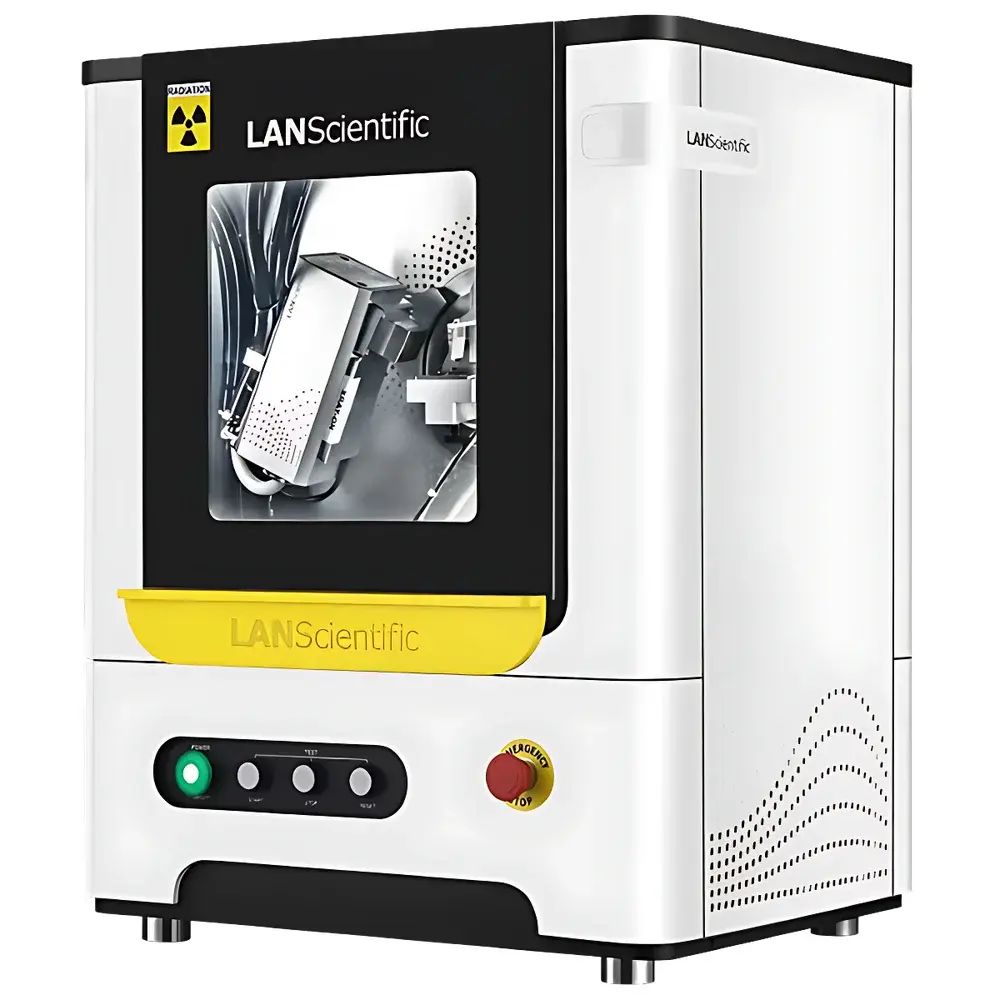
LANScientific FRINGE D200 Benchtop X-ray Diffractometer
| Brand | LANScientific |
|---|---|
| Origin | Jiangsu, China |
| Manufacturer Type | Direct Manufacturer |
| Product Category | Domestic |
| Model | FRINGE D200 |
| Instrument Type | Powder X-ray Diffractometer |
| Configuration | Benchtop |
| Power Rating | kW-class (air-cooled or integrated water-cooling system) |
| Detector | Xeye2D 2D hybrid pixel array detector |
| Goniometer | High-precision vertical θ–θ configuration |
| Software | CrystalX automated phase analysis suite |
| Sample Compatibility | Powders, bulk solids, thin films, liquids |
| Safety | Interlocked sample chamber, automatic beam shutter, real-time door status feedback |
| Optional Accessories | High-temperature stage, cryo-stage, humidity-controlled cell |
| Compliance | Designed to meet IEC 61010-1 (safety), ISO 17025 operational readiness guidelines, and GLP-aligned data integrity practices |
Overview
The LANScientific FRINGE D200 is a benchtop X-ray diffractometer engineered for high-fidelity powder X-ray diffraction (XRD) analysis in resource-constrained or space-limited laboratory environments. It operates on Bragg’s law-based crystallographic principles, utilizing monochromatic Cu Kα radiation (λ = 1.5418 Å) generated by a sealed-tube X-ray source with kW-class power output—uniquely elevated for its form factor. The instrument employs a vertical θ–θ goniometer architecture, eliminating sample displacement errors and ensuring angular reproducibility better than ±0.01° (2θ). Coupled with the Xeye2D hybrid pixel array detector, it supports simultaneous zero-dimensional (point detection), one-dimensional (line scan), and two-dimensional (area detection) data acquisition modes. In 2D mode, Debye–Scherrer rings are captured in real time, enabling rapid assessment of crystallite orientation distribution, preferred orientation, and microstructural homogeneity without reconfiguration.
Key Features
- Compact benchtop footprint (≤ 0.8 m² floor space) with integrated water-circulation cooling—no external chiller required.
- Vertical θ–θ goniometer with direct-drive stepper motors and optical encoder feedback for sub-arcminute angular resolution.
- Xeye2D detector: 256 × 256 pixel array, single-photon counting capability, dynamic range > 10⁶, frame rate up to 100 Hz—optimized for both high-intensity and low-dose measurements.
- Integrated Soller slit assembly with fixed geometry—no moving parts—enhancing long-term mechanical stability and suitability for mobile or field-deployable labs.
- Motorized air-spring assisted sample chamber door with force-limited actuation and real-time interlock verification.
- Automatic beam shutter synchronized with door position and exposure timing; full hardware-enforced radiation containment during idle states.
Sample Compatibility & Compliance
The FRINGE D200 accommodates diverse physical forms: free-flowing powders (including nanoscale and air-sensitive samples in glovebox-compatible holders), polished bulk metals and ceramics, sputtered or evaporated thin films (≥ 5 nm thickness), and suspension-based liquid samples in capillary or flat-cell configurations. Its modular sample stage interface supports third-party accessories—including programmable heating stages (up to 1200 °C), cryogenic coolers (down to −196 °C), and environmental cells for in situ humidity or gas-atmosphere control. From a regulatory perspective, the system adheres to IEC 61010-1 for electrical safety and radiation shielding integrity. Data handling workflows align with ISO/IEC 17025 documentation requirements, and CrystalX software supports audit-trail logging, user-access controls, and electronic signature functionality compliant with FDA 21 CFR Part 11 for regulated QA/QC environments.
Software & Data Management
CrystalX is a purpose-built, Windows-native application delivering end-to-end XRD data processing without reliance on external commercial packages. Upon completion of acquisition, it executes automated peak search, background subtraction, phase identification via ICDD PDF-4+ database matching (with Rietveld refinement optional), quantitative phase analysis (QPA) using internal standard or reference intensity ratio (RIR) methods, and crystallite size/strain estimation via Williamson–Hall or Warren–Averbach deconvolution. All processing parameters are saved as editable XML templates, supporting method transfer across instruments and laboratories. Raw 2D images are stored in TIFF format with embedded metadata (wavelength, geometry, exposure time, temperature); processed results export to CSV, CIF, and industry-standard .xye formats. Local database indexing enables cross-project spectral comparison and trend analysis over time.
Applications
The FRINGE D200 serves as a primary characterization tool across academic and industrial domains requiring rapid, non-destructive crystallographic insight. In materials science, it supports battery cathode/anode phase evolution studies during cycling simulations, catalyst crystallinity monitoring under thermal aging, and additive manufacturing powder feedstock qualification. In geosciences, it enables on-site mineralogical fingerprinting of drill core fragments or sediment samples. Pharmaceutical laboratories apply it for polymorph screening, excipient compatibility assessment, and stability-indicating assay development per ICH Q5A and USP . Energy sector users deploy it for photovoltaic absorber layer phase purity verification and nuclear fuel pellet stoichiometry validation. Its portability and robustness also make it suitable for teaching laboratories, where students gain hands-on experience in diffraction physics, symmetry determination, and structure solution fundamentals.
FAQ
Is the FRINGE D200 suitable for quantitative phase analysis (QPA)?
Yes—CrystalX implements both reference intensity ratio (RIR) and full-pattern Rietveld refinement approaches, with accuracy validated against NIST SRM 676a and certified geological standards.
Can the instrument operate without external water supply?
Yes—the integrated closed-loop water-cooling system includes a recirculating chiller unit with reservoir and temperature stabilization (±0.5 °C), eliminating dependency on tap water or facility chillers.
Does it support in situ or time-resolved measurements?
Yes—via TTL-triggered acquisition synchronization and optional accessory integration (e.g., heating/cooling stages with real-time temperature feedback), enabling kinetic studies with temporal resolution down to 1 second per pattern.
What level of technical training is required to operate the system?
Minimal: Core operation requires only sample loading, selection of preconfigured method, and initiation. Advanced functions (e.g., lattice parameter refinement, texture analysis) are accessible via guided wizards and context-sensitive help modules.
How is data integrity ensured for regulated environments?
CrystalX provides ALCOA+ compliant data management: attributable, legible, contemporaneous, original, accurate records—with immutable audit trails, role-based access, and electronic signature support aligned with 21 CFR Part 11 Annex 11 expectations.





