
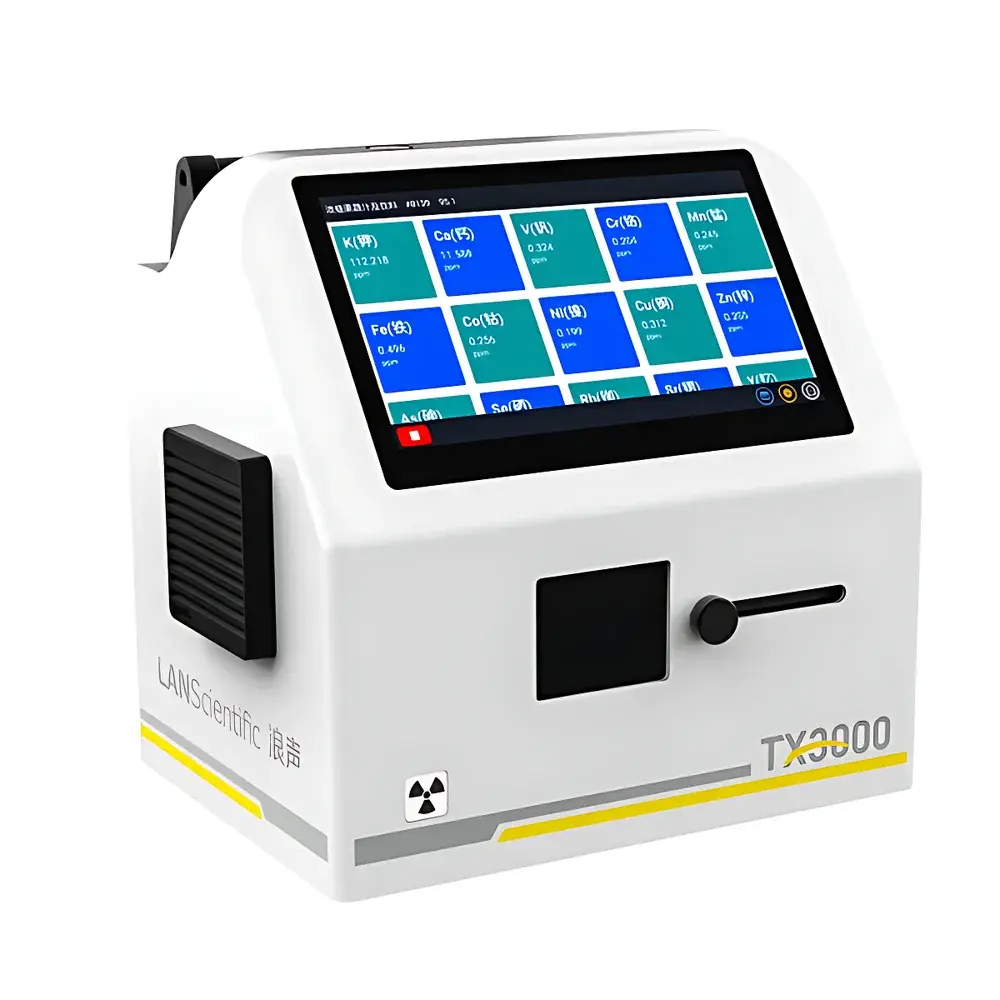
Brookfield LANScientific TX3000 Portable Total Reflection X-Ray Fluorescence Spectrometer
| Brand | LANScientific |
|---|---|
| Origin | Jiangsu, China |
| Manufacturer Type | Direct Manufacturer |
| Origin Category | Domestic (China) |
| Model | TX3000 |
| Application | Field-Portable |
| Instrument Type | Total Reflection X-Ray Fluorescence (TXRF) |
| Industry-Specific Use | Soil & Atmospheric Analysis |
| Sample Forms | Liquid, Suspension, Solid, Particulate Deposits |
| Detection Principle | Grazing-Incidence Excitation with Multilayer Monochromator |
| Key Elements | Cr, Pb, As, Cd, Hg, Ni, Cu, Zn (expandable to ~30 elements) |
| Minimum Sample Volume | <10 µL (liquid) or <100 ng (solid deposit) |
| Detection Limits | Sub-pg to low-pg range for most metals (e.g., 0.1–5 pg for transition metals under optimized conditions) |
| Radiation Safety | Compliant with GBZ 126–2011 and IEC 62495 |
Overview
The LANScientific TX3000 is a field-deployable Total Reflection X-Ray Fluorescence (TXRF) spectrometer engineered for ultra-trace elemental analysis in environmental, geological, and regulatory compliance applications. Unlike conventional energy-dispersive X-ray fluorescence (ED-XRF) systems, the TX3000 employs a grazing-incidence excitation geometry—where the primary X-ray beam strikes the sample carrier at an angle below the critical angle for total external reflection (typically <0.1°). This configuration confines excitation to a nanometer-thin surface layer, drastically suppressing bremsstrahlung background and matrix scattering. Coupled with a high-efficiency multilayer monochromator and a Peltier-cooled silicon drift detector (SDD), the instrument achieves detection limits in the sub-picogram range for heavy metals such as Cr, Pb, As, Cd, and Hg—without chemical digestion or vacuum requirements. Its compact, battery-operable design supports real-time decision-making in soil screening, airborne particulate monitoring, and rapid site assessment, aligning with ISO 17294-2, ASTM D7088, and EPA Method 6020B workflows.
Key Features
- True portable TXRF architecture: Integrated X-ray tube, monochromator, sample stage, and SDD in a single 3.2 kg chassis—no external gas supply, liquid nitrogen, or vacuum pump required.
- Grazing-incidence optics: Optimized beam path reduces background noise by >95% compared to standard ED-XRF, enabling reliable quantification at pg-level concentrations.
- Minimal sample consumption: Accepts ≤10 µL of aqueous solution or ≤100 ng of dried residue on quartz or silicon carriers—ideal for precious or limited-volume environmental samples.
- Intuitive touch interface with pre-loaded method templates: Supports one-touch calibration for soil extracts, filter deposits, and digested water samples per USP / and CLP guidance.
- Radiation-optimized enclosure: Fully shielded housing meets GBZ 126–2011 occupational exposure limits; measured dose rate <0.5 µSv/h at 10 cm from surface during operation.
- Low-power operation: Draws 6 hours continuous use in remote locations.
Sample Compatibility & Compliance
The TX3000 accepts directly deposited liquid samples (e.g., acid extracts, leachates), air filter punches (PM2.5/PM10), suspended particulates centrifuged onto carriers, and thin-film solid residues. It complies with ISO 18553:2017 (XRF performance verification), supports GLP audit trails via time-stamped spectral logs, and enables traceability per FDA 21 CFR Part 11 when paired with LANScientific’s secure software suite. For soil testing, it adheres to the measurement principles outlined in ISO 11885 and China’s HJ 680–2013 standard for heavy metal determination in solid waste. Certified reference materials (CRMs) including NIST SRM 2711a (Montana Soil) and BCR-723 (Urban Dust) are validated for routine QC.
Software & Data Management
The embedded TX3000 Control Software provides quantitative analysis using fundamental parameter (FP) algorithms with matrix correction for organic/inorganic substrates. Spectral deconvolution employs iterative least-squares fitting with peak-shape modeling for overlapping Kα/Kβ lines (e.g., As Kα/Pb Lα). All raw spectra, calibration curves, and QA/QC reports are stored in encrypted SQLite databases with configurable auto-backup to USB or network drives. Audit-ready export formats include CSV (for LIMS integration), PDF analytical reports with digital signatures, and .rdb files compatible with third-party chemometric tools (e.g., Unscrambler®, MATLAB). Remote firmware updates and method library synchronization are supported over Wi-Fi or Ethernet.
Applications
- Environmental Monitoring: Rapid screening of As, Cd, and Pb in roadside soils, sediment cores, and PM10 filters—enabling Tier 1 site characterization per ITRC guidelines.
- Geological Surveying: In-field analysis of trace REEs and base metals in rock powders and mineral concentrates without lab digestion delays.
- Regulatory Compliance: Verification of heavy metal limits in industrial effluents (GB 8978–1996), landfill leachates, and atmospheric deposition studies.
- Food Safety & Agriculture: Detection of Cd in rice grains and As in irrigation water following AOAC 2013.06 principles.
- Cultural Heritage: Non-destructive elemental mapping of pigments and corrosion products on artifacts using micro-spot analysis mode.
- Pharmaceutical QC: Residual catalyst screening (Pd, Pt, Rh) in active pharmaceutical ingredients per ICH Q2(R2) validation criteria.
FAQ
Does the TX3000 require sample digestion prior to analysis?
No—direct analysis of filtered liquids, dried deposits, or suspended particulates is supported. Acid digestion is optional and only recommended for complex matrices requiring full element recovery.
Can the instrument be calibrated for non-standard elements beyond the default 30?
Yes—users may import custom calibration curves and define new emission lines using the Advanced Method Editor, provided certified standards are available.
Is spectral interference correction available for overlapping peaks like Sb Kα and Sn Kβ?
Yes—the software applies constrained peak fitting with physical background modeling and user-adjustable inter-element correction coefficients.
What maintenance is required for long-term field deployment?
Annual verification of X-ray tube output stability and detector resolution (Mn Kα FWHM ≤135 eV) is recommended; no consumables other than disposable quartz carriers.
How does TXRF performance compare to ICP-MS for ultra-trace soil analysis?
While ICP-MS offers lower absolute detection limits, TXRF provides comparable precision (RSD <5% at 10 pg level) with orders-of-magnitude faster turnaround, no argon gas dependency, and minimal infrastructure requirements—making it optimal for high-throughput field triage.






