
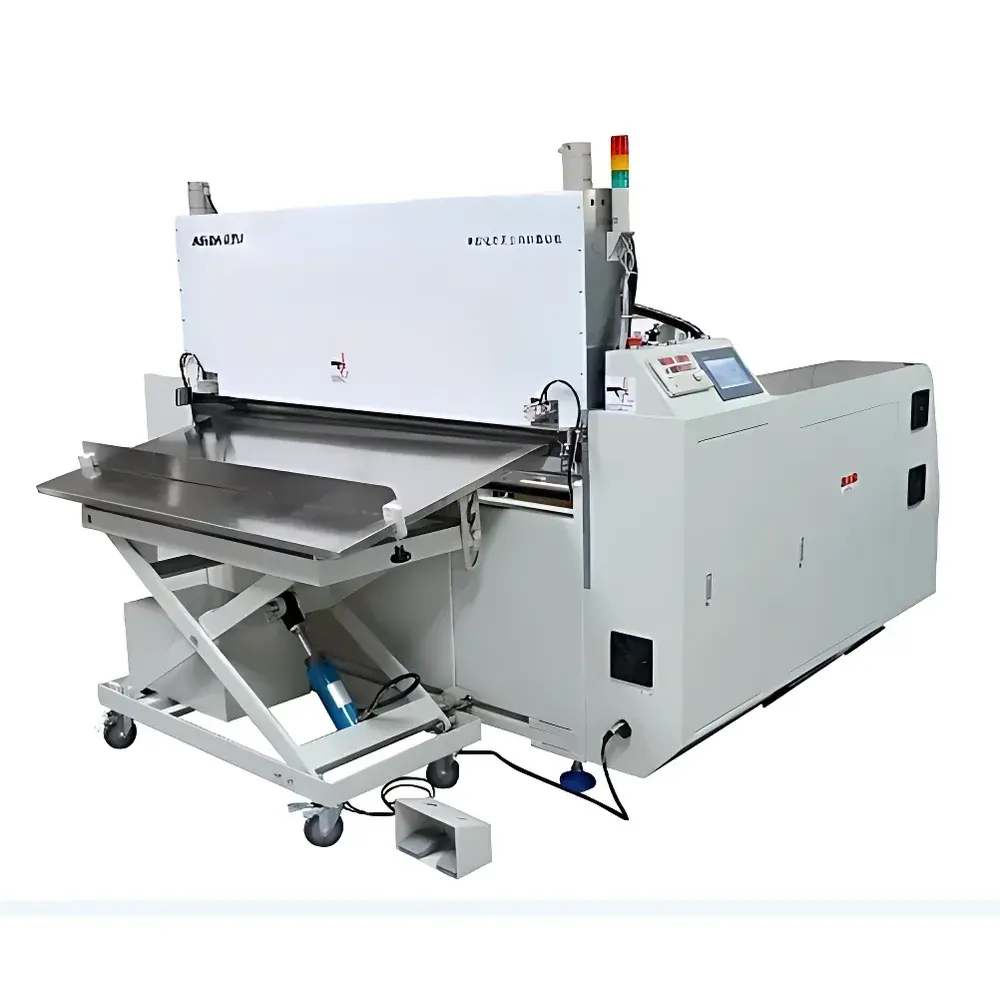
Asida CQ1000 Automated Non-Contact Thermal Cutting Machine for Prepreg (PP) Rolls
| Brand | Asida |
|---|---|
| Model | CQ1000 |
| Application | Precision slitting and blanking of uncured fiberglass-reinforced epoxy prepreg (PP) rolls used in PCB and copper-clad laminate (CCL) manufacturing |
| Cutting Principle | Non-contact localized thermal softening followed by mechanical shearing |
| Max. Roll Diameter | 320 mm |
| Cutting Length | 50–750 mm |
| Cutting Width | 200–1270 mm |
| Material Thickness | 0.04–0.3 mm |
| Positioning Accuracy | ±1.0 mm |
| Web Speed | ≤60 m/min |
| Cycle Rate | ≤13 cuts/min (at 500 mm length) |
| Power Supply | 3-phase 5-wire, AC380 V / 50 Hz / ≥40 A |
| Compressed Air | 0.7–1.0 MPa |
| Ambient Requirements | 20 °C ±2 °C, 50 %RH ±5 %RH |
| Footprint | 2600 × 2300 × 1700 mm (L×W×H) |
| Weight | ~1500 kg |
| Avg. Power Consumption | ≤9 kW |
| Compliance | Designed for ISO 9001-aligned production environments |
Overview
The Asida CQ1000 Automated Non-Contact Thermal Cutting Machine is an industrial-grade processing system engineered specifically for the precision segmentation of thermosetting prepreg (PP) rolls—primarily glass-fiber-reinforced epoxy laminates widely employed in printed circuit board (PCB) and copper-clad laminate (CCL) fabrication. Unlike conventional mechanical die-cutting or cold slitting systems, the CQ1000 integrates a controlled non-contact thermal activation stage immediately upstream of the shear blade. This process transiently softens the resin matrix at the intended cut line without triggering full crosslinking, enabling clean, dust-free separation while simultaneously sealing fiber edges. The result is elimination of common defects such as fraying, glass filament shedding, edge whitening, delamination, wrinkling, and carbonization—critical quality concerns in high-reliability PCB stack-up assembly. The machine operates under tightly regulated environmental conditions (20 °C ±2 °C, 50 %RH ±5 %RH) to ensure dimensional stability of hygroscopic prepreg substrates during handling and cutting.
Key Features
- Fully automated thermal-mechanical cutting cycle with integrated PLC-based motion control and HMI touchscreen interface for recipe-driven operation.
- Non-contact infrared or resistive heating module calibrated to achieve rapid, localized resin softening—sufficient for clean shearing yet below gelation temperature—to prevent premature curing or thermal degradation.
- High-stiffness shear mechanism with precision-ground tungsten-carbide blades and dynamic load compensation, ensuring consistent edge geometry across variable material thicknesses (0.04–0.3 mm).
- Digital length/width programming with real-time encoder feedback and closed-loop web tension monitoring to maintain ±1.0 mm dimensional repeatability even at maximum throughput (≤60 m/min).
- Hydraulic升降 (elevating) receiving table with programmable descent profile, optimized for stable stacking of high-aspect-ratio prepreg sheets (e.g., 1080-style and heavier fabrics), eliminating misalignment and telescoping.
- Parameter-packaged recipe management: pre-configured settings for common PP grades (e.g., FR-4, high-Tg, low-Dk/Df formulations) stored and recalled via intuitive touchscreen navigation.
Sample Compatibility & Compliance
The CQ1000 accommodates standard industry prepreg formats—including woven E-glass, NE-glass, and hybrid reinforcement architectures—with nominal widths from 200 mm to 1270 mm and roll diameters up to 320 mm. It is compatible with both solvent-based and no-flow B-stage resins, including phenolic, epoxy, polyimide, and BT-based systems. All operational parameters—including thermal dwell time, blade penetration depth, feed velocity, and stack height—are logged with timestamped user ID attribution, supporting audit readiness per ISO 9001:2015 Clause 8.5.2 and facilitating alignment with IPC-4101 and IPC-TM-650 test method documentation requirements. While not certified to UL or CE as a standalone safety unit, the system complies with IEC 60204-1 for electrical equipment of machines and incorporates emergency stop circuits, light curtains, and pneumatic interlocks meeting Category 3 PLd functional safety criteria.
Software & Data Management
The embedded control software runs on a deterministic real-time OS with dual-channel data logging: one channel records all setpoints and actuator outputs (e.g., heater voltage, servo position, air pressure), while the second captures operator actions, login sessions, and recipe selections. Exportable CSV reports include batch ID, cut count, cumulative runtime, deviation metrics per cut cycle, and environmental chamber logs. Optional OPC UA integration enables connection to MES platforms (e.g., Siemens Opcenter, Rockwell FactoryTalk) for SPC charting and preventive maintenance scheduling. Audit trail functionality satisfies FDA 21 CFR Part 11 requirements when deployed with network-authenticated user accounts and electronic signature enforcement.
Applications
- Prepreg blanking for multilayer PCB core and build-up film lamination sequences.
- Slitting of wide-width PP rolls into narrower strips for automated optical inspection (AOI) or robotic pick-and-place handling.
- Production of standardized test coupons per IPC-TM-650 2.3.17 (peel strength) and 2.4.13 (flexural modulus).
- Prototyping support for HDI, RF/microwave, and flex-rigid hybrid substrates requiring zero-edge-defect sheet stock.
- Quality assurance labs performing incoming material verification against supplier specifications (e.g., thickness uniformity, resin content, flow behavior).
FAQ
What types of prepreg materials are supported by the CQ1000?
The system is validated for standard FR-4, high-Tg epoxy, polyimide, cyanate ester, and BT resin systems reinforced with E-glass, NE-glass, or quartz fabrics. Custom calibration may be required for specialty low-flow or ultra-thin (<0.05 mm) formulations.
Does the machine require external exhaust or fume extraction?
No dedicated fume hood is needed, as the non-contact thermal process generates negligible volatile organic compounds (VOCs) or particulate matter—unlike laser or plasma cutting. Ambient room ventilation per ISO 14644 Class 8 is sufficient.
Can the CQ1000 integrate with existing ERP or MES infrastructure?
Yes—via optional Ethernet/IP or OPC UA gateway modules, enabling bidirectional exchange of job tickets, material traceability IDs, and quality event flags.
Is operator training included with purchase?
Asida provides on-site commissioning, SOP documentation, and two-day operator certification covering safe startup/shutdown, recipe configuration, routine maintenance, and basic fault diagnostics.
What is the recommended preventive maintenance interval?
Blade inspection and recalibration every 200 operating hours; heater element resistance check and pneumatic filter replacement every 1,000 hours; full mechanical alignment verification annually or after 5,000 cutting cycles, whichever occurs first.



