
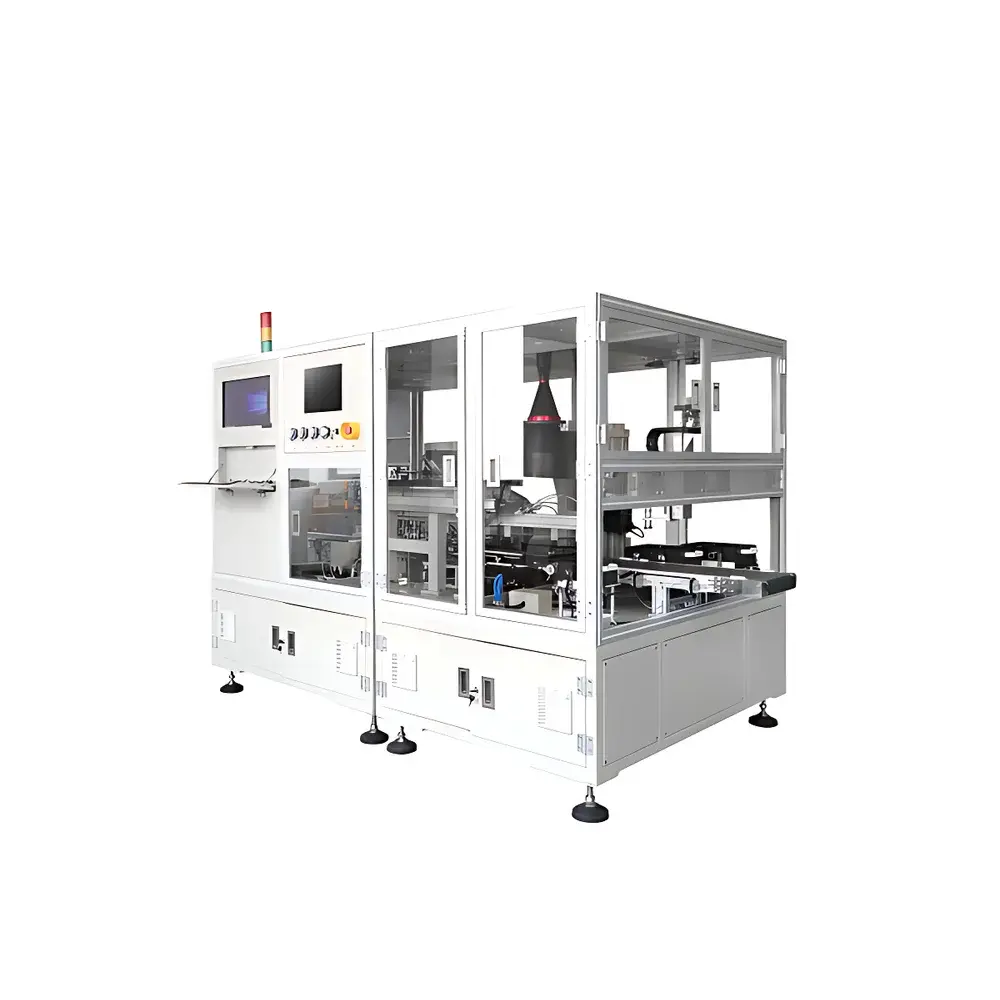
Zhengye CC5120 Automated Battery Dimensional Inspection System
| Brand | Zhengye |
|---|---|
| Origin | Guangdong, China |
| Manufacturer Type | OEM/ODM Manufacturer |
| Country of Origin | China |
| Model | CC5120 |
| Pricing | Upon Request |
| Overall Dimensions (L×W×H) | 2100 × 1500 × 1900 mm |
| Power Supply | AC 220 V / 50 Hz / 2 kW |
| Inspection Throughput | ≥25 parts per minute (PPM) |
| Repeatability & Reproducibility (GRR) | ≤10% |
| Applicable Cell Dimensions (L×W×T) | 40–160 mm × 30–110 mm × 2–12 mm |
| Dimensional Repeatability | ±0.01 mm |
| PPG Flatness | ≤10 µm |
| PPG Parallelism | ≤20 µm |
| Barcode Types Supported | 1D & 2D barcodes |
| Barcode Recognition Rate | ≥99.8% |
Overview
The Zhengye CC5120 Automated Battery Dimensional Inspection System is a purpose-built, non-contact and contact-integrated metrology platform engineered for high-precision, high-throughput dimensional verification of prismatic and pouch lithium-ion cells used in consumer electronics (3C) applications. It implements a hybrid measurement architecture combining calibrated mechanical probing (for thickness under controlled load), dual telecentric CCD imaging (for sub-pixel edge detection of length, width, electrode tab spacing, tab-to-edge distance, and exposed adhesive area), and deterministic mechanical conditioning (ceramic roller-based tab flattening). Designed for integration into battery cell manufacturing lines or standalone QC laboratories, the system complies with foundational requirements of ISO/IEC 17025 for calibration traceability and supports audit-ready documentation per GLP/GMP-aligned quality management systems.
Key Features
- Integrated multi-stage workflow: automated loading → ceramic-roller tab planarization → precision thickness measurement under regulated contact force → high-resolution dual-telecentric vision inspection → NG sorting with pneumatic ejection
- Dual-telecentric optical path with industrial-grade CCD sensor ensures minimal perspective distortion and pixel-level geometric fidelity across full FOV, enabling robust sub-0.01 mm repeatability in XY plane measurements
- Motorized, load-controlled thickness probe using certified digital micrometer transducers (resolution: 0.1 µm; force control range: 0.5–5 N) guarantees consistent compression profiles across variable cell stiffness
- Modular mechanical design enables rapid changeover between cell formats: tooling adjustments and vision recipe loading completed within 10–30 minutes without recalibration
- HMI interface built on embedded Windows OS with intuitive icon-driven navigation, real-time SPC dashboard, and configurable pass/fail thresholds per feature
- Barcode validation module supports GS1-compliant 1D (Code 128, EAN-13) and 2D (Data Matrix, QR) symbologies with >99.8% recognition rate under ambient lighting and typical label surface conditions
Sample Compatibility & Compliance
The CC5120 accommodates rigid and semi-flexible prismatic and laminated pouch cells within defined dimensional envelopes (40–160 mm L × 30–110 mm W × 2–12 mm T). Its mechanical handling subsystems—including vacuum-assisted pick-and-place, low-friction ceramic tab rollers, and adaptive gripper pads—minimize surface marring and electrode delamination risk. All measurement subsystems are traceably calibrated to national standards (e.g., CNAS-accredited reference artifacts). The system architecture supports data integrity controls aligned with FDA 21 CFR Part 11 requirements, including electronic signature capability, audit trail logging, and role-based access control when deployed in regulated environments.
Software & Data Management
The proprietary Zhengye VisionInsight™ software provides synchronized acquisition, feature extraction, statistical analysis, and reporting. Each inspection cycle generates a timestamped, digitally signed report containing raw image thumbnails, coordinate-based measurement vectors, GRR summary statistics, and barcode-matched lot traceability metadata. Data export formats include CSV, XML, and PDF (with embedded digital signatures). The software architecture supports OPC UA connectivity for MES/SCADA integration and includes built-in SPC tools (X-bar/R charts, Cp/Cpk calculation, outlier detection via modified Grubbs’ test). Audit logs record all user actions, parameter modifications, and calibration events with immutable timestamps.
Applications
- Final dimensional release testing of 3C battery cells prior to module assembly
- In-process verification after tab welding, hot-pressing, or formation cycling
- Supplier incoming inspection with automated acceptance sampling (AQL-based decision logic)
- Root cause analysis of dimensional drift correlated with process parameters (e.g., lamination pressure, thermal history)
- Supporting APQP/PPAP documentation packages with statistically valid measurement system analysis (MSA) reports
- Non-destructive evaluation of structural integrity indicators: tab alignment symmetry, seal margin uniformity, and planarity-induced current collector contact variation
FAQ
What cell chemistries and form factors does the CC5120 support?
The system is validated for commercial LiCoO₂, NMC, and LFP-based prismatic and pouch cells. Cylindrical and button cells are not supported.
Is external environmental control required for stable operation?
Yes — optimal performance requires temperature-stabilized ambient (20–25°C ±2°C) and vibration-isolated mounting to maintain sub-10 µm flatness repeatability.
Can the system interface with factory automation protocols?
Standard Ethernet/IP and Modbus TCP interfaces are provided; optional PROFINET and OPC UA gateways are available upon request.
How is measurement uncertainty quantified and documented?
Each system ships with a MSA package including GRR study reports (per AIAG MSA 4th Edition), bias linearity studies, and calibration certificates traceable to NIM (China National Institute of Metrology).
What maintenance intervals are recommended?
Daily visual inspection of rollers and vacuum nozzles; monthly verification of telecentric lens alignment and probe force calibration; annual full MSA revalidation recommended.



