
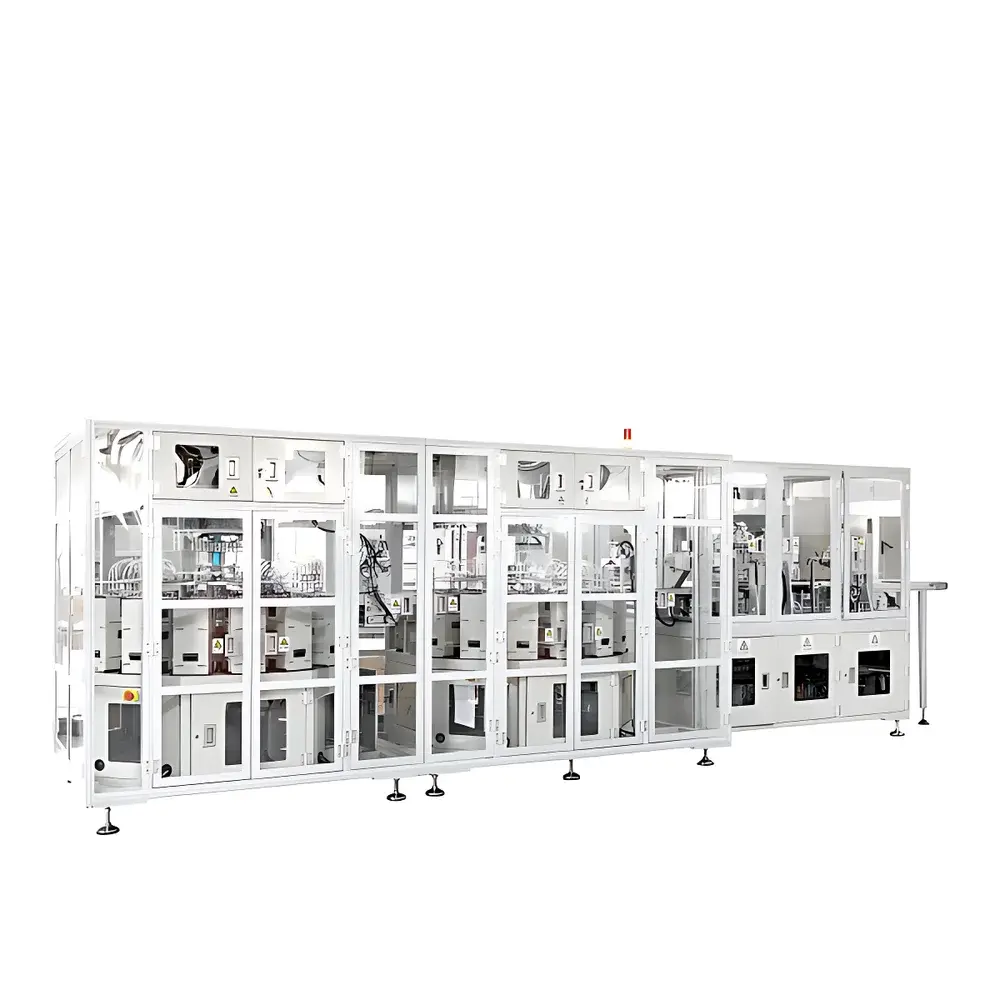
Zhengye FX001 Fully Automatic Battery Matching and Sorting System
| Brand | Zhengye |
|---|---|
| Origin | Guangdong, China |
| Manufacturer Type | Manufacturer |
| Country of Origin | Domestic (China) |
| Model | FX001 |
| Quotation | Upon Request |
| Dimensions (L×W×H) | 5200 × 1500 × 1850 mm |
| Power Supply | AC 220 V / 50 Hz / 3 kW |
| Throughput | ≥25 ppm |
| GRR (Repeatability & Reproducibility) | ≤10% |
| Applicable Cell Dimensions (L×W×T) | 40–160 mm × 30–110 mm × 2–12 mm |
| Voltage Measurement Accuracy | ±0.01% rdg ±3 digits |
| Resistance Measurement Accuracy | ±0.5% rdg ±5 digits |
| Barcode Types Supported | 1D & 2D |
| Barcode Recognition Rate | ≥99.8% |
| Changeover Time | ≤60 min |
Overview
The Zhengye FX001 Fully Automatic Battery Matching and Sorting System is an integrated electrochemical characterization and physical sorting platform engineered for high-volume production environments in the 3C lithium-ion battery industry. It performs non-destructive, real-time evaluation of critical electrical parameters—including open-circuit voltage (OCV), internal resistance (ACIR), and K-value (voltage decay rate over time)—to enable precise cell grouping prior to module assembly. Unlike conventional manual or semi-automated testers, the FX001 implements a closed-loop, multi-station architecture: barcode scanning initiates traceability; electrode tab straightening ensures consistent contact geometry; OCV and ACIR measurements are conducted using calibrated, industrial-grade instrumentation (HIOKI BT3562); laser marking applies unique identifiers; and pneumatic sorting directs cells into up to 28 discrete bins based on user-defined parametric thresholds. Its design adheres to fundamental principles of statistical process control (SPC) and battery pack balancing theory—ensuring matched cells exhibit minimal variance in capacity, impedance, and aging behavior, thereby maximizing cycle life and thermal uniformity in downstream battery modules.
Key Features
- Multi-parameter automated testing: Simultaneous acquisition of OCV, AC internal resistance, and K-value (ΔV/Δt over standardized rest periods) with synchronized timestamping and batch metadata tagging.
- High-fidelity metrology: Integrated HIOKI BT3562 precision tester delivers voltage accuracy of ±0.01% rdg ±3 digits and resistance accuracy of ±0.5% rdg ±5 digits—calibrated per IEC 61960 and traceable to national standards.
- Modular station architecture: Configurable sequence of functional modules (scanning → tab alignment → measurement → marking → sorting) enables flexible reconfiguration for evolving process requirements.
- Rapid changeover capability: Mechanical and software-based tooling adjustments support cross-format transitions (e.g., cylindrical to prismatic cells) within ≤60 minutes—validated via documented changeover SOPs compliant with ISO 9001 section 8.5.1.
- Real-time hardware diagnostics: Embedded PLC monitors actuator status, sensor feedback, air pressure, vacuum integrity, and encoder position—displayed via intuitive HMI with color-coded alerts and event logging.
- Robust mechanical construction: Heavy-duty aluminum frame with anti-vibration damping mounts; stainless-steel conveyors and wear-resistant guide rails ensure long-term dimensional stability under continuous 24/7 operation.
Sample Compatibility & Compliance
The FX001 accommodates rectangular prismatic and pouch-type Li-ion cells within dimensional limits of 40–160 mm (length), 30–110 mm (width), and 2–12 mm (thickness). Electrode tab orientation (top/bottom, left/right) is configurable via adjustable gripper fixtures. All measurement protocols conform to ASTM F1972 (Standard Guide for Lithium-Ion Battery Electrical Testing) and GB/T 31486-2015 (Chinese national standard for electric vehicle battery performance). The system supports audit-ready data integrity through secure local database storage (SQLite with write-ahead logging) and optional encrypted network transmission—meeting foundational requirements for GLP-compliant battery qualification workflows.
Software & Data Management
The embedded Windows-based control software provides full parameter configurability: users define up to 28 sorting bins using logical expressions combining OCV, ACIR, K-value, and derived metrics (e.g., RDC/RAC ratio). Each bin supports independent discharge/charge preconditioning flags, label format templates, and export triggers (CSV, XML, or direct SQL insert). Audit trail functionality records operator login/logout, parameter changes, calibration events, and sorting decisions with immutable timestamps—aligned with FDA 21 CFR Part 11 electronic record requirements when deployed with optional digital signature modules. Native OPC UA and RESTful API endpoints facilitate bidirectional integration with MES platforms (e.g., Siemens Opcenter, Rockwell FactoryTalk) without middleware dependency.
Applications
- Pre-assembly cell matching for consumer electronics battery packs (smartphones, tablets, wearables).
- Quality gate screening in contract manufacturing facilities handling multi-OEM battery programs.
- Process validation and capability studies (Cpk, Ppk) during new product introduction (NPI) for EV auxiliary batteries.
- Return material authorization (RMA) analysis—identifying out-of-spec units exhibiting accelerated voltage decay or impedance drift.
- Statistical baseline establishment for accelerated life testing campaigns requiring tightly binned cell cohorts.
FAQ
What standards does the FX001 comply with for battery testing procedures?
The system implements test sequences aligned with ASTM F1972, IEC 62660-1, and GB/T 31486-2015, with measurement uncertainty budgets documented per ISO/IEC 17025 Annex A.
Can the FX001 interface directly with SAP or Oracle Manufacturing Cloud?
Yes—via certified MES connectors or custom REST API integrations supporting JSON payloads and OAuth 2.0 authentication.
Is remote diagnostic support available for overseas installations?
All units include embedded TeamViewer QuickSupport modules with TLS 1.3 encrypted session handshaking and granular permission controls for Tier-2 technical assistance.
How is measurement traceability maintained across shifts and operators?
Each test result includes embedded instrument serial numbers, calibration expiry dates, environmental sensor readings (temperature/humidity), and operator ID—enforced by role-based access control (RBAC) in the software.
Does the system support dynamic bin reassignment during runtime?
Yes—bin logic can be updated on-the-fly without halting throughput; changes are validated against active cell buffer status and logged in the audit trail.
Related Products



