
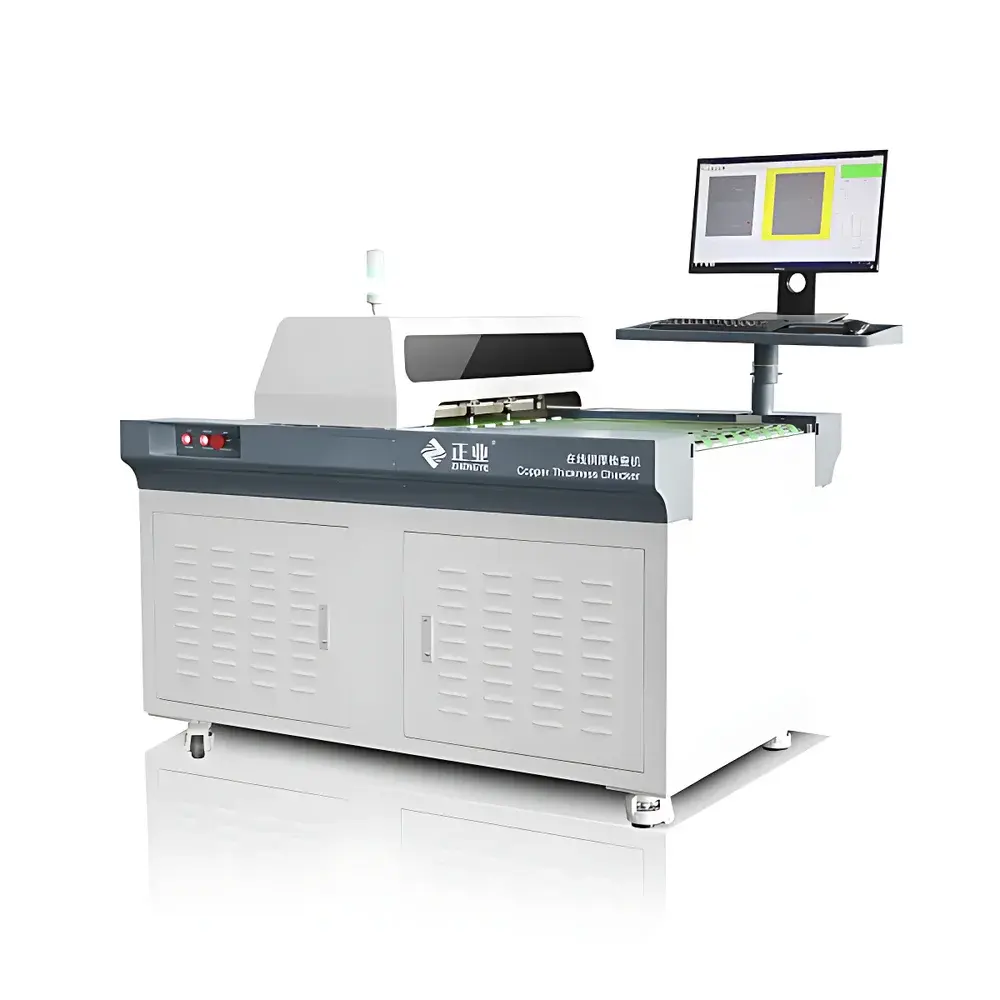
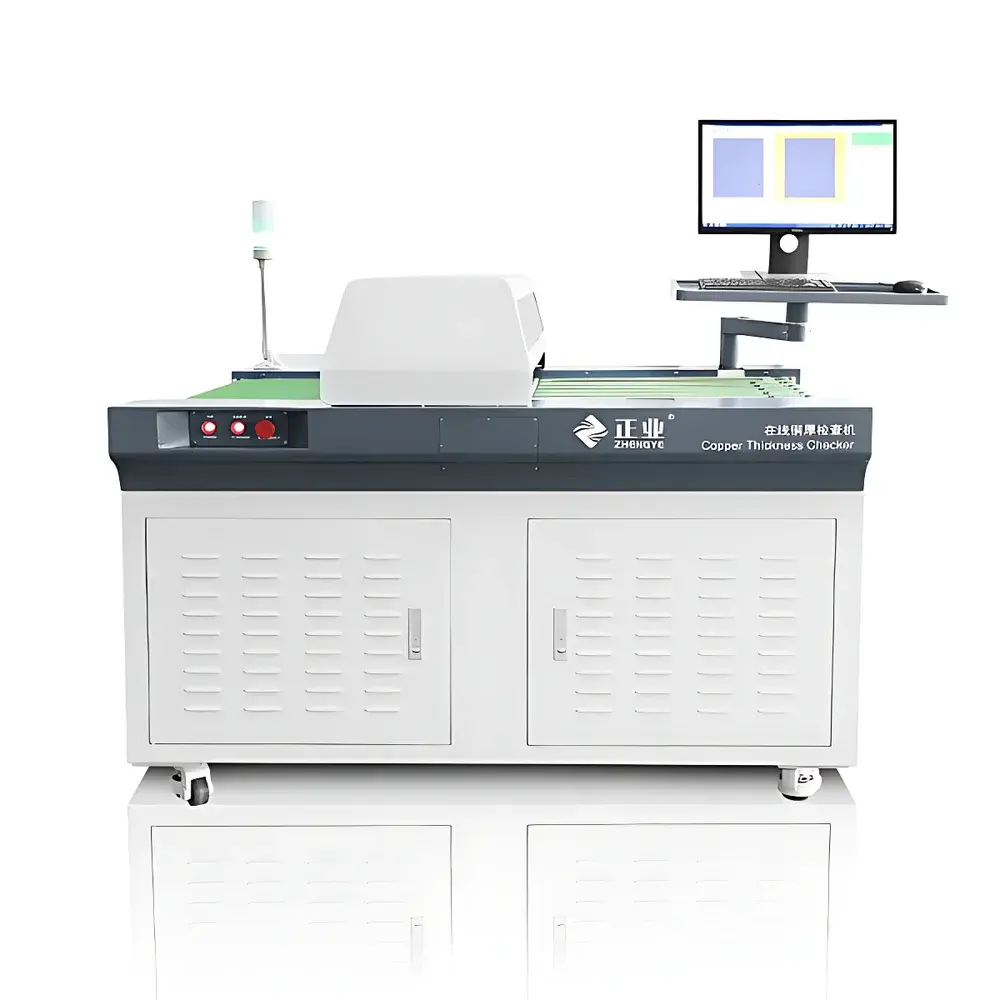
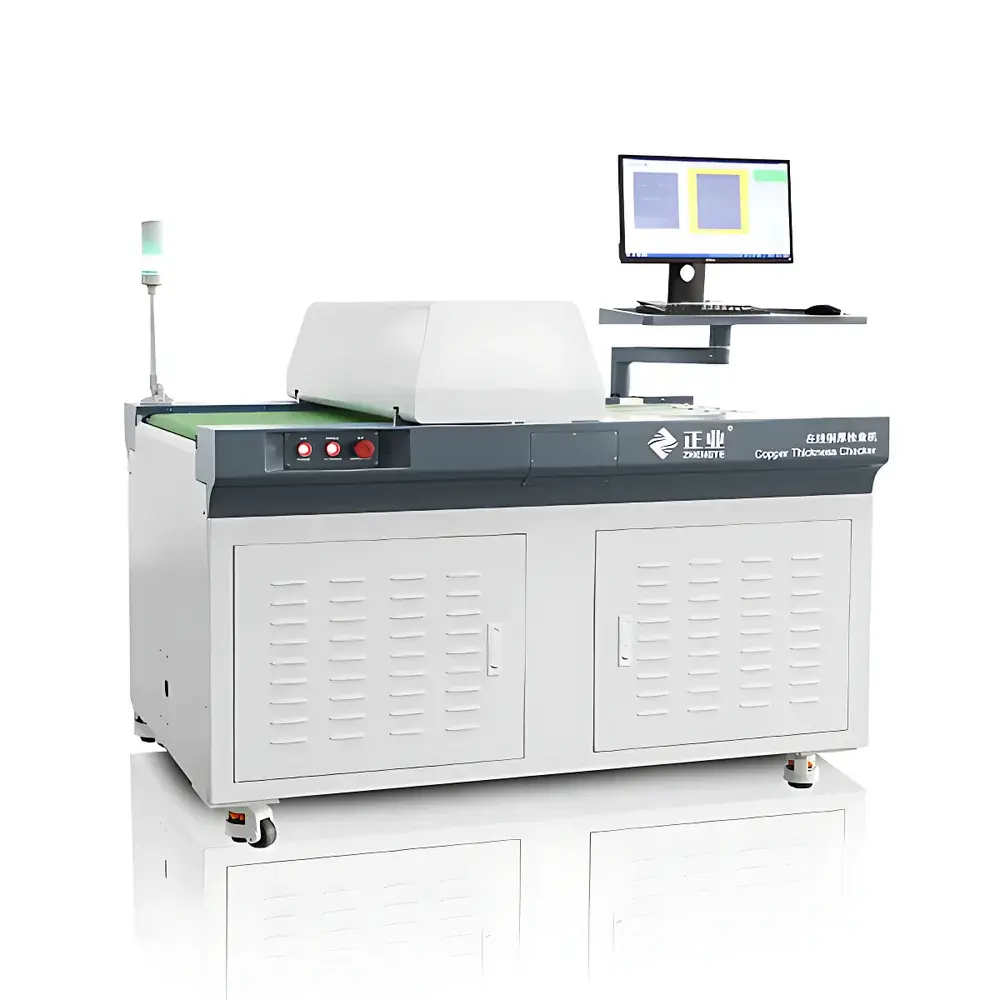
Zhengye TH11 Online Copper Thickness Measurement System
| Brand | Zhengye |
|---|---|
| Origin | Guangdong, China |
| Manufacturer Type | OEM/ODM Manufacturer |
| Country of Origin | China |
| Model | TH11 |
| Price Range | USD 14,000 – 28,000 |
| Measuring Plate Dimensions | 200 mm × 220 mm to 650 mm × 620 mm |
| Plate Thickness Range | 0.05 mm – 12 mm |
| Copper Thickness Range | 0.1 µm – 120 µm |
| Minimum Test Area | >10 mm × 15 mm |
| Measurement Accuracy | ±5% |
| Controller | Fischer MMS PC2 BU |
| Probe | Fischer ERCU N Eddy Current Probe |
| Cycle Time (6-point) | 6–9 s/pc |
| Cycle Time (18-point) | 10–13 s/pc |
| Point Positioning Accuracy | ±3 mm |
| Supported Point Definition Methods | Gerber file import, Drill file import, manual grid (5/9-point), or software-defined arbitrary points |
| Conveyor Speed | 6 m/min or 12 m/min |
| Statistical Process Control (SPC) Functionality | Yes |
| Board Unloading Option | Optional |
| Operating Temperature | 22 ± 3 °C |
| Power Supply | AC 220 V, 50 Hz |
| Pneumatic Supply | 0.6–0.8 MPa |
| Power Consumption | 2 kW |
| Weight | 500 kg |
| Dimensions (L×W×H) | 1536 mm × 1245 mm × 1420 mm (platform height: 900 mm) |
Overview
The Zhengye TH11 Online Copper Thickness Measurement System is an industrial-grade eddy current-based metrology platform engineered for real-time, non-contact quantification of electrodeposited copper layer thickness on rigid printed circuit boards (PCBs). Designed for integration into high-throughput PCB fabrication lines, the system operates on the principle of electromagnetic induction: a high-frequency alternating current in the Fischer ERCU N probe generates a magnetic field that induces eddy currents in the conductive copper layer; variations in the resulting impedance—correlated to copper thickness—are precisely resolved by the Fischer MMS PC2 BU controller. Unlike offline benchtop gauges, the TH11 performs continuous in-line measurement during conveyor transport, enabling immediate feedback for process control and early defect detection prior to subsequent lamination or etching stages.
Key Features
- Seamless production line integration via MSA-compliant interface protocols, supporting SPC data handshaking with MES and factory automation systems.
- Dual-sensor architecture with patented mechanical alignment mechanism, ensuring consistent probe-to-surface standoff across variable board warpage and surface topography.
- Fischer-certified eddy current hardware stack: MMS PC2 BU controller paired with ERCU N probe—calibrated per IEC 62047-10 and traceable to NIST-traceable reference standards.
- Three configurable automated material handling options: top-loader, bottom-loader, and dual-belt transfer—minimizing manual intervention and reducing operator-induced variability.
- Multi-mode test point definition: native Gerber RS-274X and drill (Excellon) file parsing; grid-based (5/9-point) uniform sampling; or fully user-defined coordinate mapping within the embedded HMI.
- Real-time statistical process monitoring with Cp/Cpk calculation, X-bar & R chart generation, and alarm-triggered event logging compliant with ISO 9001:2015 clause 8.5.1.
Sample Compatibility & Compliance
The TH11 accommodates rigid PCB substrates ranging from 0.05 mm to 12 mm in total thickness—including FR-4, polyimide, metal-core, and ceramic-based laminates—with copper layers from 0.1 µm (ultra-thin seed layers) up to 120 µm (heavy copper applications). It meets IPC-4552A requirements for electrochemical copper thickness verification and supports ASTM B487 (metallic coatings—microscopical determination of thickness) as a correlative offline validation method. All firmware and calibration records adhere to GLP documentation practices; audit trails, user access logs, and electronic signatures are available upon configuration for FDA 21 CFR Part 11 compliance.
Software & Data Management
The embedded control software provides a Windows-based GUI with multi-language support (English, Simplified Chinese, Japanese), configurable report templates (PDF/CSV/XLSX), and ODBC-compliant database connectivity for enterprise-level data warehousing. Raw measurement values, positional metadata, timestamp, and environmental sensor readings (temperature, humidity, pneumatic pressure) are stored with millisecond-level resolution. Data export supports SPC-compatible formats including JMP, Minitab, and InfinityQS. Firmware updates are delivered via secure HTTPS with SHA-256 signature verification; rollback capability ensures operational continuity during validation cycles.
Applications
- In-process monitoring of copper plating uniformity after electroplating or electroless deposition.
- Final QA verification prior to solder mask application or surface finish (ENIG, immersion silver, OSP).
- Process capability analysis for plating bath chemistry control and anode/cathode configuration optimization.
- Failure analysis correlation between localized copper thickness deviation and electrical performance metrics (e.g., current-carrying capacity, thermal resistance).
- Support for HDI microvia filling assessment where copper thickness at via barrels must meet IPC-6012 Class 3 tolerances.
FAQ
What standards does the TH11 comply with for copper thickness measurement?
The system implements measurement methodology aligned with IPC-4552A and supports correlation testing per ASTM B487 and ISO 2178. Calibration certificates include uncertainty budgets traceable to national metrology institutes.
Can the TH11 measure copper on non-planar or warped boards?
Yes—the dual-probe kinematic design and active Z-axis compensation algorithm maintain ≤±3 mm positional fidelity across board warpage up to 3 mm peak-to-valley over 650 mm span.
Is remote diagnostics and firmware update supported?
Remote maintenance is enabled via TLS-encrypted VNC session and secure OTA firmware deployment with dual-signature verification (manufacturer + site administrator).
Does the system support integration with existing MES or SCADA platforms?
Native Modbus TCP and OPC UA (UA 1.04) drivers are included; custom API wrappers (REST/JSON) can be commissioned for SAP ME, Rockwell FactoryTalk, or Siemens SIMATIC IT environments.
What is the recommended recalibration interval?
Fischer recommends quarterly functional verification using certified reference foils; full traceable recalibration every 12 months by an ISO/IEC 17025-accredited service provider.



