
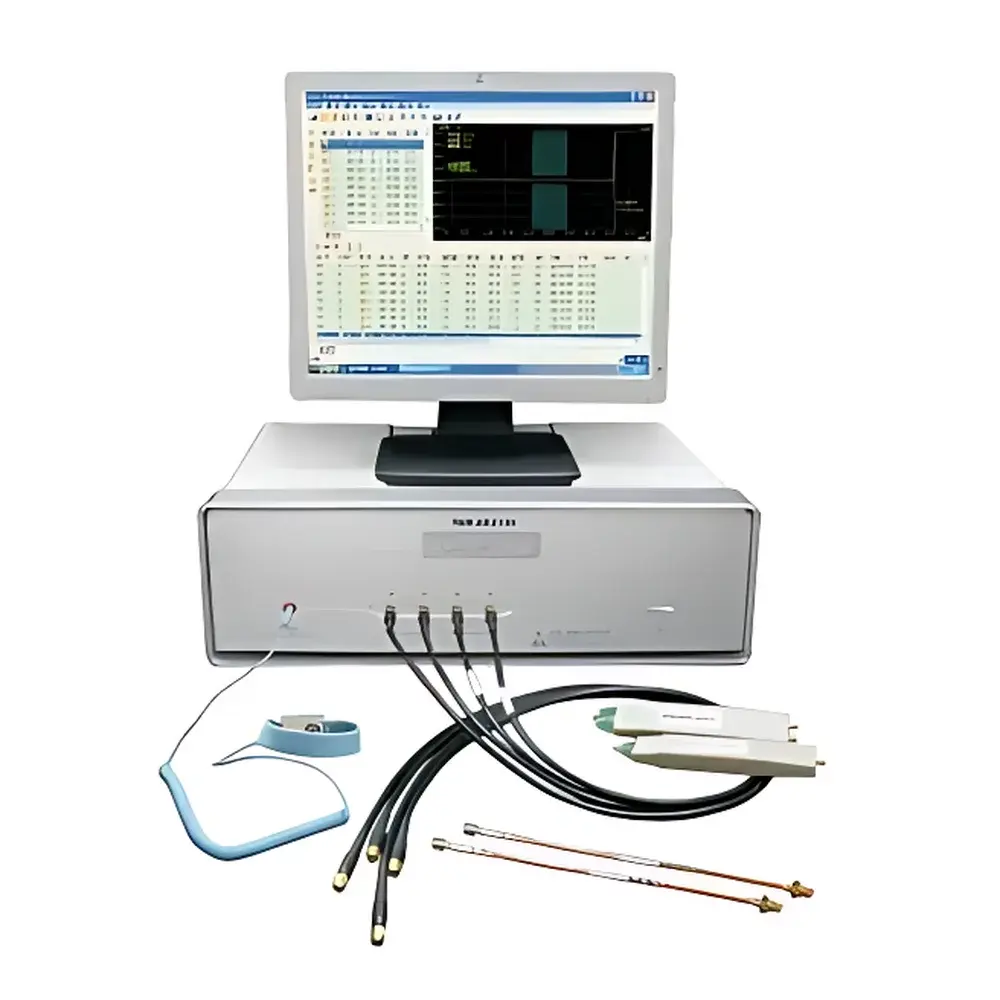
Aisida ZK2120 Time-Domain Reflectometry (TDR) Differential Impedance Analyzer
| Brand | Aisida |
|---|---|
| Model | ZK2120 |
| Origin | Guangdong, China |
| Type | TDR-Based Differential/Single-Ended Impedance Analyzer |
| Impedance Range | Single-Ended 10–150 Ω, Differential 20–300 Ω |
| Measurement Accuracy | ±1% at 50 Ω |
| Repeatability | ±0.5% at 50 Ω |
| TDR Bandwidth | >1.75 GHz |
| Sampling Oscilloscope Bandwidth | >3 GHz |
| Rise Time | <120 ps |
| Time Resolution | 10 ps |
| Length Measurement Range | 0.04–2 m |
| Horizontal Display Resolution | 0.2 mm |
| Vertical Display Resolution | 0.03 Ω |
| Supported Modes | Single-Ended, Differential, Common-Mode, Skew (Intra-Pair & Inter-Pair) |
| Compliance Standards | IEEE 1394a/b, DiiVA, DisplayPort, HDMI 1.4, SATA I/II, USB 2.0/3.0 |
Overview
The Aisida ZK2120 Time-Domain Reflectometry (TDR) Differential Impedance Analyzer is an engineered solution for high-precision, production-grade characterization of transmission line impedance in high-speed interconnects. Based on the fundamental principle of time-domain reflectometry—where a fast-rising step pulse is launched into a conductor and reflected energy is analyzed to infer local impedance discontinuities—the ZK2120 delivers quantitative, traceable measurements of characteristic impedance, differential impedance, common-mode impedance, and skew parameters (intra-pair and inter-pair delay differences). Designed specifically for PCB fabricators, flexible circuit manufacturers, and high-frequency cable producers, it replaces conventional sampling oscilloscopes with purpose-built hardware and standardized firmware that enforce repeatable test conditions across shifts and operators. Its architecture supports both R&D validation and inline QC verification under controlled environmental and procedural constraints.
Key Features
- Simultaneous dual-channel or quad-channel TDR acquisition for parallel testing of multiple traces or differential pairs—reducing cycle time in high-volume wire harness or flex PCB inspection.
- Integrated Windows-based control software with intuitive GUI, eliminating dependency on external scripting or third-party analysis tools.
- Dedicated impedance test modes: single-ended, differential, and common-mode—each with independent calibration routines and reference plane compensation.
- Automated test sequence definition via built-in test file editor; supports parameterized templates for recurring product families (e.g., HDMI 2.1 micro-coaxial assemblies or PCIe Gen5 twinax cables).
- Real-time waveform overlay, statistical process control (SPC) charts (X-bar/R, Cp/Cpk), and pass/fail threshold mapping against user-defined limits per IPC-TM-650 2.5.1 or JEDEC JESD22-B111 guidelines.
- Full audit trail: timestamped raw waveform data (.tdr binary), processed results (.csv/.xlsx), and annotated reports (.pdf) are automatically archived with operator ID, calibration date, and system configuration hash.
- Native support for industry-standard impedance profiles including controlled-impedance striplines, microstrips, coplanar waveguides, and twisted-pair geometries up to 300 Ω differential.
Sample Compatibility & Compliance
The ZK2120 accommodates rigid FR-4 and polyimide-based flex PCBs (single/double-sided, multilayer), coaxial and twinaxial cables (RG-174, UT-110, etc.), ribbon cables, and high-speed board-to-board connectors. Fixturing options include spring-loaded pogo-pin fixtures (for bare PCB coupons), SMA/N-type launch adapters (for terminated cables), and custom impedance-matched probe stations. All measurement workflows comply with ISO/IEC 17025 requirements for test method validation, and report generation meets FDA 21 CFR Part 11 electronic record integrity criteria when deployed in regulated manufacturing environments. The instrument’s firmware implements GLP/GMP-aligned calibration logging, with traceability to NIST-traceable TDR reference standards (e.g., Picosecond Pulse Labs 12000 series).
Software & Data Management
The embedded Windows 10 IoT Enterprise OS hosts Aisida’s proprietary TDR Studio Suite—comprising Test Manager, Waveform Analyzer, and Report Generator modules. Raw acquisitions are stored in IEEE 1597.1-compliant .tdr format, enabling cross-platform interoperability with Keysight PathWave, Ansys HFSS, or Cadence Sigrity. Statistical summaries include mean, standard deviation, min/max, and histogram distribution across batches. Export functions support CSV (for Excel/SPC software), PDF/A-1b (archival), and XML (MES integration). Role-based access control (RBAC) restricts calibration, report signing, and test template modification to authorized personnel—supporting internal quality audits and external ISO 9001 surveillance.
Applications
- Impedance validation of high-speed serial link interconnects (PCIe, USB4, Thunderbolt 4) during design verification and first-article inspection.
- In-process monitoring of etch uniformity and dielectric thickness variation in multilayer PCB fabrication lines.
- Final QA screening of automotive LVDS camera cables, aerospace ARINC 818 compliant video links, and medical imaging coaxial bundles.
- Root-cause analysis of signal integrity failures via spatial impedance profiling—identifying localized defects such as solder mask voids, copper thickness non-uniformity, or via stub resonances.
- Supporting IPC-A-600 and IPC-6012 compliance documentation for Class 3 electronics used in avionics and industrial control systems.
FAQ
What calibration standards are required for daily verification?
A certified 50 Ω and 100 Ω TDR calibration kit (including open, short, and load terminations) is recommended before each shift. System-level verification using a known-impedance reference trace (e.g., IPC-TM-650 2.5.1.1 coupon) is performed weekly.
Can the ZK2120 measure impedance of un-terminated cables?
Yes—via time-gated reflection analysis. The instrument automatically identifies the incident edge and isolates reflections from the far-end termination (or open/short) to compute characteristic impedance without requiring physical termination.
Is firmware update supported remotely?
Firmware updates are delivered via encrypted USB media with SHA-256 checksum verification. Remote update over LAN is disabled by default to maintain network segmentation in secure manufacturing networks.
Does the system support automated pass/fail decision logic based on IPC-2152 current-carrying capacity tables?
No—IPC-2152 relates trace geometry and temperature rise to current rating. The ZK2120 measures geometrically derived impedance only. However, exported impedance data can be imported into thermal simulation platforms for downstream current derating analysis.
How is measurement uncertainty quantified for ISO/IEC 17025 reporting?
Uncertainty budgets follow EURACHEM/CITAC Guide CG4, incorporating contributions from TDR bandwidth limitation, sampling jitter, connector repeatability, and reference standard uncertainty. Typical expanded uncertainty (k=2) is ±0.8 Ω for 50 Ω nominal at 1 GHz equivalent frequency.



