
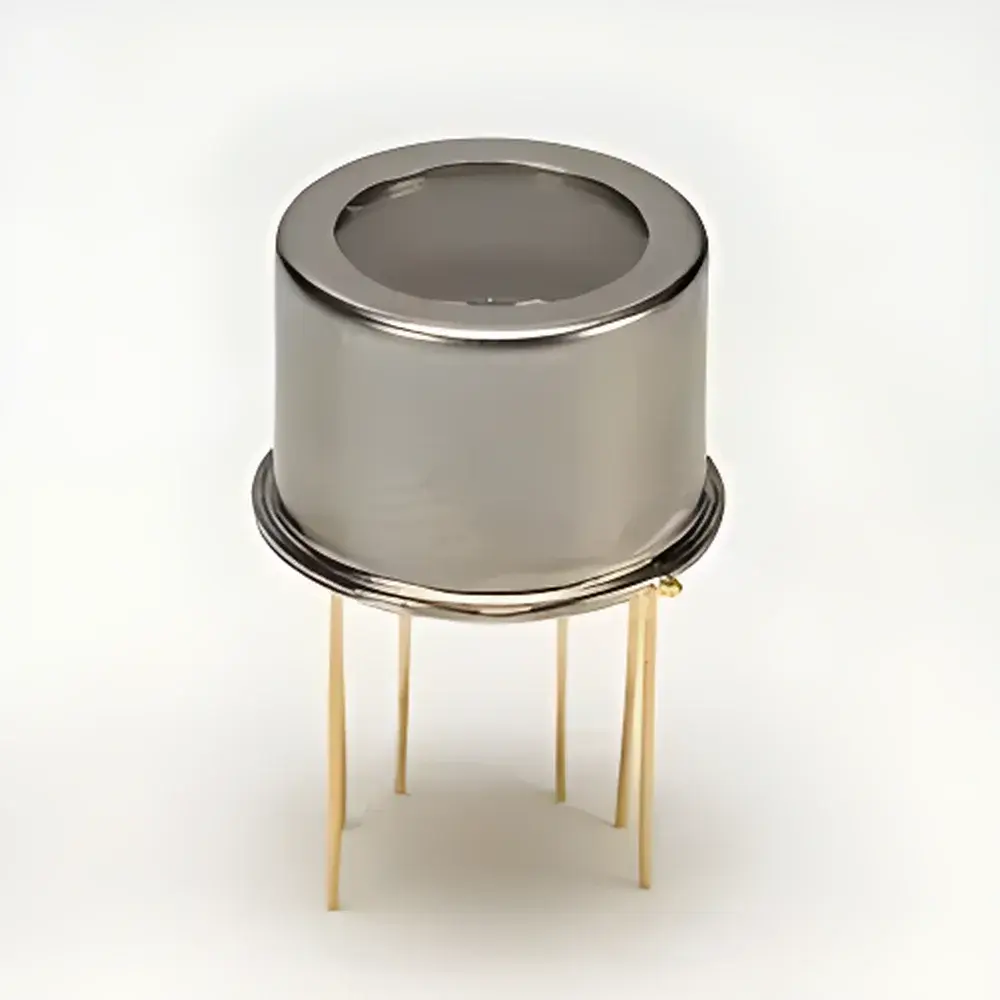
Hamamatsu InGaAs Photovoltaic Detector P10090-11
| Brand | Hamamatsu |
|---|---|
| Origin | Japan |
| Manufacturer Type | Manufacturer |
| Origin Category | Imported |
| Model | P10090-11 |
| Price Range | USD 1,350 – 2,700 |
Overview
The Hamamatsu P10090-11 is a high-performance, uncooled photovoltaic (PV) infrared detector fabricated from indium gallium arsenide (InGaAs) semiconductor material. Engineered for precision mid-infrared detection, it delivers optimized responsivity in the 2.0–3.4 µm spectral range—with peak quantum efficiency centered near 3.0 µm. Unlike photoconductive (PC) detectors such as legacy PbS devices, the P10090-11 operates on photovoltaic principle, eliminating bias current and associated Johnson–Nyquist noise sources. This architecture enables intrinsic low-noise performance, fast temporal response (typical rise time < 100 ns), and exceptional long-term stability—critical attributes for continuous-emission monitoring, extractive gas analysis, and tunable diode laser absorption spectroscopy (TDLAS) systems deployed in industrial and environmental monitoring applications.
Key Features
- Photovoltaic operation: Zero-bias design ensures minimal dark current and eliminates power-induced thermal drift
- Enhanced signal-to-noise ratio (SNR): Demonstrates >3 dB lower noise equivalent power (NEP) compared to Hamamatsu’s previous-generation P8079 series under identical optical and thermal conditions
- High detectivity (D*): Exceeds 1 × 1011 cm·√Hz/W at 3.0 µm and 25 °C (uncooled), enabling reliable detection of weak IR signatures from trace gases including CO, CH4, N2O, and H2S
- Robust hermetic TO-8 metal package with AR-coated silicon window (transmission >90% across 2.5–3.5 µm)
- Compatible with standard transimpedance amplifier (TIA) interfaces; output voltage scales linearly with incident irradiance up to 10 mW/cm²
- Customizable configurations available: Linear arrays (2–16 elements), hybrid packages with integrated thermistor or TEC, and fiber-pigtailed variants for OEM integration
Sample Compatibility & Compliance
The P10090-11 is designed for use in extractive sampling systems where infrared radiation passes through a gas cell before impinging on the detector. Its spectral response aligns with fundamental vibrational absorption bands of key environmental pollutants and greenhouse gases. The device complies with RoHS Directive 2011/65/EU and meets IEC 61000-4-2 (ESD immunity) and IEC 61000-4-3 (radiated RF immunity) standards. When integrated into certified gas analyzers, it supports adherence to EN 15267-3 (performance certification of automated measuring systems) and EPA Method 30B (for mercury vapor detection using IR absorption). No intrinsic calibration certificate is supplied; users must perform system-level calibration per ISO/IEC 17025 requirements when used in accredited testing laboratories.
Software & Data Management
As a component-level sensor, the P10090-11 does not include embedded firmware or proprietary software. It interfaces seamlessly with industry-standard data acquisition platforms—including National Instruments DAQmx, Keysight PathWave, and MATLAB Data Acquisition Toolbox—via analog voltage output. For trace gas quantification, users typically implement real-time spectral fitting algorithms (e.g., least-squares regression against reference absorption cross-sections from HITRAN2020 database). When deployed in regulated environments (e.g., CEMS installations), full audit trails, electronic signature support, and 21 CFR Part 11-compliant data logging must be implemented at the system level—not by the detector itself.
Applications
- Continuous emissions monitoring systems (CEMS) for combustion exhaust streams
- Portable and fixed-mount methane leak detection units (LDAR programs)
- In-situ TDLAS analyzers for industrial process control (e.g., ammonia synthesis, ethylene cracking)
- Fourier-transform infrared (FTIR) spectrometer focal-plane arrays for ambient air quality networks
- Calibration transfer standards in metrology labs supporting ISO 14001 environmental management systems
- Research-grade instrumentation for atmospheric chemistry studies requiring stable, low-drift IR detection
FAQ
Is the P10090-11 suitable for room-temperature operation?
Yes. It is specified for stable photovoltaic performance between −40 °C and +70 °C without thermoelectric cooling.
Does Hamamatsu provide calibration data with each unit?
No. Calibration is performed at the system level; Hamamatsu supplies spectral responsivity curves (A/W vs. wavelength) and NEP plots in the product datasheet.
Can this detector be used in explosive atmospheres?
Not inherently. Integration into ATEX- or IECEx-certified enclosures requires third-party hazardous-area evaluation of the full analyzer assembly.
What is the typical lifetime under continuous operation?
Based on accelerated life testing, median operational lifetime exceeds 100,000 hours at 25 °C ambient with <1% responsivity drift.
Is custom array configuration supported for OEM volume orders?
Yes. Hamamatsu offers multi-element linear arrays (up to 16 pixels) with common cathode/anode routing and matched responsivity tolerances (<±5%) upon request.
Related Products







