
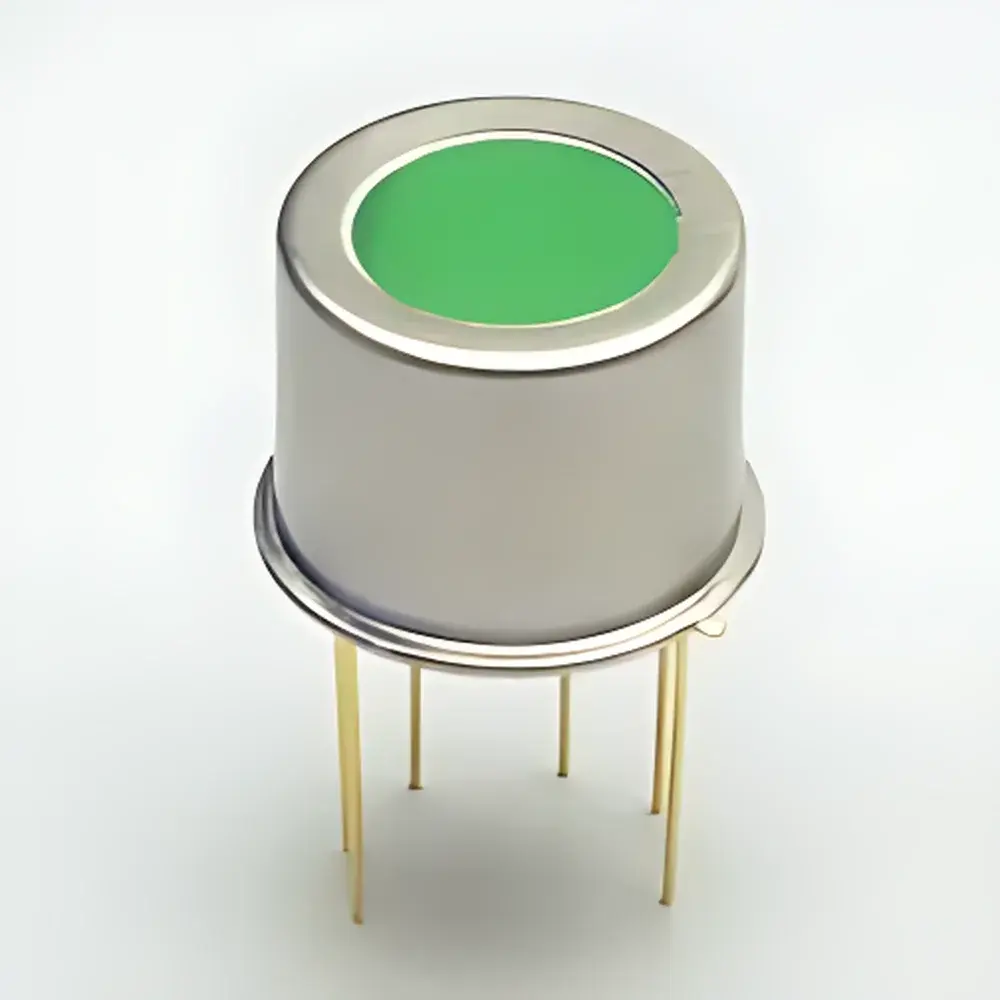
Hamamatsu P13894-211MA InAsSb Photovoltaic Infrared Detector
| Brand | Hamamatsu |
|---|---|
| Origin | Japan |
| Manufacturer Type | Original Equipment Manufacturer (OEM) |
| Origin Category | Imported |
| Model | P13894-211MA |
| Price Range | USD 1,400 – 2,800 (FOB Yokohama) |
| Active Area | 1 × 1 mm² |
| Pixel Count | 1 |
| Package | TO-8 Metal Can |
| Cooling | Two-Stage Thermoelectric (TE) Cooler |
| Cutoff Wavelength (Typ.) | 10.2 µm |
| Peak Wavelength (Typ.) | 5.6 µm |
| Spectral Response Range | 1.0 – 11.0 µm |
| Responsivity (Typ. at λ� | ₑₐₖ, Ta = 25°C): 0.0038 A/W |
| Dark Current (Typ. at λ = 5.6 µm, Tc = −40°C) | < 1.2 nA |
| Rise Time (Typ.) | < 1.5 µs |
| Shunt Resistance (Typ. at V = 0 V) | > 1.5 MΩ |
| Operating Temperature Range (Case) | −40°C to +70°C |
| Storage Temperature Range | −40°C to +85°C |
Overview
The Hamamatsu P13894-211MA is a single-element, photovoltaic (PV)-mode indium arsenide antimonide (InAsSb) infrared detector engineered for high-fidelity mid-wave to long-wave infrared (MWIR–LWIR) spectral detection in demanding environmental and industrial gas monitoring applications. Unlike photoconductive detectors requiring bias voltage and exhibiting higher noise, the PV architecture operates at zero bias—delivering inherently low dark current, excellent signal-to-noise ratio (SNR), and intrinsic stability over extended measurement cycles. Its extended cutoff wavelength of 10.2 µm (typ.) enables sensitive detection of fundamental vibrational absorption bands of critical industrial gases—including CO, CO₂, NO, SO₂, CH₄, NH₃, and volatile organic compounds (VOCs)—within the 3–11 µm atmospheric transmission window. The detector integrates a two-stage thermoelectric (TE) cooler to stabilize the junction temperature at −40°C, ensuring thermal drift suppression and reproducible responsivity across ambient fluctuations. Manufactured in Hamamatsu’s ISO 9001-certified Japanese facility using proprietary bulk crystal growth and passivation processes, the device achieves high uniformity and long-term reliability without cryogenic infrastructure.
Key Features
- Photovoltaic operation: Zero-bias design minimizes Johnson–Nyquist noise and eliminates bias-induced drift—ideal for continuous-duty gas analyzers requiring baseline stability.
- Extended spectral response: Covers 1.0–11.0 µm with peak responsivity at 5.6 µm, aligning with strong absorption lines of hydrocarbons and acidic gases.
- Two-stage TE cooling: Maintains stable detector junction temperature at −40°C (±0.1°C), enabling consistent responsivity and dark current performance under varying ambient conditions (−40°C to +70°C case temperature).
- Compact TO-8 metal can package: Hermetically sealed, ruggedized housing with standard pinout supports direct integration into optical bench assemblies, NDIR gas cells, and OEM analyzer modules.
- High shunt resistance (>1.5 MΩ typ. at 0 V): Reduces leakage-related uncertainty and improves linearity over dynamic range (up to 10⁴:1 detectable signal span).
- Fast temporal response (<1.5 µs rise time): Supports high-modulation-frequency non-dispersive infrared (NDIR) and photoacoustic spectroscopy (PAS) configurations for real-time concentration tracking.
Sample Compatibility & Compliance
The P13894-211MA is optimized for use in extractive and in-situ gas monitoring systems employing broadband or narrowband IR sources (e.g., MEMS thermal emitters, quantum cascade lasers) and interference filters (e.g., 4.26 µm for CO₂, 4.67 µm for CO). It complies with RoHS Directive 2011/65/EU and REACH Regulation (EC) No. 1907/2006. Its performance characteristics meet the functional requirements outlined in IEC 60079-29-1 (explosive atmospheres – gas detectors) and ASTM D6348–22 (standard test method for determination of gaseous compounds by GC/FTIR). When integrated into certified analyzers, it supports compliance with EPA Method 25A, EN 14625, and ISO 12039 for stack emission monitoring.
Software & Data Management
While the P13894-211MA is a component-level detector—not a standalone instrument—it interfaces seamlessly with industry-standard analog front-end (AFE) circuits and data acquisition platforms (e.g., National Instruments PXIe, Analog Devices AD7124-8). Hamamatsu provides comprehensive SPICE models, thermal derating curves, and calibration reference data (responsivity vs. temperature, spectral irradiance maps) for system-level simulation and traceable calibration. For OEM integrators, full GLP/GMP-aligned documentation—including lot-specific test reports, aging data (MTTF > 100,000 hrs), and FDA 21 CFR Part 11–compatible audit trails—is available upon request to support regulatory submissions.
Applications
- Non-dispersive infrared (NDIR) gas analyzers for continuous emissions monitoring systems (CEMS) in power plants and cement kilns.
- Portable and fixed-mount toxic gas detectors for petrochemical refineries, semiconductor fabrication cleanrooms, and biogas facilities.
- Fourier-transform infrared (FTIR) spectrometer detector arrays (as single-pixel reference or beam-path monitor).
- Industrial process control sensors for combustion optimization (O₂/CO ratio), landfill gas quality assessment (CH₄/C₂H₆), and refrigerant leak detection (SF₆, HFCs).
- Research-grade instrumentation for atmospheric chemistry studies, including open-path differential optical absorption spectroscopy (DOAS) and cavity ring-down spectroscopy (CRDS) setups.
FAQ
Is the P13894-211MA compatible with standard NDIR optical benches?
Yes—the TO-8 package features a flat, AR-coated germanium window (transmission >85% from 2–12 µm) and standardized 0.1″ pin spacing, enabling direct mounting on commercial NDIR modules with collimated beam paths.
What is the recommended operating temperature setpoint for optimal SNR?
For maximum responsivity and minimum dark current, operate the TE cooler to maintain detector junction temperature at −40°C; Hamamatsu provides detailed thermal management guidelines for PCB layout and heatsink selection.
Does Hamamatsu supply calibration certificates traceable to NIST standards?
Yes—certified spectral responsivity data (A/W per nm) and absolute irradiance calibration reports are available as optional deliverables, traceable to NMI-Japan (AIST) primary standards.
Can this detector be used in photoacoustic gas sensing?
Yes—its sub-microsecond rise time and low capacitance (<15 pF) make it suitable for detecting acoustic pressure waves generated by modulated IR absorption in resonant photoacoustic cells.
Is there a radiation-hardened variant for space-based environmental monitoring?
No—this series is designed for terrestrial industrial and laboratory use; Hamamatsu offers separate radiation-tolerant InSb and HgCdTe detectors for aerospace applications under its Space Grade product line.







