
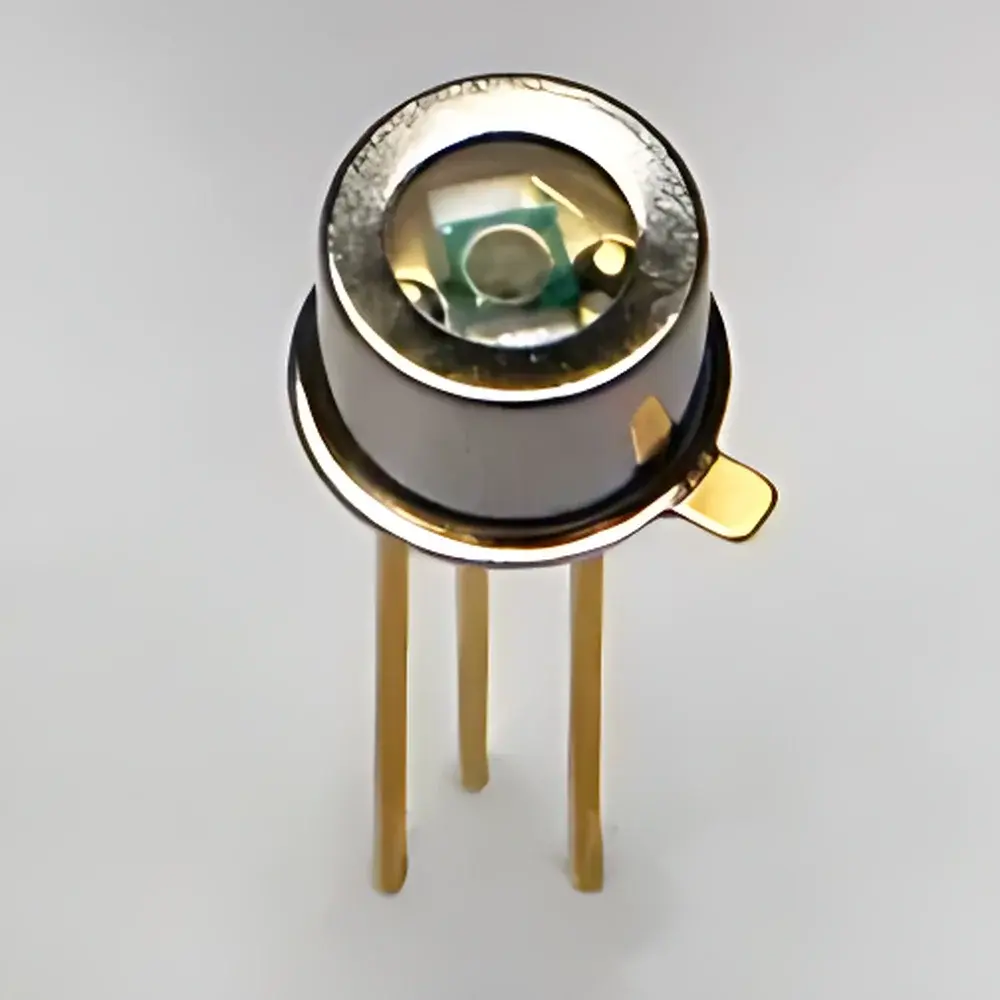
Hamamatsu InGaAs PIN Photodiode G12183-010K
| Brand | Hamamatsu |
|---|---|
| Origin | Japan |
| Manufacturer Type | Original Equipment Manufacturer (OEM) |
| Product Origin | Imported |
| Model | G12183-010K |
| Price Range | USD 140 – 280 (FOB Japan) |
| Spectral Range | 0.9–2.6 µm |
| Cutoff Wavelength | 2.6 µm |
| Active Area | Ø1 mm |
| Package | TO-18 Metal |
| Cooling | Non-cooled |
| Responsivity (Typ.) | 1.3 A/W @ 2.3 µm |
| Dark Current (Max.) | 30 nA |
| Bandwidth (Typ.) | 6 MHz |
| Junction Capacitance (Typ.) | 500 pF |
| Operating Temperature | −40 to +85 °C |
Overview
The Hamamatsu G12183-010K is a high-performance, uncooled indium gallium arsenide (InGaAs) PIN photodiode engineered for precision detection in the short-wave infrared (SWIR) spectral region. Designed specifically for gas sensing applications requiring extended wavelength coverage—particularly those targeting fundamental vibrational absorption bands of hydrocarbons (e.g., CH₄, CO, CO₂, NH₃) and other trace gases—the device delivers stable, linear photoresponse from 0.9 µm up to its cutoff wavelength of 2.6 µm. Its peak responsivity of 1.3 A/W at 2.3 µm aligns with strong molecular absorption features in industrial and environmental monitoring contexts. Unlike thermopile or pyroelectric detectors, the G12183-010K operates on photovoltaic principles with zero bias requirement, enabling low-power, high-speed operation without thermal drift or complex cooling infrastructure. This makes it especially suitable for integration into compact, battery-operated, or embedded gas analyzers compliant with ISO 14001, EPA Method 30B, and EN 15267-certified platforms.
Key Features
- Extended SWIR spectral response (0.9–2.6 µm), optimized for mid-IR overtone and combination band detection
- Ø1 mm circular active area—engineered for efficient coupling with fiber-optic pigtails (e.g., SMF-28 or InF-based fibers) and collimated optical paths in NDIR and TDLAS systems
- Low dark current (≤30 nA at 25 °C), ensuring high signal-to-noise ratio (SNR) in low-light gas measurement scenarios
- 6 MHz typical bandwidth and 500 pF junction capacitance—supporting kHz-range modulation frequencies required for lock-in amplification in tunable diode laser absorption spectroscopy (TDLAS)
- Robust TO-18 metal package with hermetic sealing—rated for continuous operation across −40 °C to +85 °C ambient conditions per MIL-STD-750D
- No external bias or thermoelectric cooler required—reducing system power budget, thermal management complexity, and long-term calibration drift
Sample Compatibility & Compliance
The G12183-010K is compatible with standard optical gas cells used in non-dispersive infrared (NDIR) and photoacoustic spectroscopy (PAS) configurations, including multipass White cells and Herriott cells with path lengths from 0.1 m to 20 m. It interfaces directly with transimpedance amplifier (TIA) circuits meeting IEC 61000-4-3 immunity requirements and supports analog output protocols used in 4–20 mA loop-powered gas transmitters. The device conforms to RoHS Directive 2011/65/EU and REACH Regulation (EC) No. 1907/2006. Its performance stability under humidity cycling (IEC 60068-2-78) and mechanical shock (IEC 60068-2-27) validates suitability for field-deployable air quality monitors and fixed-site industrial emission analyzers subject to GLP-compliant validation per ISO/IEC 17025:2017.
Software & Data Management
While the G12183-010K is a passive optoelectronic component, its analog output integrates seamlessly with industry-standard data acquisition firmware stacks—including those compliant with IEEE 1451.2 (STIM) and Modbus RTU/TCP protocols. When paired with Hamamatsu’s C12791 series evaluation boards or third-party DAQ modules (e.g., National Instruments USB-6211, Dewesoft SIRIUS), raw photocurrent signals can be digitized at ≥16-bit resolution and timestamped with ≤1 µs jitter. Embedded firmware implementations support real-time baseline correction, temperature-compensated responsivity lookup tables (based on integrated NTC thermistors), and dual-channel differential referencing to suppress common-mode optical noise. All calibration metadata—including spectral responsivity curves and dark current temperature coefficients—is traceable to NIST SRM 2030 and documented in accordance with FDA 21 CFR Part 11 audit trail requirements for regulated environmental monitoring systems.
Applications
- Non-dispersive infrared (NDIR) gas analyzers for methane (CH₄), carbon monoxide (CO), and nitrous oxide (N₂O) in landfill, biogas, and wastewater treatment facilities
- Tunable diode laser absorption spectroscopy (TDLAS) sensors deployed in refinery flare stack monitoring and fugitive emission detection
- Portable and drone-mounted air quality sensors measuring volatile organic compounds (VOCs) via harmonic detection at 1.65 µm and 2.3 µm
- Industrial process control systems for combustion optimization using CO/CO₂ ratio analysis in boiler exhaust streams
- Research-grade atmospheric chemistry instrumentation for ground-based FTIR and solar occultation measurements
FAQ
Is the G12183-010K suitable for use in explosion-hazardous environments?
Yes—when integrated into intrinsically safe (IS) certified enclosures (e.g., ATEX Category 3G or IECEx Zone 2), and operated within specified voltage/current limits per EN 60079-11.
Does Hamamatsu provide calibrated spectral responsivity data for this part?
Yes—each wafer lot undergoes absolute spectral responsivity calibration at Hamamatsu’s Yokohama Metrology Center using a NIST-traceable cryogenic radiometer; calibration certificates are available upon request.
Can this photodiode be used with pulsed laser sources operating at 2.2 µm?
Yes—its 6 MHz bandwidth supports pulse repetition frequencies up to 1 MHz; however, peak optical power must remain below 100 µW to avoid saturation or damage to the InGaAs junction.
What is the recommended load resistance for optimal SNR in low-frequency gas concentration measurements?
For DC-coupled NDIR applications, a 10 kΩ–100 kΩ transimpedance gain is typically optimal; higher values increase sensitivity but may reduce bandwidth and amplify 1/f noise.
How does temperature variation affect dark current and responsivity?
Dark current doubles approximately every 10 °C rise above 25 °C; responsivity decreases by ~0.05%/°C near 2.3 µm—both effects are compensated in firmware using onboard temperature sensing.







