
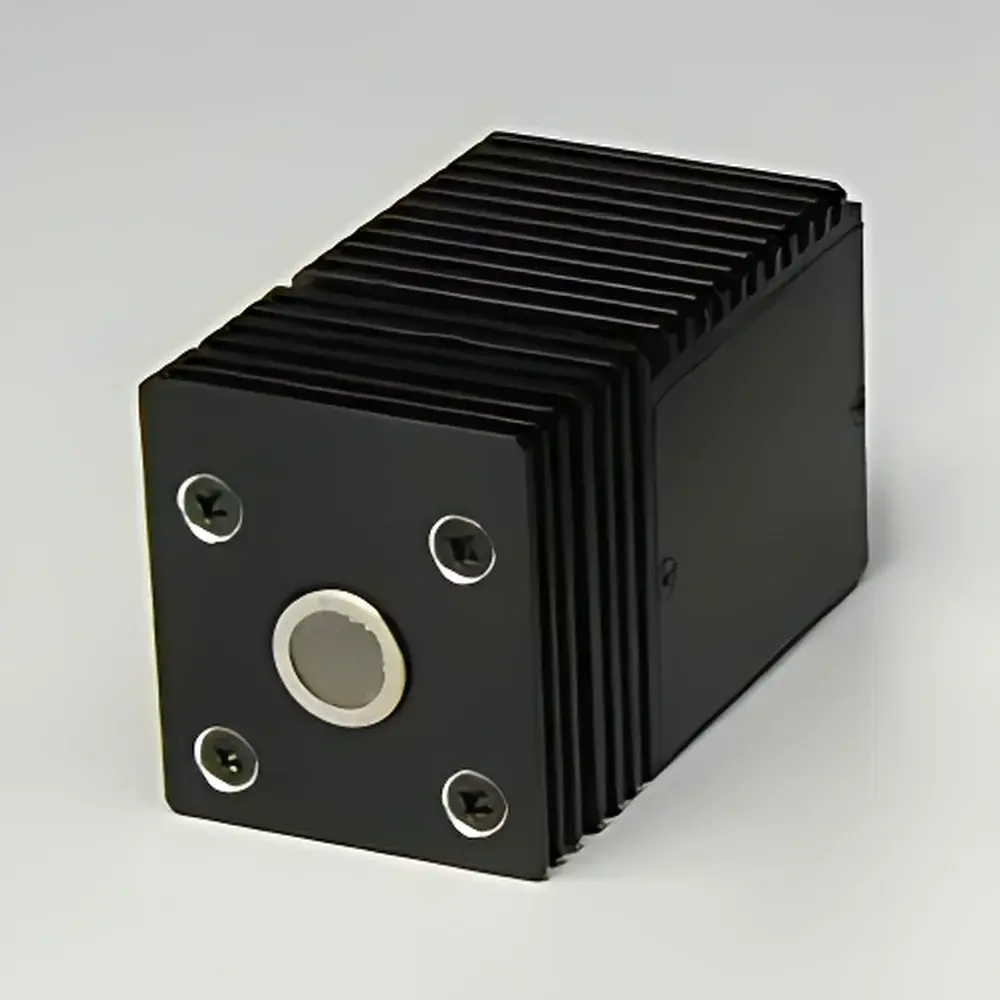
Hamamatsu Photomultiplier Tube Module H10720-110
| Brand | Hamamatsu |
|---|---|
| Origin | Japan |
| Manufacturer Type | Original Equipment Manufacturer (OEM) |
| Product Category | Imported |
| Model | H10720-110 |
| Price Range | USD 0–9,999 |
Overview
The Hamamatsu Photomultiplier Tube Module H10720-110 is a compact, self-contained, high-sensitivity photodetection solution engineered for integration into spectroscopic and low-light measurement systems. Built around a side-on, bialkali photocathode photomultiplier tube (PMT), this module incorporates a precision high-voltage power supply, optimized signal amplification circuitry, and stable temperature-compensated gain control—all housed in a shielded, aluminum alloy enclosure. It operates on the principle of photoelectron multiplication via discrete dynode electron multiplication, delivering linear response over six orders of magnitude (typically 10⁴–10¹⁰) in photon flux. Designed for applications demanding high quantum efficiency in the UV–visible range (peak QE ≈ 22% at 400 nm), low dark current (<1 nA at 25°C), and fast pulse response (rise time <2.5 ns), the H10720-110 serves as a core detector in fluorescence spectrometers, Raman analyzers, liquid chromatography detectors, and time-resolved luminescence setups.
Key Features
- Integrated high-voltage power supply (adjustable from −700 V to −1000 V) with low ripple (<0.01%) and excellent long-term stability (±0.05% over 8 hours)
- Bialkali photocathode (S-20 spectral response) with effective photocathode area of Ø10 mm and typical radiant sensitivity of 45 A/W at 400 nm
- 10-stage linear-focused dynode chain enabling high gain (>1 × 10⁶) with minimal pulse amplitude variation (pulse non-uniformity <15%)
- Low-noise, DC-coupled amplifier with 50 Ω output impedance and bandwidth of DC–50 MHz (−3 dB)
- EMI/RFI-shielded housing compliant with IEC 61326-1 for electromagnetic compatibility in laboratory and industrial environments
- Standard analog output (BNC connector) and TTL-compatible gate input for external synchronization or gated detection
Sample Compatibility & Compliance
The H10720-110 is not a sample-contacting device but functions as a light-detection subsystem compatible with optical interfaces ranging from fiber-optic couplers (e.g., SMA 905) to free-space lens tubes (with optional collimating/focusing adapters). Its spectral response (160–650 nm) aligns with common excitation sources including deuterium lamps, xenon arc lamps, and pulsed LEDs. The module meets RoHS Directive 2011/65/EU and conforms to ISO 9001-certified manufacturing processes. For regulated analytical workflows—such as those governed by USP , ASTM E275, or ICH Q2(R2)—the module supports traceable calibration via NIST-traceable reference standards when paired with calibrated light sources and neutral density filters. Its design facilitates compliance with GLP documentation requirements through consistent batch-level performance certification provided by Hamamatsu.
Software & Data Management
As a hardware-level analog detector, the H10720-110 does not include embedded firmware or onboard data storage. It outputs analog voltage signals proportional to incident photon flux, intended for acquisition by external digitizers (e.g., PCIe DAQ cards, oscilloscopes, or spectroscopy controllers). Integration with third-party software—including LabVIEW, MATLAB, Python (via PyVISA or NI-DAQmx), and commercial spectroscopy platforms (e.g., Ocean Insight’s OceanView, Horiba’s LabSpec)—is achieved through standardized analog I/O protocols. When deployed in FDA-regulated environments, users may implement 21 CFR Part 11-compliant audit trails by routing the analog output through validated acquisition systems that log timestamped raw voltage data, HV settings, and environmental metadata (e.g., ambient temperature, humidity) alongside instrument configuration files.
Applications
- UV-Vis absorption and fluorescence spectroscopy, particularly in microvolume cuvette and flow-cell configurations
- Time-correlated single-photon counting (TCSPC) systems requiring sub-nanosecond timing resolution and low afterpulsing probability
- Chemiluminescence and bioluminescence detection in ELISA, reporter gene assays, and ATP quantification
- High-speed laser-induced breakdown spectroscopy (LIBS) signal capture with pulse-to-pulse intensity normalization
- Multi-channel spectral detection arrays where space-constrained, matched-gain modules are required for inter-channel consistency
FAQ
What is the recommended operating temperature range for stable gain performance?
The H10720-110 is rated for continuous operation between +5 °C and +40 °C; gain drift is specified at ≤0.05% per °C within this range when using internal temperature compensation.
Can this module be used in vacuum or controlled-atmosphere enclosures?
No—the module is designed for ambient air operation only; its epoxy-sealed PMT envelope and PCB layout are not rated for vacuum or inert gas environments.
Is there a digital interface option available for the H10720-110?
Not natively; however, Hamamatsu offers companion digital readout units (e.g., C12880MA series) for OEM integration, or users may pair it with external ADC modules supporting USB, Ethernet, or PCIe interfaces.
How is calibration traceability maintained across production batches?
Each unit ships with a factory calibration report listing measured dark current, gain at nominal HV, and spectral responsivity at three wavelengths (365 nm, 436 nm, 546 nm), traceable to Hamamatsu’s internal primary standards aligned with NMIJ/AIST.
Does Hamamatsu provide application-specific mounting brackets or optical coupling accessories?
Yes—standard mechanical drawings and optional accessories (e.g., lens holders, fiber adapters, magnetic shielding sleeves) are available under Hamamatsu part numbers H10720-ACC-xx and are documented in the H10720 Series Application Manual Rev. 5.2.







