
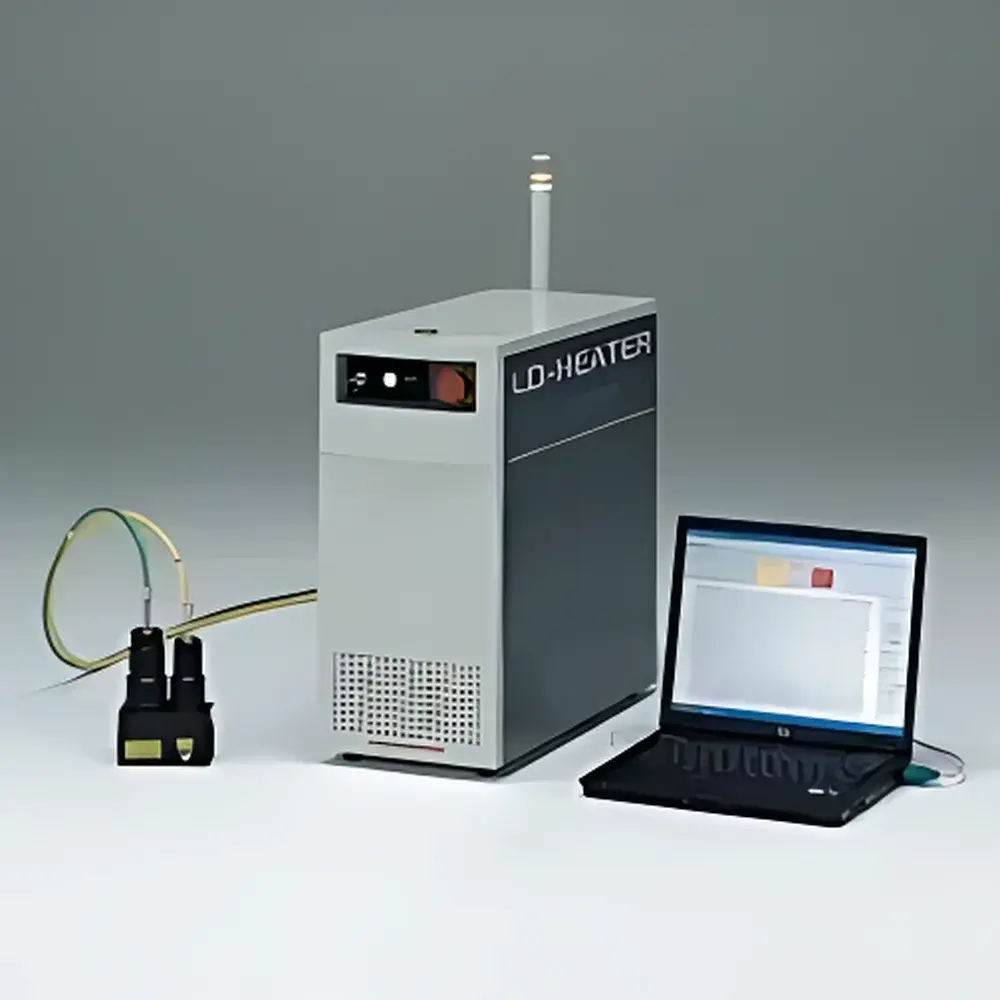
Hamamatsu L10060 LD-Heater Compact Laser-Based Thermal Processing Source
| Brand | Hamamatsu |
|---|---|
| Origin | Japan |
| Manufacturer Type | Original Equipment Manufacturer (OEM) |
| Product Origin | Imported |
| Model | L10060 |
| Pricing | Available Upon Request |
Overview
The Hamamatsu L10060 LD-Heater is a compact, integrated laser-based thermal processing source engineered for precision localized heating in industrial and R&D applications. Unlike conventional resistive or lamp-based heaters, the L10060 employs a fiber-coupled semiconductor laser (LD) as its core energy delivery mechanism—enabling non-contact, spatially confined heat input with rapid thermal response and high power stability. Its operational principle relies on photothermal conversion: near-infrared laser light (typically 808 nm or 940 nm, depending on configuration) is delivered via optical fiber to a focused spot, where absorbed photon energy is converted into controlled thermal energy at the target surface. This enables deterministic thermal management—critical for processes requiring minimal heat-affected zones, reproducible thermal cycles, and real-time feedback control. The system integrates three functional subsystems within a single tower-style chassis: a temperature-sensing unit (typically based on integrated pyrometry or calibrated infrared detection), a fiber-coupled LD module, and a synchronized driver/control electronics platform. Designed for integration into automated workstations or inline manufacturing cells, the L10060 meets the stringent requirements of high-mix, low-volume prototyping as well as high-reliability production environments.
Key Features
- Fiber-coupled semiconductor laser module—manufactured in-house by Hamamatsu Photonics, ensuring long-term wavelength stability, low noise (10,000 hours MTBF.
- Real-time closed-loop temperature monitoring—integrated non-contact pyrometer (spectral response optimized for 1.0–1.6 µm range) enables dynamic feedback control with ±2 °C accuracy across 100–1200 °C measurement range.
- Compact tower architecture—footprint under 200 × 200 mm, height <450 mm—designed for space-constrained integration into robotic cells, cleanroom-compatible enclosures, or benchtop optical tables.
- Energy-efficient operation—laser-to-heat conversion efficiency exceeds 45%, significantly reducing total power consumption versus broadband IR emitters; typical electrical input ≤300 W for 20 W optical output.
- Dual-mode control interface—supports analog voltage (0–10 V) for PLC integration and digital RS-485/USB-C communication for PC-based parameter scripting, waveform programming, and event logging.
- Comprehensive safety architecture—includes interlock-ready emergency stop circuitry, fiber break detection, overtemperature cutoff, and laser emission status LED with IEC 60825-1 Class 4 compliance documentation.
Sample Compatibility & Compliance
The L10060 LD-Heater is compatible with thermally responsive materials including thermoplastics (e.g., PA6, PBT, PC, ABS), thin-film metal alloys (Cu, Al, SnAg), and oxide-coated substrates used in microelectronics packaging. It supports both transmission-mode (e.g., clear-to-black polymer welding) and reflection-mode (e.g., localized annealing of Si wafers) configurations when paired with appropriate focusing optics. The system conforms to ISO 13849-1 (PL d, Category 3) for functional safety, meets EMC Directive 2014/30/EU (EN 61326-1), and carries CE marking for industrial machinery. Optional FDA 21 CFR Part 11-compliant software modules are available for GMP-regulated medical device manufacturing environments, supporting audit trails, electronic signatures, and user-access level management.
Software & Data Management
Hamamatsu provides the optional LD-Heater Control Suite—a Windows-based application enabling full parametric control, thermal profile definition (ramp-hold-cool sequences), and synchronized data acquisition. All temperature readings, laser power setpoints, and timing events are timestamped and exported in CSV or HDF5 format for traceability. The software supports scripting via Python API (PyHamamatsu SDK), allowing integration into LabVIEW, MATLAB, or custom MES platforms. Raw thermal data includes metadata such as ambient temperature, fiber coupling efficiency calibration offset, and system uptime—facilitating root-cause analysis during process qualification per ISO 9001 or AS9100 requirements.
Applications
- Laser transmission welding of dissimilar polymers in automotive sensor housings and medical fluidic devices.
- Localized brazing of copper busbars in battery module assembly—minimizing intermetallic formation and residual stress.
- Controlled annealing of thin-film transistor (TFT) backplanes to activate dopants without substrate warpage.
- Thermal reflow of micro-solder joints in MEMS packaging—achieving sub-100 µm spot size repeatability.
- In-process thermal stabilization of optical adhesive bonds during lens alignment in precision optics manufacturing.
FAQ
What laser wavelength options are available for the L10060?
Standard configurations use 808 nm or 940 nm multimode pump lasers; custom wavelengths (e.g., 1470 nm for enhanced water absorption) are available upon request.
Can the L10060 be integrated with motion stages or robotic arms?
Yes—the system supports TTL-triggered laser firing and analog position synchronization; Hamamatsu provides mechanical mounting interfaces and coordinate mapping utilities for Cartesian and SCARA systems.
Is fiber replacement supported in-field?
The fiber termination uses an industry-standard SMA-905 connector; certified replacement fibers (core diameters: 200 µm, 400 µm, or 600 µm) are available with factory recalibration certificates.
Does the temperature monitoring function require emissivity input?
Yes—emissivity correction is configurable per material type (default presets provided for common polymers and metals); advanced users may define piecewise emissivity curves vs. temperature.
What maintenance intervals are recommended?
Optical path inspection every 500 operating hours; annual recalibration of pyrometer and laser power meter is advised for ISO/IEC 17025 traceability.



