
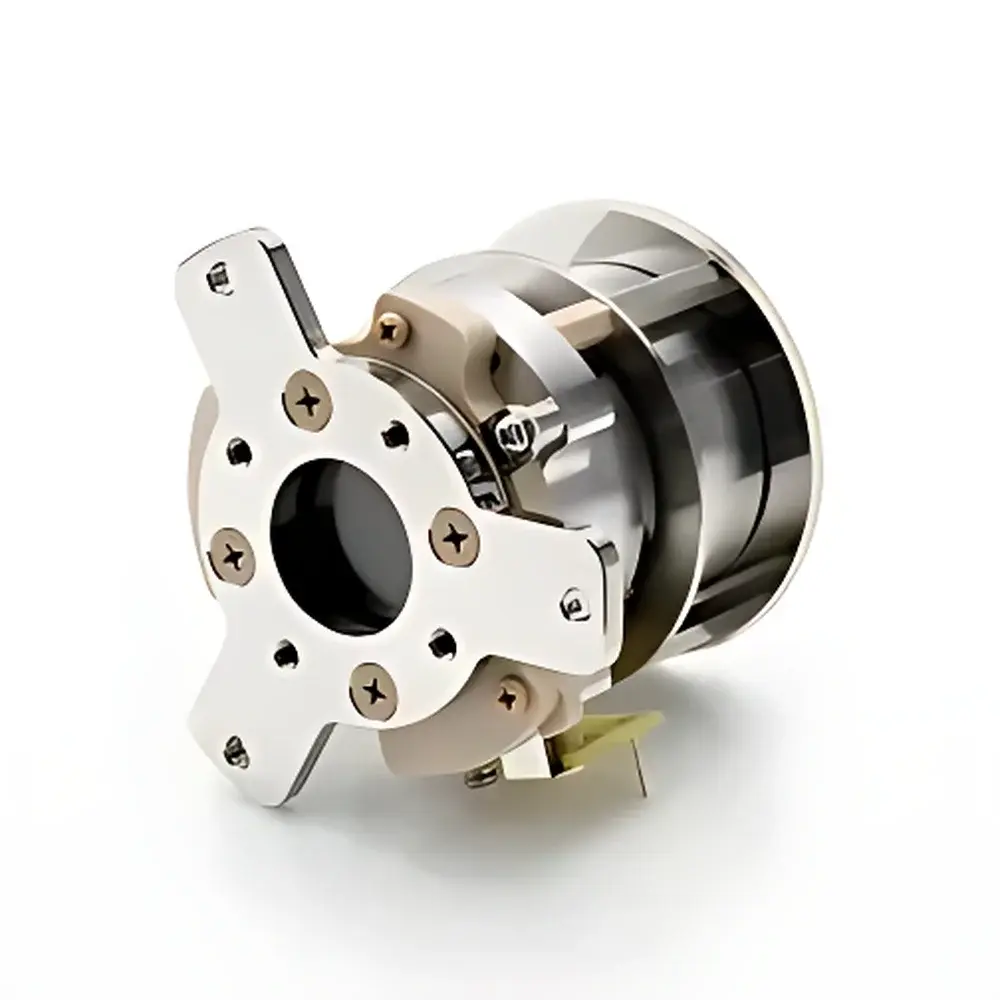
Hamamatsu MCP Detector Module F14845-11
| Brand | Hamamatsu |
|---|---|
| Origin | Japan |
| Manufacturer Type | Original Equipment Manufacturer (OEM) |
| Product Category | Imported |
| Model | F14845-11 |
| Pricing | Upon Request |
Overview
The Hamamatsu MCP Detector Module F14845-11 is a high-performance, integrated ion detection system engineered for demanding mass spectrometry applications. It combines a microchannel plate (MCP) electron multiplier with an avalanche photodiode (APD) in a single vacuum-compatible package—marketed under the proprietary name “MIGHTION.” This hybrid architecture leverages the MCP’s high secondary electron gain (typically 10⁴–10⁷) and sub-nanosecond temporal response, while the APD provides low-noise, high-bandwidth signal readout with excellent pulse-height resolution. Unlike discrete MCP–anode configurations, the monolithic integration minimizes inter-electrode capacitance and transit-time dispersion, enabling time-of-flight (TOF) mass spectrometers to achieve <300 ps timing jitter and sustained count rates exceeding 1 MHz without significant dead-time distortion. The detector operates at standard high-vacuum conditions (≤1×10⁻⁶ Pa), making it suitable for coupling with orthogonal acceleration TOF, reflectron TOF, and quadrupole time-of-flight (Q-TOF) platforms.
Key Features
- Integrated MCP–APD architecture optimized for pulsed ion beam detection
- Sub-nanosecond rise time (<0.5 ns) and low timing jitter (<300 ps FWHM)
- High dynamic range: linear response over 5 orders of magnitude (1–10⁵ ions/pulse)
- Long operational lifetime (>2 C/cm² total extracted charge under typical TOF duty cycles)
- Vacuum-compatible ceramic-metal hermetic housing with CF-35 or ISO-KF 40 flange options
- Low dark count rate (<10 cps at −20 °C APD bias)
- Active area: 18 mm diameter circular detection zone (standard configuration)
- Compatible with negative- and positive-ion modes via adjustable MCP bias polarity
Sample Compatibility & Compliance
The F14845-11 supports detection of singly and multiply charged atomic and molecular ions across a broad mass range (m/z 1–10,000), including fragile biomolecular ions (e.g., peptides, oligonucleotides) and inorganic clusters. Its fast recovery time mitigates space-charge saturation effects during high-flux desorption events (e.g., MALDI, laser ablation). The module complies with IEC 61326-1 (EMC for laboratory equipment) and meets RoHS 2015/863/EU material restrictions. While not certified to FDA 21 CFR Part 11 out-of-the-box, its analog voltage output and TTL-compatible gate input enable traceable integration into GLP/GMP-compliant data acquisition systems when paired with validated digitizers and audit-trail-enabled software.
Software & Data Management
The detector interfaces via standard 50 Ω coaxial output (BNC or SHV) delivering fast negative pulses (−0.5 V to −2 V amplitude, 1–2 ns width) synchronized to ion arrival. No proprietary driver is required; it integrates seamlessly with commercial TOF data systems including Tofwerk’s TOFDAQ, Bruker’s flexAnalysis, and custom LabVIEW- or Python-based acquisition frameworks. Pulse timing and amplitude histograms can be recorded using time-to-digital converters (TDCs) or high-speed digitizers (≥1 GS/s). When used in regulated environments, raw pulse timestamps and amplitudes are retained in HDF5 or mzML format, supporting retrospective reprocessing and full audit trail reconstruction per ISO/IEC 17025 requirements.
Applications
- Time-of-flight mass spectrometry (TOF-MS) for proteomics and metabolomics
- Laser desorption/ionization (LDI) and matrix-assisted laser desorption/ionization (MALDI) imaging
- Secondary ion mass spectrometry (SIMS) with high spatial resolution
- Ion trap and Orbitrap hybrid instruments requiring fast transient detection
- Fundamental studies of ion–surface interactions and electron emission dynamics
- Spaceborne mass analyzers where radiation hardness and thermal stability are critical
FAQ
What vacuum level is required for stable operation?
The F14845-11 requires a base pressure ≤1×10⁻⁶ Pa (≤1×10⁻⁸ mbar) for optimal MCP gain stability and minimal ion-induced background noise.
Can the detector be operated in counting mode or analog mode?
It supports both: individual ion events yield discrete pulses suitable for photon-counting electronics; high-flux conditions produce superimposed pulses interpretable as analog current via peak-hold or RMS integration.
Is cooling required for the APD section?
Yes—thermoelectric cooling to −20 °C is recommended to suppress dark current and maintain pulse-height resolution; the module includes integrated Peltier control terminals.
Does Hamamatsu provide calibration certificates or gain characterization data?
Each unit ships with a factory test report including measured gain vs. MCP voltage, timing response (FWHM), and dark count rate at specified temperature and bias conditions.
What flange options are available for vacuum integration?
Standard configurations include CF-35 (ISO-KF 35) and ISO-KF 40; custom ConFlat or DN25 flanges are available upon request with minimum order quantity.





