
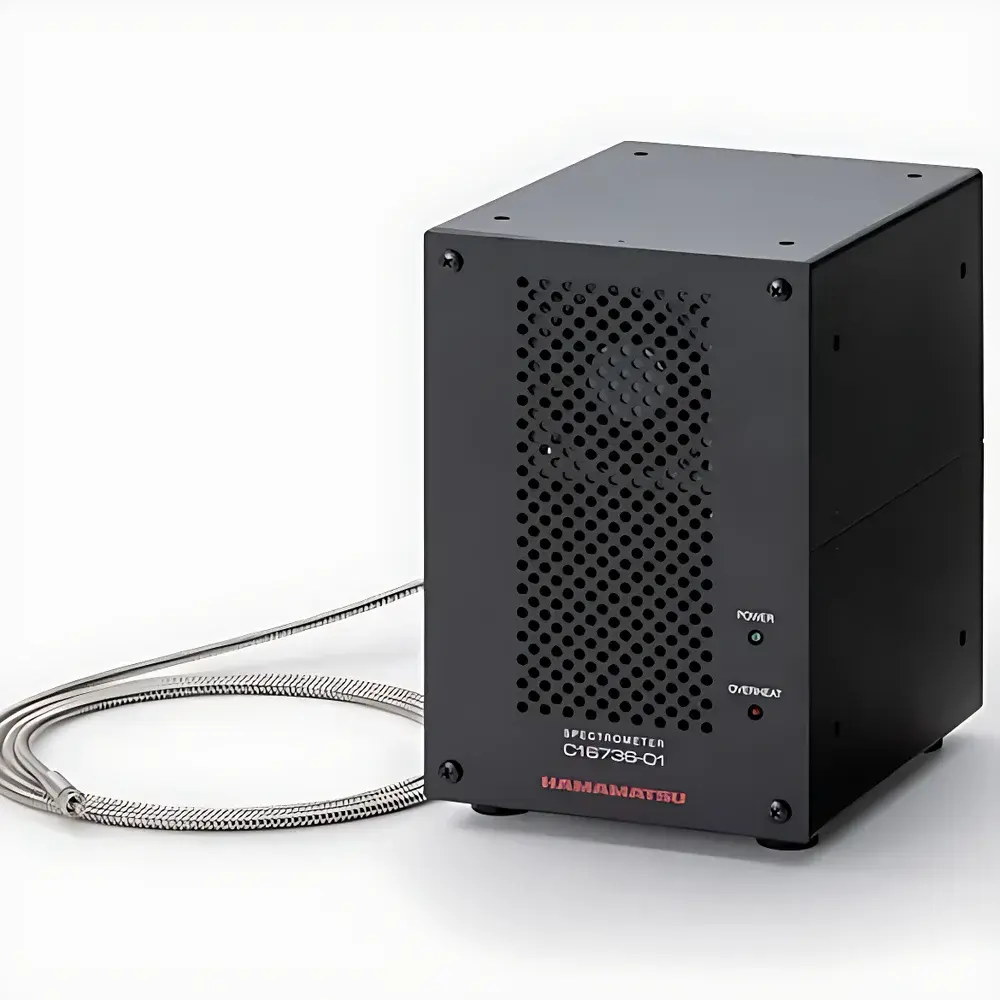
Hamamatsu OPAL-Luxe C16736-01 High-Dynamic-Range Fiber Optic Spectrometer
| Brand | Hamamatsu |
|---|---|
| Origin | Japan |
| Manufacturer Type | Original Equipment Manufacturer (OEM) |
| Import Status | Imported |
| Model | OPAL-Luxe C16736-01 |
| Spectral Range | 200–900 nm |
| Optical Resolution | ≤0.9 nm (typ. 0.85 nm) |
| Dynamic Range | 2,500,000:1 |
Overview
The Hamamatsu OPAL-Luxe C16736-01 is a high-performance fiber optic spectrometer engineered for demanding quantitative spectroscopic applications requiring exceptional signal fidelity across ultraviolet, visible, and near-infrared spectral regions. Built upon Hamamatsu Photonics’ proprietary CMOS linear image sensor architecture and optimized optical bench design, the instrument leverages advanced on-chip charge-domain signal processing to achieve a true dynamic range of 2,500,000:1 — among the highest commercially available for benchtop CCD/CMOS-based spectrometers in its class. This capability stems from simultaneous dual-gain readout architecture and intelligent pixel-level saturation management, enabling accurate detection of both intense primary absorption bands and weak secondary or trace-level spectral features within a single acquisition. Unlike conventional spectrometers that require multiple exposures or hardware attenuation to span wide intensity ranges, the OPAL-Luxe eliminates measurement artifacts associated with exposure stacking or mechanical filter switching — ensuring photometric linearity and spectral integrity over six orders of magnitude.
Key Features
- True 2,500,000:1 dynamic range achieved via synchronized dual-gain analog-to-digital conversion and non-destructive correlated double sampling (CDS)
- High-fidelity spectral response from 200 nm to 900 nm, covering deep UV through NIR — ideal for UV-Vis-NIR absorbance, reflectance, and emission studies
- Optical resolution ≤0.9 nm (typ. 0.85 nm) at FWHM, verified using NIST-traceable mercury-argon emission lines
- Integrated thermoelectric cooling (TEC) stabilizes sensor temperature to ±0.1 °C, minimizing dark current drift and enabling long integration times up to 60 seconds
- Fiber-coupled input with SMA 905 connector; compatible with standard 200 µm core multimode fibers and optional slit adapters for spectral bandwidth control
- USB 3.0 interface with real-time data streaming at up to 400 spectra per second (full 2048-pixel frame), supporting trigger synchronization and external clocking
Sample Compatibility & Compliance
The OPAL-Luxe C16736-01 supports direct coupling to liquid flow cells, integrating sphere accessories, plasma monitoring probes, and custom optical interfaces — making it suitable for both laboratory and industrial process environments. Its spectral calibration is traceable to NIST standards, and factory-certified wavelength accuracy is ±0.3 nm across the full range. The device complies with IEC 61326-1 (EMC for laboratory equipment) and IEC 61010-1 (safety requirements for electrical equipment). When deployed in regulated QC/QA workflows — such as pharmaceutical raw material identification or semiconductor process gas analysis — the system can be validated under ISO/IEC 17025 guidelines. Optional firmware modules support audit trail logging and user-access controls aligned with FDA 21 CFR Part 11 requirements when integrated into compliant software platforms.
Software & Data Management
Hamamatsu provides the bundled SpectraSmart™ software suite (v3.5+), which offers real-time spectral visualization, multi-curve overlay, peak search with centroid fitting, and customizable export formats (CSV, HDF5, XML). Application programming interfaces (APIs) are available for C/C++, Python (PyHamamatsu), LabVIEW, and MATLAB, enabling seamless integration into automated analytical platforms or LIMS environments. Raw spectral data includes embedded metadata (timestamp, integration time, sensor temperature, calibration coefficients), facilitating reproducible post-processing and traceability. All spectral acquisitions support lossless compression without quantization error, preserving full dynamic fidelity for downstream chemometric modeling (e.g., PLS regression, PCA).
Applications
- Quantitative multi-component analysis in chemical synthesis and formulation, where high-concentration matrix absorptions and low-abundance impurity signatures coexist
- In-line and at-line monitoring of plasma processes (e.g., etch endpoint detection, plasma uniformity mapping) via time-resolved emission spectroscopy
- UV-Vis-NIR characterization of nanomaterials, quantum dots, and organic semiconductors with overlapping absorption shoulders
- Pharmaceutical dissolution testing and excipient interaction studies requiring precise baseline stability and low-noise detection below 0.001 AU
- Environmental water quality analysis for simultaneous detection of nitrate (220 nm), nitrite (355 nm), and organic chromophores (up to 750 nm)
FAQ
What does “2,500,000:1 dynamic range” mean in practical measurement terms?
It indicates the ratio between the largest non-saturating signal and the smallest detectable signal above system noise floor in a single exposure — equivalent to measuring absorbance values from 6.4 AU without changing integration time or optical attenuation.
Is the OPAL-Luxe compatible with third-party chemometric software packages?
Yes — spectral data exports in standard ASCII and HDF5 formats are natively supported by Unscrambler®, Pirouette®, and Python-based scikit-learn pipelines.
Does the instrument include factory calibration certificates?
Each unit ships with a NIST-traceable wavelength calibration certificate and radiometric responsivity report, valid for 12 months from date of shipment.
Can the OPAL-Luxe operate in continuous monitoring mode for industrial environments?
Yes — with optional DIN-rail mounting kit and extended temperature-rated housing (-10 °C to +50 °C), it meets IP52 ingress protection and supports 24/7 operation under controlled ambient conditions.
How is spectral resolution verified and maintained over time?
Resolution is characterized using atomic emission lines (Hg, Ar, Ne); users may perform routine verification via included calibration lamp module (Cat. No. L11365-01), with drift compensation algorithms embedded in SpectraSmart™ firmware.





