
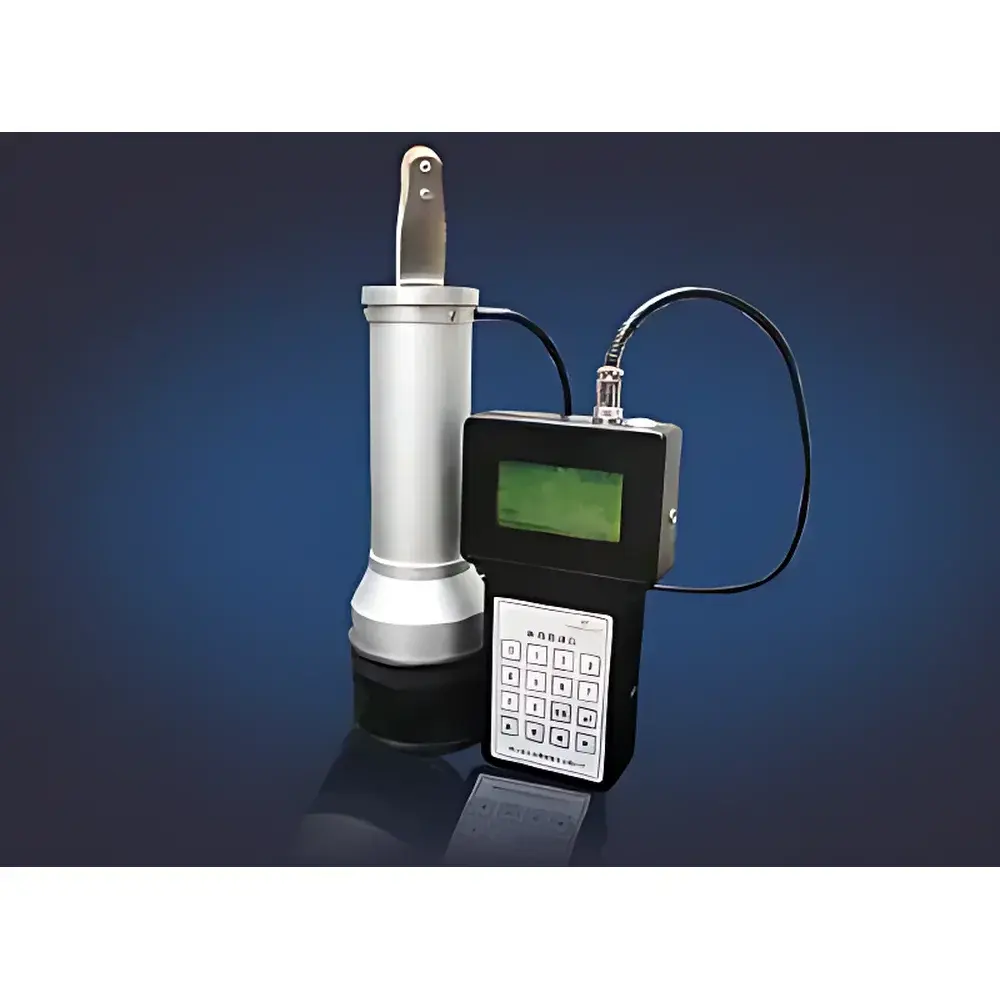
Xinxianda CIT-3000F Handheld Gamma-Ray Spectrometer
| Brand | Xinxianda |
|---|---|
| Model | CIT-3000F |
| Detector | Ø75 mm × 75 mm NaI(Tl) crystal |
| Energy Resolution | ≤8% at 662 keV (¹³⁷Cs) |
| Uranium (eU) Range | 2–1000 ppm |
| Thorium (eTh) Range | 3–1000 ppm |
| Potassium (eK) Range | 0.5–100 wt% |
| U Channel | 1.60–1.90 MeV |
| Th Channel | 2.40–3.00 MeV |
| K Channel | 1.30–1.60 MeV |
| Total Spectrum | 0.5–3.00 MeV |
| Accuracy | eU/eTh ≤ ±7%, eK ≤ ±12% |
| Pulse Shaping Time | 2 µs |
| Data Storage | 2 million spectra |
| Power | Rechargeable 2.4 Ah Li-ion battery, ≤200 mW |
| Operating Temp | 0–50 °C |
| Relative Humidity | ≤90% at 50 °C |
| Weight | Control Unit 0.6 kg, Detector 3.0 kg |
| Interface | RS-232 |
Overview
The Xinxianda CIT-3000F Handheld Gamma-Ray Spectrometer is a field-deployable, high-sensitivity scintillation spectrometer engineered for in situ gamma-ray energy spectrum acquisition and quantitative radionuclide analysis. It operates on the principle of gamma-ray spectroscopy using a thallium-doped sodium iodide [NaI(Tl)] scintillation detector, where incident gamma photons generate light pulses proportional to their energy; these pulses are digitized via fast digital pulse processing with 2 µs shaping time, enabling high-throughput spectral acquisition under variable field conditions. Designed for geological exploration, environmental radiation monitoring, and building material screening, the CIT-3000F delivers calibrated concentration estimates for uranium (eU), thorium (eTh), and potassium (eK) directly in the field—without requiring laboratory-based gamma spectrometry infrastructure. Its compact architecture, low power consumption (<200 mW), and robust thermal/humidity tolerance (0–50 °C, ≤90% RH at 50 °C) support extended operational duty cycles in remote or logistically constrained environments.
Key Features
- Digital pulse processing with 2 µs pulse shaping time—optimized for count-rate stability and spectral fidelity in dynamic field conditions
- High-volume onboard data storage: up to 2 million measurement records with timestamp, GPS-tagged metadata (when integrated), and full spectral histograms
- Backlit LCD display with intuitive menu-driven interface and tactile keypad navigation—designed for gloved operation and daylight readability
- Configurable output modes: real-time count rate (cps) or calibrated concentration units (ppm for eU/eTh; wt% for eK)
- RS-232 serial interface compliant with standard geophysical data exchange protocols—enabling seamless integration with GIS mapping software and geological survey workflows
- Modular mechanical design: lightweight control unit (0.6 kg) paired with a dedicated 3.0 kg detector head—optimized for ergonomic single-operator deployment
- Energy calibration stability maintained across temperature gradients—validated per JJG 858–2012 (Chinese metrological verification regulation for gamma spectrometers)
Sample Compatibility & Compliance
The CIT-3000F is intended for direct, non-destructive measurement of natural gamma-emitting nuclides in unprocessed geological materials—including soils, rock outcrops, drill cuttings, and construction aggregates. It does not require sample preparation, homogenization, or shielding—making it suitable for rapid reconnaissance surveys and regulatory screening per national standards such as GB 6566–2010 (Limits of radioactivity in building materials) and HJ 61–2021 (Technical specification for environmental radiation monitoring). While not certified to IEC 62327 or ANSI N42.34 for medical or nuclear security applications, its performance metrics—including energy resolution ≤8% FWHM at 662 keV and accuracy within ±7% (eU/eTh) and ±12% (eK)—align with accepted field-spectrometry tolerances defined in ASTM D6909 (Standard Guide for In Situ Gamma-Ray Spectrometry) and ISO 18589-4 (Radiological characterization of sites — Part 4: In situ measurements).
Software & Data Management
Data export via RS-232 supports ASCII-formatted spectral files (.spe or .txt) containing channel counts, energy calibration coefficients, acquisition time stamps, and instrument configuration parameters. Field-collected datasets are compatible with industry-standard spectral analysis platforms including GammaVision (Ortec), Genie 2000 (Canberra), and open-source tools such as RadWare or PyMCA. The device firmware supports user-defined region-of-interest (ROI) boundaries for U, Th, and K windows—ensuring traceable, auditable quantification aligned with QA/QC requirements for environmental reporting. Audit trails, calibration logs, and operator ID fields can be embedded during post-processing to satisfy GLP-compliant documentation practices. No cloud connectivity or proprietary software lock-in is required; all raw spectral data remain fully accessible and interoperable.
Applications
- Geological prospecting: rapid identification and delineation of radioactive mineralization zones (U, Th, K anomalies) during airborne or ground-based surveys
- Radiometric mapping: generation of eU/eTh/K ratio maps for lithological discrimination and structural interpretation in regional geological studies
- Environmental baseline assessment: screening of soil, sediment, and groundwater-associated media for anthropogenic or naturally occurring radioactive material (NORM)
- Construction material compliance testing: on-site verification of radioactivity levels in concrete aggregates, ceramic tiles, granite countertops, and industrial by-products (e.g., phosphogypsum, fly ash)
- Nuclear legacy site characterization: preliminary radiological zoning prior to detailed remediation planning or dose modeling
- Academic field training: hands-on instruction in gamma spectrometry fundamentals, detector physics, and environmental radioecology
FAQ
What is the energy resolution specification, and how is it verified?
The CIT-3000F achieves ≤8% full-width-at-half-maximum (FWHM) resolution at the 662 keV photopeak of 137Cs. This value is measured during factory calibration using a traceable 137Cs reference source and confirmed per JJG 858–2012 procedures.
Can the instrument distinguish between 238U series and 232Th series progeny?
No—it performs gross-channel spectroscopy using fixed ROI windows and does not resolve individual gamma lines (e.g., 1.76 MeV from 214Bi vs. 2.61 MeV from 208Tl). Quantification assumes secular equilibrium within each decay chain.
Is GPS integration supported natively?
The base CIT-3000F model does not include an integrated GPS module; however, external NMEA-compatible GPS receivers may be connected via RS-232 for position-stamped spectral logging.
How is energy calibration maintained during long-term field use?
The system employs temperature-compensated photomultiplier gain stabilization and allows periodic recalibration using a check source (e.g., 137Cs or 60Co); calibration coefficients are stored per session and applied during spectral deconvolution.
Does the device meet electromagnetic compatibility (EMC) requirements for international shipment?
It complies with GB/T 18268.1–2010 (IEC 61326-1 equivalent) for industrial EMC, but formal CE or FCC certification is not held; users deploying outside China should verify local regulatory acceptance prior to import.
Related Products







