
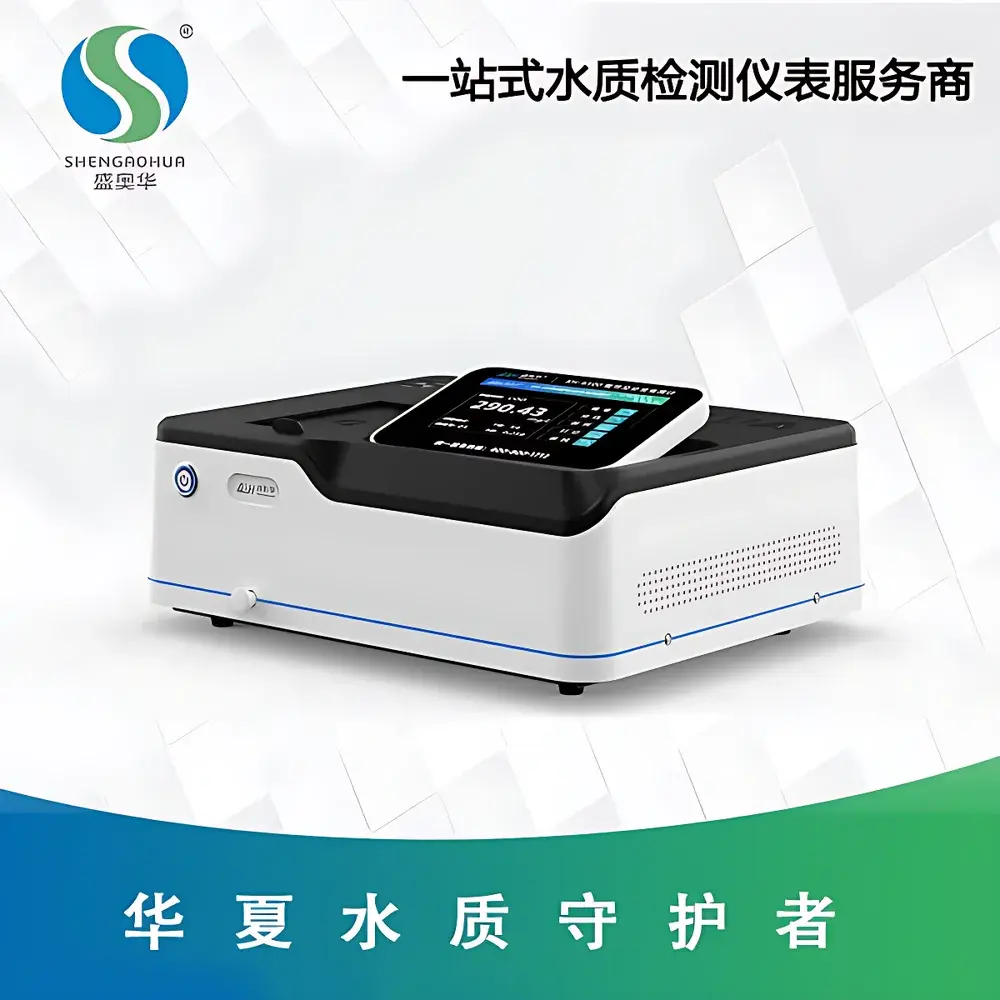
Shengaohua SH-6600 / SH-6600PC Ultraviolet-Visible Spectrophotometer
| Brand | Shengaohua |
|---|---|
| Origin | Jiangsu, China |
| Manufacturer Type | Direct Manufacturer |
| Instrument Type | Domestic |
| Model | SH-6600 / SH-6600PC |
| Optical System | Single-beam |
| Detector | Photodiode Array (PDA) |
| Wavelength Range | 190–1100 nm |
| Wavelength Accuracy | ±0.5 nm |
| Wavelength Repeatability | ≤0.2 nm |
| Spectral Bandwidth | 2 nm |
| Stray Light | ≤0.05% T |
| Baseline Flatness | ±0.003 A |
| Baseline Noise (Dark) | ≤0.2% T |
| Drift | ≤0.2% T |
| Absorbance Range | –0.301 to 3.000 A |
| Transmittance Range | 0.00–200.0% T |
| Max Scan Speed (via PC Software) | 2500 nm/min |
| Wavelength Step Resolution | 0.1 nm |
| Wavelength Drive Mechanism | Stepper Motor |
| Sample Holder | Manual 4-cell Cuvette Holder (50 mm pathlength) |
| Data Interfaces | USB & RS-232 |
| Dimensions (W×D×H) | 485 × 438 × 190 mm |
| Net Weight | 4 kg |
| Operating Temperature | 5–45 °C |
Overview
The Shengaohua SH-6600 and SH-6600PC are single-beam ultraviolet-visible (UV-Vis) spectrophotometers engineered for precision quantitative and qualitative analysis across research, quality control, and regulatory environments. Based on the fundamental principle of Beer–Lambert law absorption spectroscopy, these instruments measure sample absorbance and transmittance across a continuous spectral range from 190 nm to 1100 nm—covering deep UV, visible, and near-infrared regions. The optical architecture integrates a sealed monochromator with SiO2-coated optical components to minimize environmental degradation and enhance long-term photometric stability. A high-resolution photodiode array (PDA) detector enables rapid spectral acquisition and robust signal-to-noise performance. Designed for global deployment, the instrument supports wide-range AC input (100–240 V, 50/60 Hz) and features dual-language firmware (English and Chinese), facilitating seamless integration into multinational laboratories.
Key Features
- 7-inch high-resolution capacitive touchscreen interface with intuitive icon-driven navigation and real-time spectral visualization
- Onboard method storage supporting up to 200 user-defined measurement protocols—including fixed-wavelength, kinetic, wavelength scanning, and standard curve modes
- Multi-wavelength quantification capability: simultaneous acquisition of absorbance (A), transmittance (%T), and concentration at up to 10 user-specified wavelengths per run
- Automated wavelength calibration at startup with user-accessible offset correction routines compliant with JJG 178–2017 (Chinese National Verification Regulation for UV-Vis Spectrophotometers)
- Integrated time-based kinetic mode with programmable sampling intervals (100 ms–999 s) for monitoring reaction kinetics or thermal stability profiles
- Linear regression-based standard curve generation with coefficient-of-determination (R²) reporting and residual error analysis
- Stepper motor-driven grating mechanism ensuring precise, repeatable wavelength positioning (≤0.2 nm repeatability)
- USB and RS-232 interfaces enabling direct data export, remote instrument control, and integration with LIMS or ELN systems
Sample Compatibility & Compliance
The SH-6600 series accommodates standard 10 mm or 50 mm square quartz, glass, or plastic cuvettes via its manually operated 4-position cuvette holder. It is routinely deployed in applications requiring adherence to pharmacopeial standards—including USP , EP 2.2.25, and ChP IV—where absorbance accuracy (±0.002 A), stray light limits (<0.05% T at 220 nm and 340 nm), and baseline flatness (±0.003 A over 190–1100 nm) are critical. While not pre-certified for FDA 21 CFR Part 11, the system’s audit-trail-capable PC software (SH-6600PC edition) supports configurable electronic signatures, user access levels, and immutable data logging—enabling alignment with GLP and GMP documentation requirements when implemented within validated workflows.
Software & Data Management
The optional SH-6600PC software provides full instrument control, advanced spectral processing (smoothing, derivative calculation, peak detection), and compliance-ready data handling. All measurements are timestamped and stored in structured CSV and XML formats compatible with third-party statistical tools (e.g., JMP, OriginLab). The software enforces data integrity through automatic file versioning, session-level metadata tagging (operator ID, instrument ID, calibration date), and export logs traceable to individual measurement events. Raw spectral data can be exported without proprietary compression, ensuring full transparency for external review or reprocessing. USB flash drive support allows offline method transfer and report archiving without network dependency.
Applications
- Pharmaceutical QC: Assay of active pharmaceutical ingredients (APIs), excipient compatibility studies, and dissolution profile analysis
- Environmental testing: Quantification of nitrate, phosphate, COD, and heavy metal complexes (e.g., Cr(VI) as diphenylcarbazide complex)
- Food & beverage: Colorimetric determination of antioxidants (e.g., DPPH scavenging), pigment content (chlorophyll, anthocyanins), and adulterant screening
- Life sciences: Protein quantification (Bradford, Lowry, BCA), nucleic acid purity assessment (A260/A280), and enzyme kinetics (e.g., NADH oxidation at 340 nm)
- Academic research: Teaching spectroscopic fundamentals, ligand-binding studies, and thin-film optical characterization
FAQ
Is the SH-6600 compliant with ISO/IEC 17025 requirements for testing laboratories?
The instrument meets metrological specifications referenced in ISO/IEC 17025:2017 Annex B (e.g., wavelength accuracy, stray light, photometric linearity). Full compliance requires documented calibration against NIST-traceable standards and inclusion in a laboratory’s scope of accreditation.
Can the SH-6600PC software generate 21 CFR Part 11–compliant audit trails?
Yes—the software records all user actions (method edits, data deletions, calibration events) with timestamps, operator IDs, and IP addresses (if network-connected), satisfying ALCOA+ principles when deployed under controlled IT governance.
What cuvette materials are supported for UV-range measurements below 220 nm?
Quartz cuvettes with high-transmission UV grade (e.g., Suprasil®) are required for reliable operation between 190–220 nm; standard optical glass or PMMA cuvettes exhibit significant absorption in this region.
Does the instrument support kinetic measurements with variable time intervals?
Yes—users can define custom sampling intervals from 100 milliseconds to 999 seconds, enabling resolution of rapid enzymatic reactions or slow degradation processes.
Is external printer connectivity standard or optional?
Printer support is optional and implemented via USB or RS-232; drivers for common ESC/P and PCL-compatible printers are included in the PC software package.





