
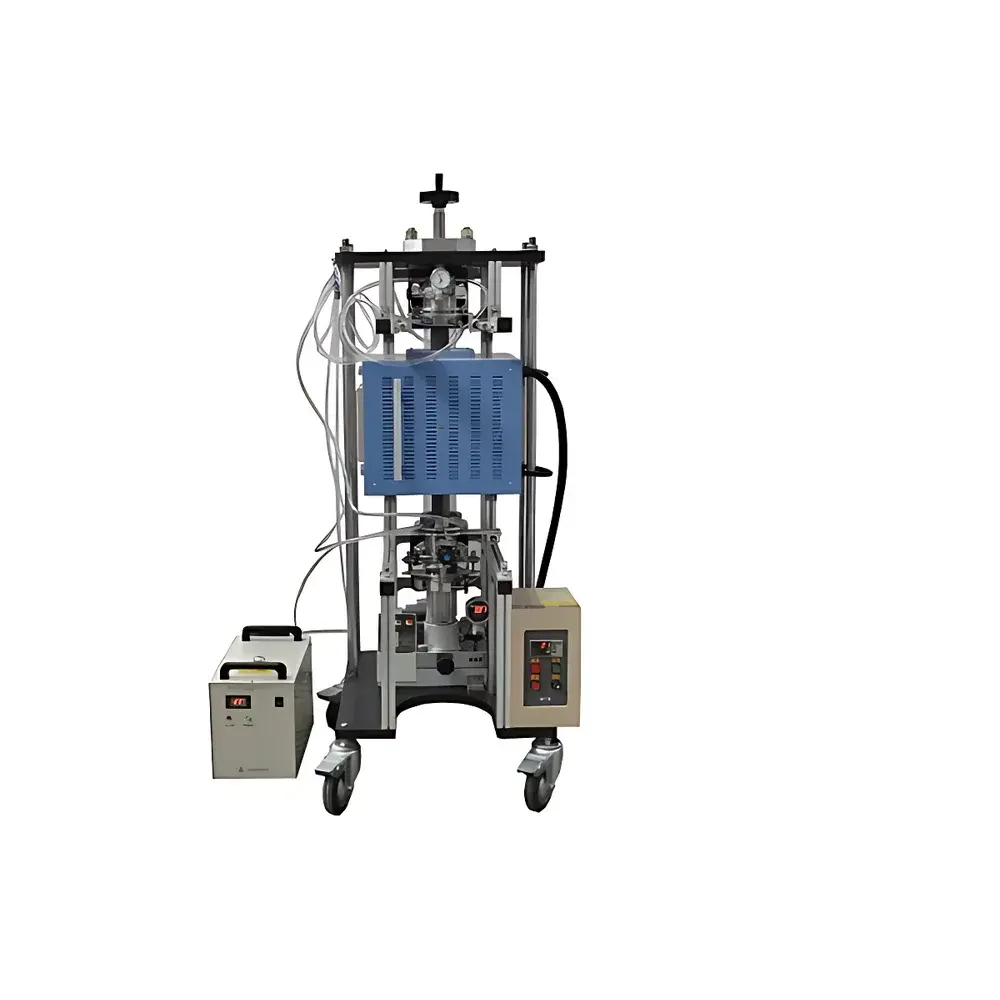
KJG VHP4 Vertical Vacuum Hot Press Furnace
| Brand | KJG (Hefei Kejing) |
|---|---|
| Origin | Anhui, China |
| Model | VHP4 |
| Type | Tube Furnace |
| Max Temperature | 1100 °C |
| Temperature Uniformity | ±1 °C |
| Heating Power | 2200 W |
| Heating Rate to Max Temp | 10 °C/min |
| Heating Method | Resistive Wire |
| Tube Dimensions | High-Purity Quartz, 100 mm OD × 95 mm ID × 1200 mm L |
| Max Applied Pressure | 6 ton (10 MPa indicated) |
| Programmable Segments | 30-step |
| Vacuum Level | ≤1×10⁻⁵ Torr (with turbomolecular pump), ≤1×10⁻² Torr (with mechanical pump) |
| Cooling | Water-Cooled KF-25 Flanges |
| Net Weight | 365 kg |
| Overall Dimensions | 1050 mm (L) × 750 mm (W) × 1750 mm (H) |
Overview
The KJG VHP4 Vertical Vacuum Hot Press Furnace is an integrated high-temperature, high-pressure processing system engineered for solid-state synthesis, densification of advanced ceramics, and wafer-level bonding under controlled inert or vacuum atmospheres. It combines a programmable vertical tube furnace with a precision hydraulic press and ultra-high-vacuum capability—enabling simultaneous application of thermal energy (up to 1100 °C), uniaxial compressive load (up to 6 tons / 10 MPa), and vacuum conditions (down to 1×10⁻⁵ Torr). The system operates on the principle of pressure-assisted sintering, where elevated temperature reduces atomic diffusion barriers while applied pressure enhances particle rearrangement and pore elimination—critical for fabricating fully dense, low-porosity functional materials such as thermoelectric oxides, MAX phases, solid electrolytes, and multilayer ceramic capacitors (MLCCs). Its open-top vertical configuration allows rapid sample insertion, real-time pressure alignment verification, and compatibility with custom graphite or refractory metal tooling.
Key Features
- Vertical open-frame design with motorized 20-ton electric hydraulic actuator for precise, repeatable force control and automated pressure hold during thermal cycles.
- High-purity fused quartz tube (100 mm OD × 95 mm ID × 1200 mm L) sealed via water-cooled KF-25 flanges, enabling stable vacuum integrity and thermal shock resistance.
- 30-segment programmable temperature controller with ±1 °C accuracy and ramp/soak profiles—fully compatible with GLP-compliant process documentation workflows.
- Internally coated alumina insulation layer (US-sourced high-emissivity coating) improves thermal efficiency and extends furnace lifetime by minimizing thermal degradation of heating elements.
- Dual-stage vacuum architecture: base vacuum achieved with optional mechanical pump; ultimate vacuum (≤1×10⁻⁵ Torr) attainable using integrated turbomolecular pumping system (sold separately).
- Integrated pressure transducer and digital readout calibrated to 10 MPa, supporting closed-loop pressure regulation during dwell periods at target temperature.
Sample Compatibility & Compliance
The VHP4 accommodates cylindrical and disc-shaped samples up to 100 mm in diameter and 120 mm in height within standard graphite dies. Custom tooling—including segmented graphite molds, SiC crucibles, and molybdenum-based pressure assemblies—can be fabricated per ASTM C1322 and ISO 2738 standards for sintering performance validation. The system meets structural and electrical safety requirements per IEC 61000-6-3 (EMC) and IEC 61000-6-4, and its temperature and pressure logging functionality supports audit readiness for ISO/IEC 17025-accredited laboratories. While not pre-certified for FDA 21 CFR Part 11, the optional data acquisition module provides timestamped, user-logged parameter records suitable for GMP-aligned process validation when paired with qualified electronic signatures.
Software & Data Management
Temperature and pressure profiles are managed via a front-panel PID controller with USB export capability for CSV-formatted time-series data (T, P, t). Optional PC-based software enables remote monitoring, real-time graphing, alarm configuration (e.g., overpressure or vacuum loss), and automatic report generation compliant with internal QA protocols. All logged parameters include operator ID, session timestamp, and firmware version—facilitating traceability across multiple production or R&D batches. Raw data files are stored in non-proprietary formats to ensure long-term accessibility without vendor lock-in.
Applications
- Sintering of nanostructured ceramics (e.g., Al₂O₃, ZrO₂, SiC) with suppressed grain growth and enhanced fracture toughness.
- Hot pressing of thermoelectric materials (Bi₂Te₃, SnSe, Mg₂Si) to achieve optimal carrier concentration and phonon scattering density.
- Direct bonding of dissimilar substrates (Si/SiO₂, SiC/GaN) for heteroepitaxial device fabrication under sub-10⁻⁴ Torr vacuum.
- Consolidation of powder metallurgy preforms for aerospace-grade titanium aluminides and Ni-based superalloys.
- Processing of solid-state battery components—including Li₇La₃Zr₂O₁₂ (LLZO) electrolyte membranes—under oxygen-controlled or argon-purged environments.
FAQ
What vacuum pumps are required to achieve 1×10⁻⁵ Torr?
A turbomolecular pump backed by a two-stage rotary vane mechanical pump is mandatory. The VHP4 includes KF-25 ports and cooling interfaces compatible with standard TMP systems (e.g., Pfeiffer HiPace series); pumps are not included but can be selected from certified OEM partners.
Can the system operate under inert gas flow instead of vacuum?
Yes—the bottom-mounted 1/4″ stainless steel needle valve allows continuous purge with Ar, N₂, or forming gas at regulated flow rates up to 500 sccm, with pressure maintained between 0.1–1 atm absolute.
Is the hydraulic cylinder stroke adjustable during operation?
The 15 mm stroke is fixed per cycle, but displacement is monitored in real time via linear encoder feedback; position data is logged alongside temperature and pressure for full process correlation.
What die materials are recommended for 1100 °C hot pressing?
High-purity graphite (ISO 6507-1 grade) is standard for ≤1100 °C; for higher stability under cyclic loading, isotropic fine-grain graphite (e.g., SIGRABOND®) or TZM alloy tooling may be specified.
Does the system support automated pressure ramping synchronized with temperature profiles?
Yes—via optional analog I/O interface, external PLCs can coordinate pressure ramp rates (MPa/min) with thermal segments, enabling complex multi-step sintering protocols such as two-stage HIP-like sequences.



