
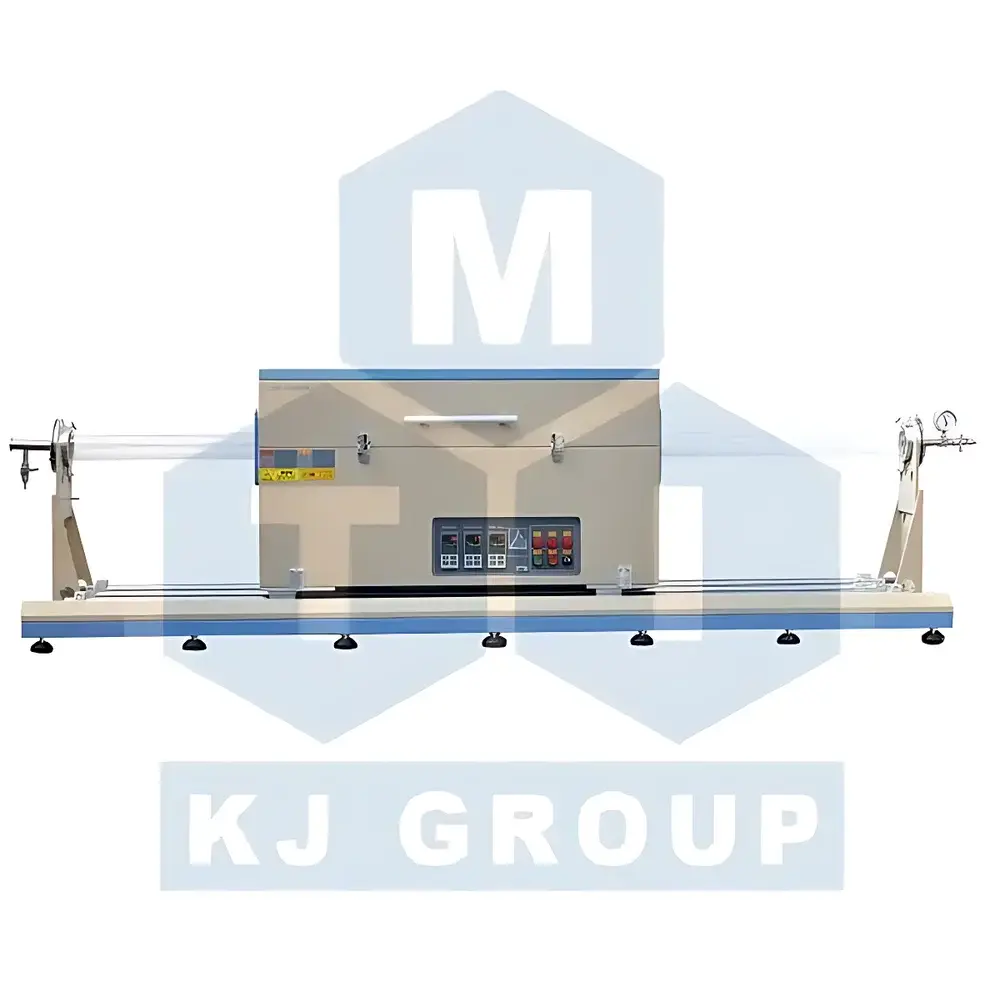
OTF-1200X-III-80SL Triple-Zone Sliding Tube Furnace with CE Certification
| Brand | Hefei Kejing |
|---|---|
| Origin | Anhui, China |
| Manufacturer Type | Authorized Distributor |
| Origin Category | Domestic (China) |
| Model | OTF-1200X-III-80SL |
| Instrument Type | Horizontal Tube Furnace |
| Max Temperature | 1200 °C (<1 hr) |
| Continuous Operating Temp | 1100 °C |
| Temperature Uniformity | ±1 °C over 600 mm (400–1200 °C) |
| Control Accuracy | ±1 °C |
| Heating Rate (max) | 100 °C/min |
| Cooling Rate (max, under inert/vacuum) | 10 °C/s |
| Total Power | 7 kW |
| Voltage | AC 208–240 V, 50/60 Hz, Single Phase |
| Heating Element | Mo-doped Fe-Cr-Al Alloy |
| Tube Dimensions | Quartz, OD 80 mm × ID 75 mm × L 2400 mm |
| Heating Zone Length | 3 × 300 mm (900 mm total) |
| Effective Sliding Travel | 600 mm on 1200 mm Cr-plated Steel Dual Rails |
| External Dimensions | 2500 × 510 × 750 mm (L×W×H) |
| Net Weight | 150 kg |
| Vacuum Compatibility | Up to 10⁻⁵ Torr (with turbomolecular pump) |
| Safety Certifications | CE |
| Warranty | 12 months (excludes consumables: quartz tube, O-rings, heating elements) |
Overview
The OTF-1200X-III-80SL is a precision-engineered, CE-certified triple-zone horizontal sliding tube furnace designed for rapid thermal processing under controlled atmospheres—vacuum, inert, or reactive gas environments. Its core architecture integrates three independently controlled heating zones (each 300 mm long), enabling precise axial temperature gradients and extended uniformity (±1 °C over 600 mm at 400–1200 °C). Unlike static furnaces, the OTF-1200X-III-80SL features a manually actuated, Cr-plated dual-rail sliding mechanism (1200 mm rail length, 600 mm travel range), allowing dynamic positioning of the hot zone relative to the sample. This configuration supports two fundamental thermal strategies: pre-heating the furnace and translating it onto a stationary sample for ultra-fast ramping (up to 100 °C/min), or moving the hot zone away post-treatment to induce rapid quenching (up to 10 °C/s under optimized vacuum/inert conditions). The furnace employs Mo-doped Fe-Cr-Al alloy heating elements housed in a double-walled, air-cooled stainless steel shell, with surface temperature maintained below 60 °C during operation. Internal furnace walls are coated with US-sourced high-purity alumina ceramic, enhancing infrared emissivity, thermal stability, and service life.
Key Features
- Triple independent PID-controlled heating zones (30 segments each) with K-type Omega thermocouples (3 units) for spatially resolved temperature monitoring and gradient programming.
- Robust sliding platform with hardened chromium-plated steel rails and low-friction linear motion design—enabling repeatable, stable positional control without motorized complexity.
- High-efficiency thermal insulation: multi-layer ceramic fiber + reflective aluminum foil backing, minimizing radial heat loss and improving energy efficiency.
- Integrated safety architecture including over-temperature cutoff, thermocouple break detection, and solid-state relay (SSR) PWM power modulation for stable, noise-free control.
- Standard high-purity fused quartz tube (OD 80 mm × ID 75 mm × L 2400 mm) with dual stainless-steel vacuum flanges (CF-compatible), VCR-style sealing, and integrated pressure relief valve interface.
- Compliant electrical subsystem: all components rated >24 V meet UL, MET, and CSA safety standards; optional TÜV or CSA full-system certification available upon request.
Sample Compatibility & Compliance
The OTF-1200X-III-80SL accommodates samples up to 75 mm in diameter and 2400 mm in length within its quartz tube. It supports a wide range of material systems—including ceramics, thin films, battery cathode precursors, catalysts, and 2D nanomaterials—under atmospheric, reduced-pressure (10⁻³–10⁻⁵ Torr), or continuous-flow gas conditions (N₂, Ar, H₂, NH₃, forming gas). Vacuum integrity is ensured via metal-sealed CF flanges and optional digital Pirani/cold-cathode gauges (range: 3.8×10⁻⁵ to 1125 Torr), eliminating gas-specific calibration factors. Operation adheres to ISO 15190:2020 (laboratory safety), ASTM E1112 (furnace temperature uniformity testing), and supports GLP/GMP workflows through optional PC-based logging (time-stamped temperature profiles, user audit trails). Note: quartz tube operation above 1100 °C is not recommended for prolonged use; vacuum operation is prohibited above 1000 °C per IEC 61000-4-11 voltage sag immunity guidelines.
Software & Data Management
Temperature programming is managed via a front-panel 30-segment PID controller with real-time display and manual override. Optional PC connectivity enables full remote supervision using Kejing’s proprietary LabFurnaceControl™ software (Windows-compatible), supporting CSV export of time-temperature-pressure datasets, multi-profile scheduling, and automated shutdown triggers. All logged data include timestamps, operator ID fields, and system event flags (e.g., “over-temp alarm”, “thermocouple fault”). For regulated environments, the software supports 21 CFR Part 11-compliant electronic signatures, role-based access control, and immutable audit trails—fully traceable for FDA or ISO 17025 laboratory accreditation audits.
Applications
- Rapid thermal annealing (RTA) of semiconductor substrates and transition metal dichalcogenides (TMDs).
- Controlled atmosphere synthesis of Li-ion battery cathode materials (e.g., NMC, LFP) with precise oxygen partial pressure tuning.
- Thermal decomposition studies of MOFs and porous polymers under programmed gas flow.
- Graphene CVD growth on Cu/Ni foils using synchronized zone temperature gradients.
- Pre-sintering and binder burnout of ceramic green bodies under nitrogen sweep.
- Calibration and validation of thermocouples and infrared pyrometers across 400–1200 °C.
FAQ
What is the maximum safe operating pressure inside the quartz tube?
The internal pressure must not exceed 0.02 MPa (≈0.2 bar gauge). Always use a certified pressure regulator (recommended range: 0.01–0.1 MPa) when introducing gases from high-pressure cylinders.
Can the furnace operate under full vacuum at 1200 °C?
No. Vacuum operation is strictly prohibited above 1000 °C to prevent quartz devitrification and structural failure. At temperatures >1000 °C, maintain near-atmospheric pressure using inert gas purge.
Is the 600 mm uniformity zone verified per ASTM E1112?
Yes—the ±1 °C uniformity specification is measured using a 5-point thermocouple mapping protocol aligned with ASTM E1112 Annex A2 for horizontal tube furnaces.
What maintenance is required for long-term reliability?
Inspect quartz tube for haze or microcracks before each high-temperature run; replace O-rings annually or after 50 thermal cycles; verify thermocouple calibration every 6 months using a reference standard.
Does the sliding mechanism require lubrication or periodic alignment?
No—Cr-plated rails are dry-running and self-lubricating; no maintenance is needed beyond periodic wipe-down with isopropyl alcohol to remove particulate accumulation.



