Nb Wire (Niobium Wire) –合肥科晶 Instrument Component
| Brand | Hefei Kejing |
|---|---|
| Origin | Anhui, China |
| Manufacturer Type | Authorized Distributor |
| Origin Category | Domestic (PRC) |
| Model | Nb Wire |
| Pricing | Upon Request |
| Diameter Range | 0.01–2.0 mm |
| Purity | 99.99% (4N) |
| Packaging | Class 1000 Cleanroom-Processed, Sealed in Class 100 Clean Bags with Aluminum Foil Lining |
Overview
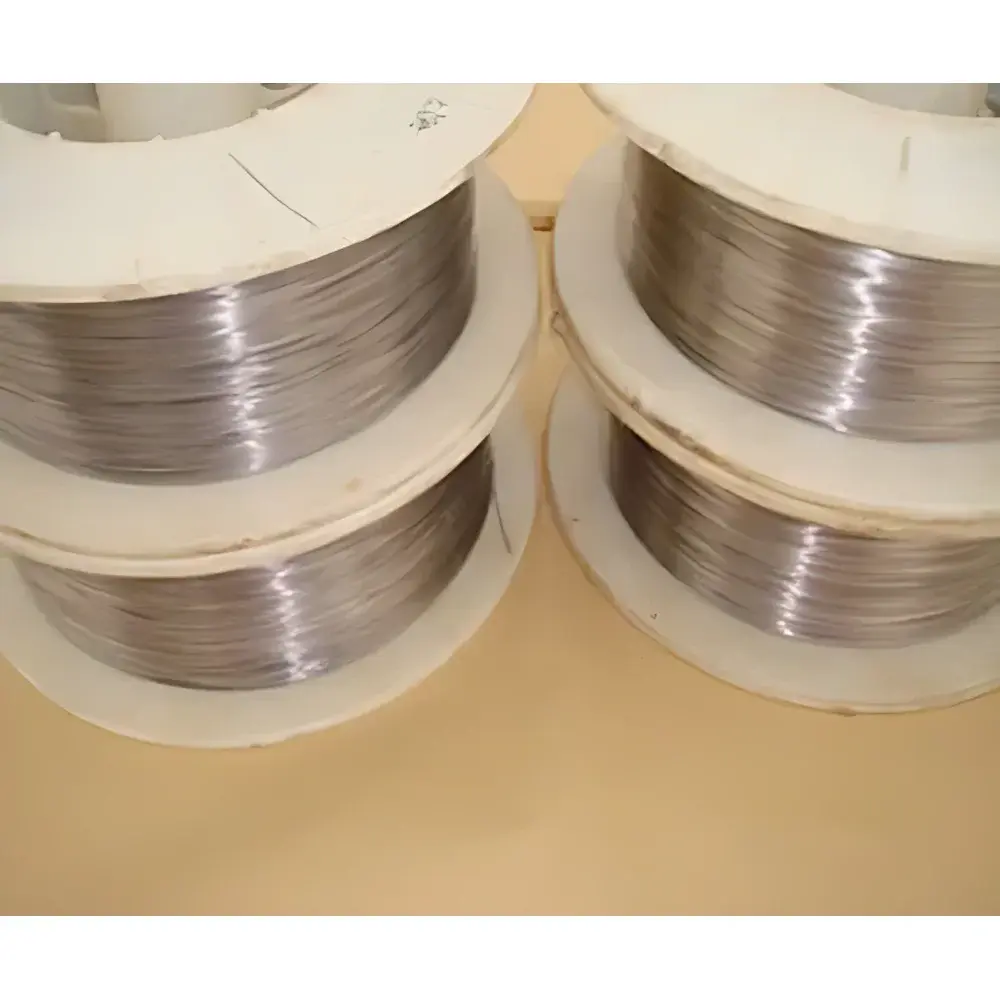
Nb Wire (Niobium Wire) is a high-purity metallic wire component engineered for demanding applications in ultra-high vacuum (UHV) systems, superconducting device fabrication, thin-film sputtering targets, and high-temperature sensor elements. Composed of niobium metal with certified 99.99% (4N) purity, this wire exhibits exceptional ductility, low electrical resistivity at cryogenic temperatures, and outstanding resistance to oxidation below 200 °C. Its consistent microstructure and controlled surface finish—achieved via multi-pass drawing under inert atmosphere and final annealing in hydrogen or vacuum—ensure reproducible performance in precision deposition and thermal cycling environments. Unlike generic metal wires, Nb Wire is manufactured to meet stringent trace-element specifications (<1 ppm each for Fe, Cr, Ni, Mo, Ta), minimizing contamination risk in semiconductor-grade processing and R&D-scale superconducting resonator development.
Key Features
- Ultra-high purity: 99.99% (4N) niobium, with certified elemental impurity profile compliant with ASTM F2852–22 (Standard Specification for Niobium Metal for Electronic and Electrical Applications)
- Diameter tolerance: ±0.5 µm for diameters ≤0.1 mm; ±1% for diameters >0.1 mm, verified by laser micrometry and calibrated optical profilometry
- Surface quality: Ra < 0.15 µm (as-drawn), free of scratches, pits, or oxide discoloration; surface oxide thickness < 3 nm (XPS-verified)
- Cleanroom handling: Processed and packaged in ISO Class 6 (Class 1000) cleanroom environment; double-bagged in ISO Class 5 (Class 100) polyethylene clean bags with aluminum foil inner liner
- Traceability: Each spool includes lot-specific certificate of analysis (CoA) listing ICP-MS results, tensile strength (≥280 MPa), and elongation at break (≥15%) per ASTM E8/E8M
Sample Compatibility & Compliance
Nb Wire is compatible with electron-beam evaporation, thermal evaporation, magnetron sputtering (DC/RF), and wire-bonding processes in class-100 cleanrooms. Its low vapor pressure (<10⁻⁸ Torr at 1800 °C) and minimal outgassing rate (<1×10⁻¹² Pa·m³/s·cm² after 24-hr bakeout at 200 °C) make it suitable for UHV chamber feedthroughs and filament supports. The material complies with RoHS Directive 2011/65/EU and REACH Annex XVII restrictions. For regulated pharmaceutical or medical device manufacturing, Nb Wire may be supplied with full documentation packages supporting ISO 13485 traceability and FDA 21 CFR Part 11–compliant electronic records upon request.
Software & Data Management
As a passive instrumentation component, Nb Wire does not incorporate embedded firmware or software interfaces. However, its certified CoA data—including batch-specific impurity spectra, mechanical test reports, and packaging validation logs—is delivered in PDF/A-1b format and optionally integrated into customer LIMS or QMS platforms via secure SFTP or API-based data exchange (e.g., RESTful endpoints supporting JSON Schema v1.2). All documentation adheres to ALCOA+ principles (Attributable, Legible, Contemporaneous, Original, Accurate, Complete, Consistent, Enduring, Available) for GLP/GMP audit readiness.
Applications
- Superconducting radio-frequency (SRF) cavity tuning elements and magnetic field probes
- Sputter target bonding wire and cathode filament material in high-power vacuum tubes
- Substrate heater leads and thermocouple extension wire in MBE and CVD reactors
- Reference electrodes and current collectors in solid-state battery R&D cells
- Calibration standards for X-ray fluorescence (XRF) and energy-dispersive spectroscopy (EDS) quantification
FAQ
What is the maximum recommended operating temperature for Nb Wire in air?
Continuous use in ambient air is limited to ≤200 °C to prevent rapid niobium pentoxide (Nb₂O₅) formation. For inert or vacuum environments, short-term exposure up to 2400 °C is permissible with appropriate thermal management.
Can Nb Wire be supplied with custom diameters outside the 0.01–2.0 mm range?
Yes—custom diameters from 5 µm to 5 mm are available subject to minimum order quantity (MOQ) and extended lead time; dimensional verification includes SEM cross-section imaging and roundness measurement per ISO 1101.
Is hydrogen embrittlement a concern during storage or handling?
No—hydrogen charging is negligible under standard dry nitrogen or argon storage. Long-term storage (>6 months) requires desiccated conditions (RH < 5%) to prevent surface hydroxide formation.
Do you provide bend testing or fatigue cycle data for Nb Wire?
Yes—bend endurance data (ASTM E292–21) and low-cycle fatigue curves (R = 0.1, 10–10⁴ cycles) are included in extended CoA packages for diameters ≥0.25 mm.