
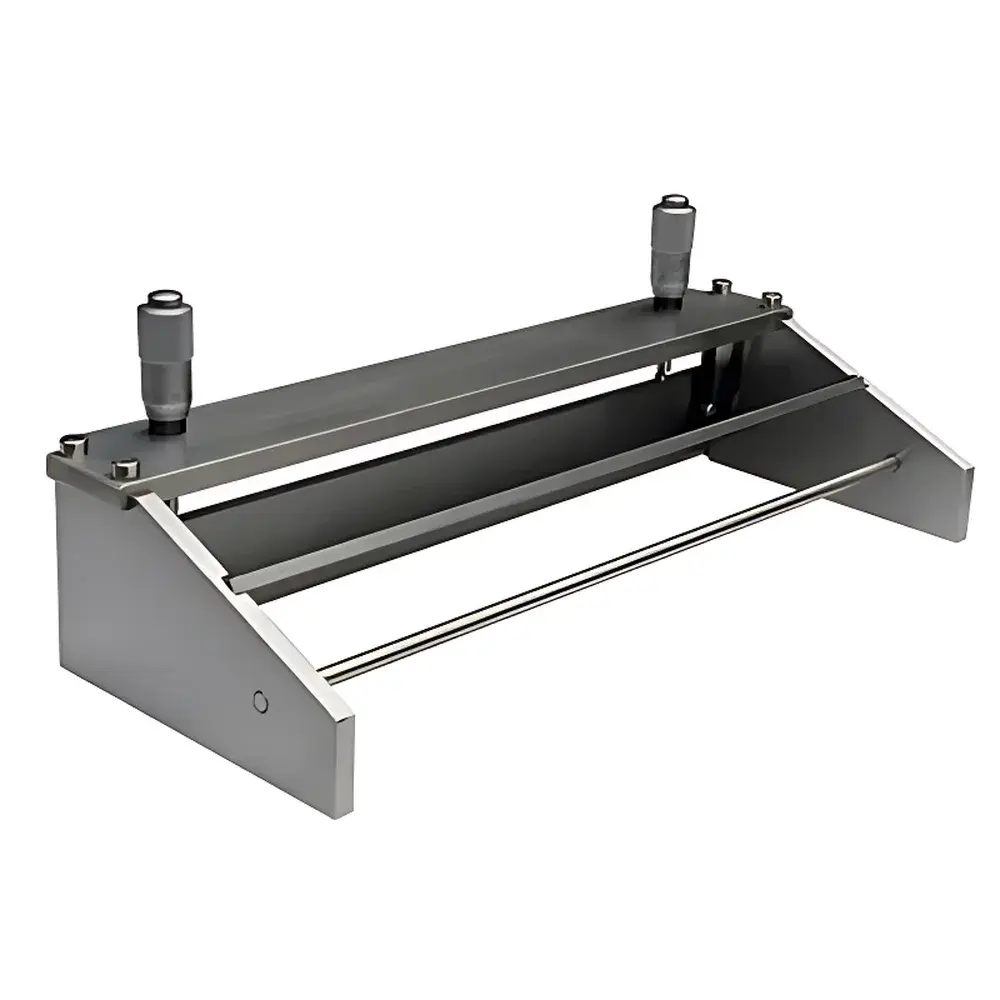
Adjustable Film Applicator –合肥科晶 KJ-250M
| Brand | Hefei Kejing |
|---|---|
| Origin | Anhui, China |
| Model | KJ-250M |
| Blade Width | 250 mm |
| Wet Film Thickness Range | 0–9500 µm |
| Micrometer Accuracy | ±2 µm |
| Blade Material | Stainless Steel with Precision-Ground Edge |
| Type | Manual Adjustable Doctor Blade Applicator |
Overview
The KJ-250M Adjustable Film Applicator is a precision-engineered manual doctor blade system designed for reproducible wet film deposition in materials science laboratories. It operates on the principle of controlled gap coating—where a stainless steel knife blade is positioned at a precisely defined clearance above a substrate surface, enabling uniform metering of viscous slurries, pastes, or polymer solutions during draw-down. Unlike fixed-gap applicators, this instrument integrates dual micrometer heads (one on each end) to allow independent, symmetric, or asymmetric vertical adjustment of the blade relative to the substrate plane. This capability supports both flat and slightly warped substrates and accommodates variations in substrate thickness or surface topography. The device is widely deployed in ceramic tape casting, lithium-ion battery electrode fabrication (anode/cathode slurry coating), functional thin-film R&D, and polymer composite processing—where precise control over green-state thickness directly influences sintered density, porosity, electrochemical performance, and mechanical integrity.
Key Features
- 250 mm nominal blade width, optimized for standard laboratory-scale substrates including alumina tapes, PET/PI foils, copper/aluminum current collectors, and glass slides.
- Dual precision micrometer heads (ISO 9001–certified linear actuators) with 10 µm graduation and ±2 µm repeatability per full rotation, enabling sub-micron resolution in gap setting.
- Stainless steel blade with mirror-finished, diamond-lapped edge geometry—engineered for low wear, minimal slurry shear degradation, and resistance to chemical corrosion from aqueous and organic solvents (e.g., NMP, DMF, ethanol/water mixtures).
- Modular base plate with T-slot grooves and clamping fixtures for secure mounting on leveling tables, vacuum chucks, or custom conveyor stages.
- No external power supply required—fully manual operation ensures intrinsic safety in solvent-rich environments and eliminates electromagnetic interference during in situ rheological or electrical characterization.
- Calibration traceability supported via optional NIST-traceable micrometer verification kit (sold separately) and documented SOP templates aligned with ISO/IEC 17025 internal calibration requirements.
Sample Compatibility & Compliance
The KJ-250M accommodates rigid and semi-flexible substrates up to 3 mm thick and 300 mm wide, including but not limited to: ceramic green tapes (Al₂O₃, ZrO₂, BaTiO₃), metal foils (Cu, Al, Ni), polymer films (PET, PI, PTFE), silicon wafers, and glass microscope slides. It supports Newtonian and weakly shear-thinning suspensions with viscosities ranging from 100 mPa·s to 50,000 mPa·s (measured at 10 s⁻¹). The system complies with ASTM D823 (Standard Practice for Producing Films of Uniform Thickness of Paint, Varnish, and Related Products), ISO 2808 (Paints and Varnishes — Determination of Film Thickness), and supports GLP-compliant documentation when used with validated SOPs and audit-trail-enabled data loggers. While not an electronic instrument subject to FDA 21 CFR Part 11, its mechanical adjustability and calibration records are fully compatible with GMP quality systems for preclinical materials manufacturing.
Software & Data Management
As a purely mechanical, non-electronic tool, the KJ-250M does not incorporate embedded firmware or digital interfaces. However, it integrates seamlessly into digital lab workflows: micrometer settings are logged manually or via structured LIMS templates; film thickness values are cross-referenced with offline profilometry (e.g., Dektak, Wyko), optical interferometry, or gravimetric analysis. Hefei Kejing provides downloadable Excel-based thickness calculation worksheets that convert micrometer readings into theoretical wet film thickness based on substrate speed, slurry solids content, and drying shrinkage factors—enabling predictive process modeling prior to pilot-scale trials. All technical documentation—including dimensional drawings, torque specifications for micrometer locking screws, and cleaning protocols—is available in English and conforms to IEC 61000-6-2 immunity standards for adjacent instrumentation.
Applications
- Ceramic tape casting for multilayer capacitors, LTCC substrates, and solid oxide fuel cell electrolytes.
- Slurry coating of LiCoO₂, NMC, LFP cathodes and graphite/Si-anodes onto Cu/Al foil—supporting DOE-defined electrode loading targets (2–4 mAh/cm²).
- Deposition of piezoelectric PVDF-TrFE films, perovskite precursor layers, and conductive polymer blends (PEDOT:PSS, PANI) for flexible electronics.
- Rheological benchmarking: paired with rotational viscometers to correlate slurry yield stress with achievable defect-free coating windows.
- Educational use in materials engineering labs for hands-on demonstration of meniscus-controlled flow, capillary number effects, and defect formation mechanisms (e.g., ribbing, streaking, air entrainment).
FAQ
What is the maximum recommended substrate speed for consistent 50 µm wet films using this applicator?
For slurries with viscosity ~5,000 mPa·s and solids loading >60 wt%, optimal draw-down speeds range from 5–20 cm/min. Higher speeds may induce edge bead defects or non-uniformity; empirical optimization is advised per formulation.
Can the blade be replaced or resharpened in-house?
Yes—the blade is secured with M4 socket-head cap screws and can be removed for professional regrinding. Kejing supplies replacement blades (P/N: KJ-BL-250-SS) with certified edge geometry and surface roughness Ra < 0.05 µm.
Is thermal expansion compensation required when operating near elevated temperatures?
No—micrometer calibration is performed at ambient temperature (23 ± 2 °C). For hot-stage applications (>60 °C), users should perform in situ gap verification using calibrated feeler gauges or laser displacement sensors.
Does this applicator meet ISO 13847 for coating thickness measurement uncertainty?
While the KJ-250M itself is not a measuring instrument, its ±2 µm micrometer accuracy contributes to overall Type B uncertainty budgets when combined with verified profilometry. Full uncertainty analysis per ISO/IEC 17025 is achievable using Kejing’s application note AN-KJ250M-01.



