
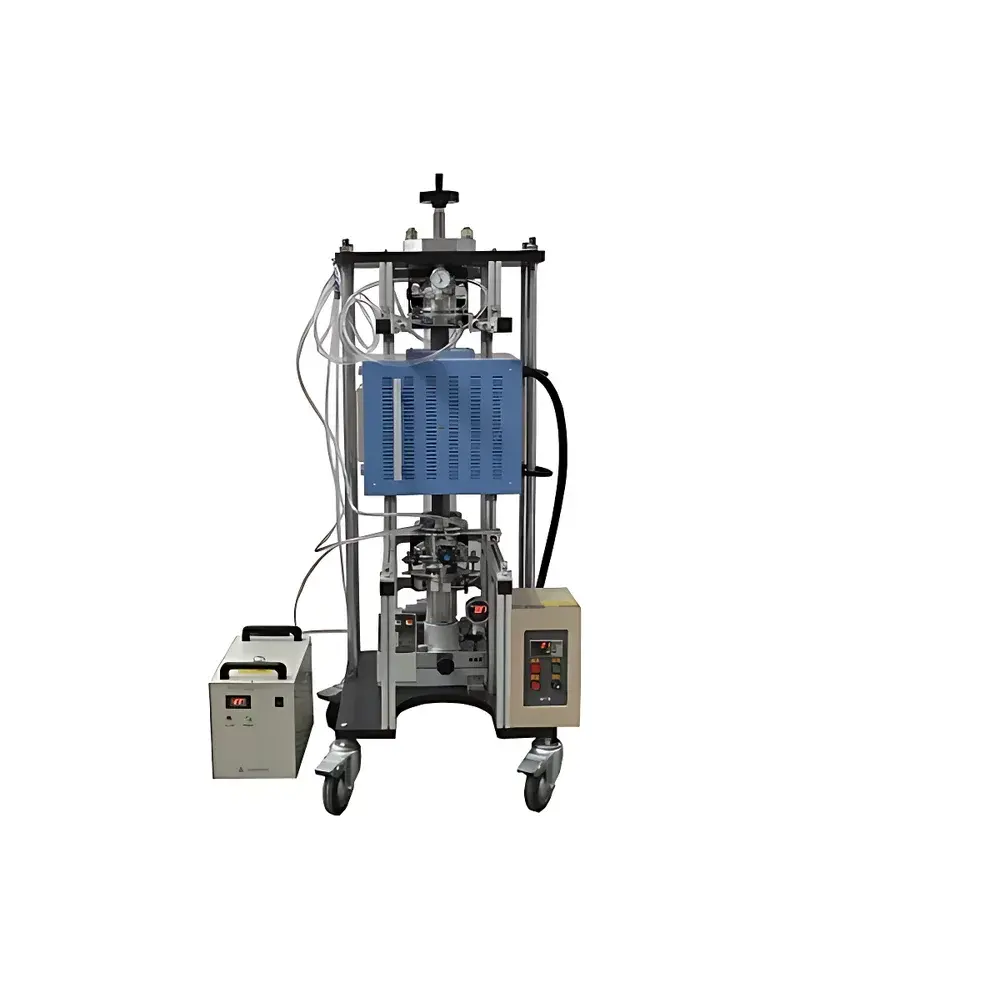
OTF-1500X-VHP4 Vacuum Hot Press Furnace by Hefei Kejing
| Brand | Hefei Kejing |
|---|---|
| Origin | Anhui, China |
| Model | OTF-1500X-VHP4 |
| Maximum Temperature | 1500 °C |
| Temperature Control Accuracy | ±1 °C |
| Heating Rate (to Max Temp) | 20 °C/min |
| Maximum Applied Pressure | 5 T (10 MPa with 1/2″ graphite die) |
| Hydraulic System Capacity | 20 T |
| Furnace Tube | Mullite, 101 mm OD × 92 mm ID × 680 mm L |
| Heating Element | Mo-doped Fe–Cr–Al alloy with ZrO₂ coating |
| Power Rating | 8 kW |
| Voltage/Frequency | 208–240 VAC, 50/60 Hz, single-phase |
| Cooling | Water-cooled flanges |
| Vacuum Level | ≤10⁻⁵ torr (with turbomolecular pump), ≤10⁻² torr (with rotary vane pump) |
| Programmable Stages | 30-segment ramp-soak profiles |
| Thermocouple Type | S-type |
| Heating Zone Length | 250 mm |
| Overall Dimensions | 510 mm H × 510 mm W × 440 mm D |
| Net Weight | 350 kg |
| Compliance | CE-marked design principles |
Overview
The OTF-1500X-VHP4 Vacuum Hot Press Furnace is an integrated high-temperature, high-pressure sintering system engineered for advanced materials synthesis under controlled vacuum or inert atmosphere conditions. It combines resistive heating, uniaxial mechanical pressure, and precise thermal programming in a single open-ended tubular architecture. Unlike conventional muffle or box furnaces, this system operates on the principle of simultaneous thermal activation and mechanical densification—enabling solid-state diffusion bonding, powder consolidation, ceramic sintering, and interfacial reaction studies. Its core functionality relies on a dual-stage process: first, evacuation to ultra-high vacuum (down to 10⁻⁵ torr) using an optional turbomolecular pumping station; second, application of axial compressive force (up to 5 T at 1500 °C, scalable to 20 T via external hydraulic actuation) directly onto the sample housed within a high-purity mullite tube and graphite die assembly. The furnace’s SiC-free design—utilizing Mo-doped Fe–Cr–Al heating elements with ZrO₂ surface passivation—ensures long-term stability at sustained temperatures up to 1500 °C, with continuous operation rated at 1400 °C.
Key Features
- Open-tube configuration with water-cooled stainless-steel flanges enabling rapid sample loading/unloading and real-time pressure transmission through bellows-coupled hydraulic actuation
- 30-segment programmable temperature controller with ±1 °C accuracy across the full 0–1500 °C range, supported by S-type thermocouple feedback and optional RS485 interface for remote PC-based profile management
- Dual-vacuum capability: base pressure of 10⁻² torr achievable with standard rotary vane pump; upgradeable to 10⁻⁵ torr with integrated turbomolecular pump and cold trap
- Modular graphite die system—customizable per user specifications—including standard 1/2″ internal diameter configurations rated for 50 MPa compressive strength at elevated temperatures
- Integrated 20 T electric-hydraulic press with 25 mm-diameter top plunger and 15 mm stroke, featuring automatic load-hold functionality and digital pressure readout calibrated to 10 MPa display resolution
- Robust mechanical architecture: reinforced steel frame, insulated double-layer furnace housing, and fail-safe overtemperature cutoffs compliant with IEC 61000-6-2 electromagnetic compatibility standards
Sample Compatibility & Compliance
The OTF-1500X-VHP4 accommodates diverse material forms—including metal/alloy powders, ceramic green bodies, multilayer thin-film stacks, and semiconductor wafers—within its 92 mm inner-diameter mullite tube. Graphite tooling ensures chemical inertness and thermal stability during reactive sintering (e.g., Ti–Al–N systems, MAX phases, or oxide ion conductors). Vacuum integrity supports oxygen-sensitive processing (e.g., Nb–Ti alloys, rare-earth magnets), while optional gas inlet ports allow for forming-gas (N₂/H₂) or Ar purging. From a regulatory standpoint, the system’s programmable logic controller (PLC)-based operation, configurable alarm thresholds, and optional data-logging firmware support alignment with ISO/IEC 17025 laboratory accreditation requirements. When equipped with validated software and electronic signature modules, it meets foundational expectations for FDA 21 CFR Part 11 compliance in regulated R&D environments.
Software & Data Management
The furnace includes an RS485 serial port for integration with third-party SCADA or custom LabVIEW-based control platforms. Optional Kejing TC-Manager software enables full graphical visualization of real-time temperature/pressure curves, export of CSV-formatted time-series datasets, and secure storage of calibration logs and run histories. Audit-trail functionality—recording operator ID, parameter changes, and system events—is available upon request for GxP-aligned deployment. All firmware updates are delivered via encrypted USB key to maintain version traceability and prevent unauthorized modification.
Applications
- Densification of refractory ceramics (e.g., SiC, Al₂O₃, ZrO₂) without sintering aids
- Diffusion bonding of dissimilar metals (e.g., Cu–Mo, Ti–Steel) for hermetic sealing in microelectronics packaging
- Preparation of transparent polycrystalline ceramics via vacuum hot pressing (VHP)
- Synthesis of metastable intermetallic compounds under constrained thermal–mechanical pathways
- Processing of thermoelectric materials (e.g., Bi₂Te₃, Skutterudites) requiring low-oxygen, high-pressure consolidation
- Prototyping of solid-state battery electrolyte–electrode interfaces under controlled interfacial stress
FAQ
What is the maximum pressure achievable at 1500 °C?
At 1500 °C, the system delivers up to 5 T (equivalent to 10 MPa) using the standard 1/2″ graphite die. Higher pressures require custom die geometry and optional hydraulic augmentation.
Can the furnace operate under inert gas flow instead of vacuum?
Yes—the front and rear flanges include sealed gas inlet/outlet ports compatible with mass flow controllers for dynamic atmosphere control (Ar, N₂, or forming gas).
Is the mullite tube replaceable, and what is its typical service life?
Mullite tubes are consumable components; expected lifetime exceeds 200 cycles at 1400 °C under proper thermal cycling protocols and absence of thermal shock.
Does the system include vacuum pumping hardware?
No—vacuum pumps (mechanical or turbomolecular), cooling water circulators, and gas manifolds are optional accessories sold separately.
How is temperature uniformity maintained across the 250 mm heating zone?
Zonal power distribution and symmetric element winding ensure ±5 °C axial uniformity at 1500 °C, verified per ASTM E220 calibration practice.



