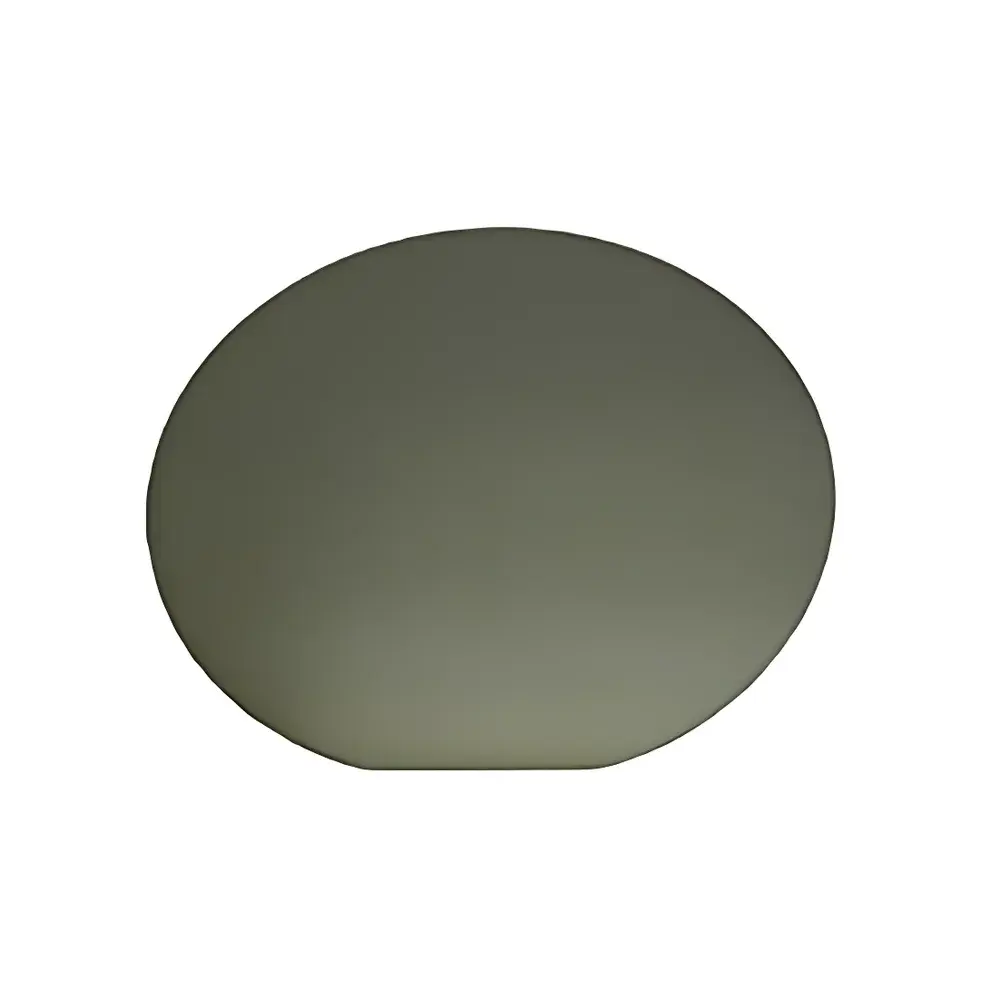
InP Substrate with Epitaxial p-Type InGaAs:Zn Thin Film (Lattice-Matched, <100> Orientation)
| Brand | Hefei Kejing |
|---|---|
| Origin | Anhui, China |
| Manufacturer Type | Authorized Distributor |
| Origin Category | Domestic |
| Model | InP/InGaAs:Zn Epi-Wafer |
| Pricing | Upon Request |
| Substrate Diameter | 2 inch (50.8 mm) |
| Substrate Thickness | 350 µm ± 25 µm |
| Substrate Orientation | <100> ± 0.5° with Primary Flat |
| Substrate Doping | Undoped |
| Substrate Carrier Concentration (Nc) | < 1 × 10¹⁶ cm⁻³ |
| Substrate Etch Pit Density (EPD) | < 1 × 10⁴ cm⁻² |
| Epilayer Composition | Lattice-Matched p-Type InGaAs:Zn (100) |
| Epilayer Doping | Zn (p-type) |
| Epilayer Carrier Concentration | 1 × 10¹⁷ – 1 × 10¹⁸ cm⁻³ |
| Epilayer Thickness | 1.0 µm ± 5% |
| Surface Finish | Single-Side Polished |
| Epilayer RMS Roughness | ≤ 0.2 nm (≈1 monolayer) |
| Packaging | Class 100 cleanroom bag under vacuum or individual cassette in Class 1000 cleanroom environment |
Overview
This epitaxial wafer consists of a high-purity, undoped indium phosphide (InP) substrate supporting a lattice-matched, zinc-doped p-type indium gallium arsenide (InGaAs:Zn) thin film grown via metalorganic chemical vapor deposition (MOCVD) or molecular beam epitaxy (MBE). Engineered for infrared optoelectronics and high-speed heterojunction devices, the structure delivers precise lattice matching (Δa/a < 0.01%) to minimize interfacial strain and threading dislocation density. The InP substrate is oriented along the <100> crystallographic plane with tight angular tolerance (±0.5°), ensuring reproducible growth kinetics and uniform layer nucleation. The epilayer exhibits low surface roughness—RMS ≤ 0.2 nm—as confirmed by atomic force microscopy (AFM), corresponding to near-atomic-layer smoothness essential for subsequent heterostructure integration, quantum well formation, or Schottky contact fabrication.
Key Features
- High-crystallinity InP substrate with etch pit density (EPD) < 1 × 10⁴ cm⁻², verified per ASTM F1188–19 for semiconductor wafer quality assessment
- Lattice-matched p-type InGaAs:Zn epilayer with controlled Zn doping concentration (1 × 10¹⁷–1 × 10¹⁸ cm⁻³), enabling predictable hole mobility and stable Fermi-level positioning
- Tight thickness control: 1.0 µm ± 5%, measured by high-resolution X-ray reflectivity (XRR) and cross-sectional TEM
- Single-side polished surface with RMS roughness ≤ 0.2 nm—compatible with nanoscale lithography, atomic-layer deposition (ALD), and e-beam evaporation processes
- Processed and packaged in ISO Class 4 (100) cleanroom environment; final packaging meets SEMI S2–17 standards for electrostatic discharge (ESD) and particle contamination control
- Substrate carrier concentration < 1 × 10¹⁶ cm⁻³ ensures minimal background conduction and high resistivity (>1 × 10⁷ Ω·cm), critical for low-noise photodetector and HBT base layers
Sample Compatibility & Compliance
This wafer is compatible with standard III–V semiconductor processing toolsets, including plasma-enhanced chemical vapor deposition (PECVD), reactive ion etching (RIE), wet chemical etching (e.g., HCl:H₃PO₄), and rapid thermal annealing (RTA) up to 600 °C. It conforms to key industry specifications: ASTM F1596–22 (for InP substrate flatness and orientation), IEC 60747–10 (optoelectronic device substrates), and JEDEC JESD22–A108 (moisture sensitivity level MSL 1, dry-packaged). All wafers undergo full metrology screening—including XRD ω-rocking curve analysis (< 30 arcsec FWHM), four-point probe sheet resistance mapping, and optical inspection per MIL-STD-883H Method 2010—and are supplied with traceable QC documentation compliant with ISO 9001:2015 quality management requirements.
Software & Data Management
While this is a passive epitaxial material product (not an instrument), full characterization datasets—including XRD spectra, SIMS dopant depth profiles, Hall effect mobility/resistivity maps, and AFM topography files—are available upon request in standardized formats (CSV, .tdms, .tiff). Data packages support integration into laboratory information management systems (LIMS) and comply with FAIR principles (Findable, Accessible, Interoperable, Reusable). For customers engaged in process qualification under FDA 21 CFR Part 11 or ISO 13485, raw metrology logs include electronic signatures, audit trails, and version-controlled metadata aligned with GLP/GMP documentation frameworks.
Applications
- Long-wavelength infrared (LWIR) photodetectors (λ = 1.3–1.55 µm) for telecom and datacom transceivers
- Heterojunction bipolar transistors (HBTs) and high-electron-mobility transistors (HEMTs) operating above 100 GHz
- Quantum cascade laser (QCL) active regions and waveguide cladding layers
- Monolithic integration platforms for InP-based photonic integrated circuits (PICs)
- Reference standards for calibration of ellipsometers, reflectometers, and SIMS instruments
- Research substrates for low-dimensional physics studies, including 2D hole gas transport and spin-orbit coupling effects
FAQ
What is the typical threading dislocation density (TDD) in the InGaAs epilayer?
Measured TDD is < 5 × 10⁵ cm⁻², inferred from cross-sectional TEM and consistent with EPD-limited growth on low-defect InP substrates.
Can this wafer be used for fabricating Schottky diodes?
Yes—the p-type InGaAs:Zn layer supports reproducible Ni/Au or Ti/Pt/Au Schottky contact formation with barrier heights of 0.45–0.52 eV, validated by current–voltage (I–V) and capacitance–voltage (C–V) characterization.
Is the InP substrate semi-insulating?
No—it is undoped and semi-conductive (ρ ≈ 10⁷ Ω·cm); for semi-insulating applications, Fe-doped or Cr-doped InP variants are recommended.
Do you provide wafer-level photoluminescence (PL) or Raman data?
Standard PL at 77 K (excitation: 633 nm HeNe laser) and micro-Raman spectra (532 nm excitation) are available as optional add-ons with full spectral metadata.
What is the maximum allowable annealing temperature without degrading the epilayer?
Stability testing shows structural integrity retained up to 550 °C for 60 s in N₂ ambient; prolonged exposure >500 °C may induce Zn out-diffusion and surface decomposition.
Related Products